

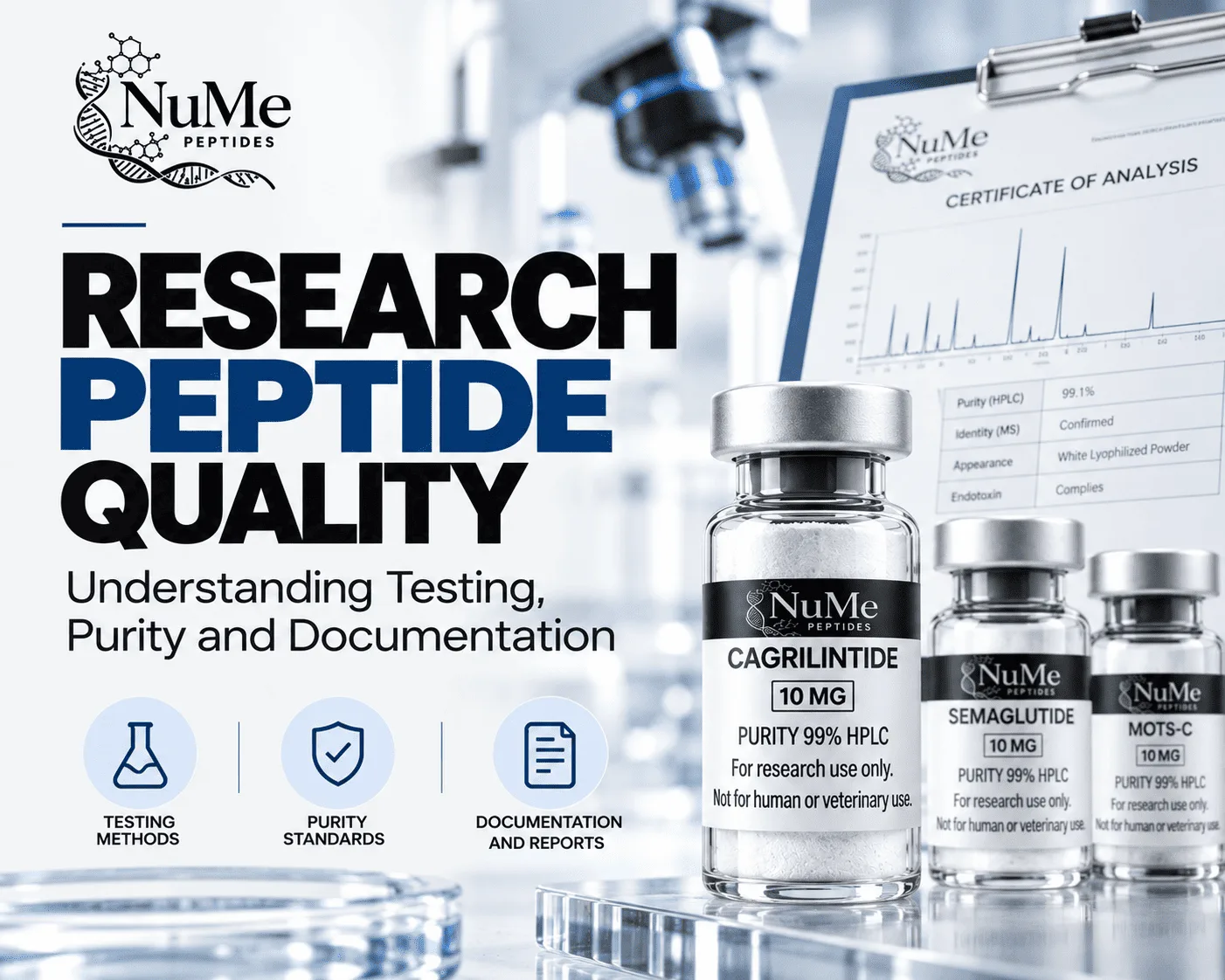
Research Peptide Quality: Understanding Testing, Purity and Documentation


Evaluating a peptide for laboratory research requires more than checking a product name or a single purity percentage. The characteristics of a peptide sample can be influenced by synthesis, purification, handling, storage, and the analytical methods used to characterize it.
For researchers, research peptide quality is therefore best viewed as a combination of measurable attributes. Molecular identity, chromatographic pu rity, impurity profile, peptide content, physical condition, stability, and lot-specific documentation can each answer a different question about the material.
No individual result provides a complete quality assessment. A strong chromatogram does not independently confirm molecular identity, while a matching molecular mass does not demonstrate that a sample contains no relevant impurities. Researchers gain a more useful picture when multiple analytical measurements are interpreted together.
Explore the NuMe Peptides US Shop to review research-focused peptide materials and supporting laboratory information for scientific investigation.
What Factors Define the Quality of a Research Peptide?
The quality of a research material depends partly on whether its characteristics are appropriate for the intended experiment.
A peptide used in preliminary screening may not require the same analytical depth as a quantitative reference standard. Consequently, quality should not be reduced to one universal threshold.
Several questions can help laboratories evaluate a sample:
- Does the material correspond to the expected amino-acid sequence?
- Has molecular identity been analytically supported?
- What does the reported purity value actually measure?
- Are peptide-related impurities visible or characterized?
- Is peptide content distinguished from chromatographic purity?
- Does the documentation correspond to the specific lot?
- Were storage and stability conditions appropriately controlled?
These questions address different attributes rather than repeating the same quality measurement.
Synthetic peptide production can generate closely related impurities through incomplete reactions, side reactions, starting materials, purification processes, or subsequent degradation. LC-MS research has shown that structural isomers, stereoisomers, modifications, and degradation products may require sophisticated analytical methods for adequate characterization. (Lian et al., 2021)
Quality is also connected to suitability for a particular scientific purpose. Guidance for peptides used in quantitative mass-spectrometry assays emphasizes characterization of purity, organic and inorganic contaminants, water content, storage stability, concentration accuracy, and handling conditions. (Hoofnagle et al., 2016)
This broader perspective is more informative than treating “high purity” as synonymous with overall sample quality.
Visit the NuMe Peptides US Shop to explore available research peptides and laboratory-focused products for scientific study.
Which Quality Characteristics Should Researchers Examine?
A structured review can begin with several core characteristics.
Molecular Identity
Identity asks whether the material being analyzed is actually the intended peptide.
Mass spectrometry is commonly used because the measured molecular mass can be compared with the theoretical mass expected from the known sequence. Modern MS methods can also provide additional structural information when more detailed characterization is required.
A 2024 methodological review describes mass spectrometry as a key method for evaluating the authenticity and integrity of synthetic peptides, including approaches such as LC-MS and MALDI-TOF-MS. (Højrup, 2024)
Chromatographic Purity
Purity measurements help determine how much of the detectable peptide-related signal corresponds to the principal component.
Reversed-phase HPLC is widely used for this purpose. The resulting chromatogram may show one dominant peak together with smaller peaks representing detectable related substances.
However, chromatographic purity is method-dependent. A reported value such as 99% should be interpreted in relation to the analytical conditions used rather than as proof that 99% of the total vial mass is the desired peptide.
Impurity Profile
The overall percentage of impurities and the identity of those impurities are separate questions.
Peptide synthesis can generate deletion sequences, insertion sequences, truncations, stereochemical variants, oxidation products, or other structurally related substances. Some may closely resemble the intended sequence and require advanced analytical methods for adequate separation and identification.
FDA materials concerning synthetic peptide products emphasize that peptide-related impurities can arise from incomplete coupling, truncation, side reactions, starting-material impurities, residual reagents, solvents, catalysts, and other process-related sources. (U.S. Food and Drug Administration, 2026)
Stability
Quality can also change after initial testing.
Oxidation, deamidation, hydrolysis, aggregation, or adsorption may occur during storage or handling depending on peptide sequence and environmental conditions. Stability information therefore helps researchers understand whether the material’s characteristics remain controlled over the period relevant to the experiment.
Together, these characteristics provide a more meaningful view of research peptide quality than any single specification.
How Do Analytical Methods Help Evaluate Peptide Quality?
Different analytical techniques answer different questions, which is why researchers often use complementary methods.
HPLC
High-performance liquid chromatography separates components according to their physicochemical interactions with a chromatographic system.
For peptide analysis, reversed-phase HPLC is frequently used to assess relative sample composition and identify detectable impurity peaks.
The resulting chromatogram can help answer:
How much of the detected chromatographic signal is associated with the principal component?
It cannot necessarily answer:
Is that component definitively the intended sequence?
This is where additional methods become valuable.
Mass Spectrometry
Mass spectrometry measures ions according to their mass-to-charge ratios.
For a synthetic peptide with a known sequence, researchers can compare the observed molecular mass with the expected theoretical value. When combined with liquid chromatography, MS can also help characterize related substances separated during analysis.
LC-MS has become particularly useful for peptide impurity investigations because structurally similar compounds can be difficult to distinguish using chromatography alone. Reviews of synthetic peptide therapeutics describe LC-MS strategies for evaluating modifications, structural isomers, stereoisomers, and other process- or storage-related impurities. (Lian et al., 2021)
Additional Analytical Techniques
More demanding research applications may require further characterization.
Depending on the purpose, laboratories may use:
- amino-acid analysis;
- quantitative NMR;
- water or moisture determination;
- residual-solvent testing;
- counterion analysis;
- size-exclusion chromatography;
- chiral analysis;
- stability-indicating methods.
The U.S. Pharmacopeia’s work on synthetic peptide reference standards illustrates this multi-method approach. Characterization can involve chromatography, mass spectrometry, NMR, residual-solvent testing, water determination, identity analysis, and stability evaluation to establish different attributes of a reference material. (McCarthy et al., 2023)
The value of analytical testing therefore comes from choosing methods that answer the specific questions relevant to the experiment.
Why Are Purity, Identity and Documentation Separate Quality Indicators?
These terms are often discussed together, but they should not be treated as interchangeable.
Purity describes the relative presence of the target material compared with detectable impurities under a defined method.
Identity addresses whether the analyzed material corresponds to the intended molecule.
Documentation provides traceability and records the methods, results, lot information, and specifications associated with the sample.
Consider a peptide with a reported HPLC purity of 99%.
That result may indicate that the primary chromatographic peak accounts for approximately 99% of the integrated signal under the stated analytical conditions. However, the percentage alone does not establish that the main peak has the correct molecular mass.
Mass spectrometry can help address identity, but a matching mass also does not automatically demonstrate that all relevant impurities have been identified.
Documentation then adds another layer.
A Certificate of Analysis may allow researchers to determine whether the analytical results correspond to the exact batch being used. Useful information can include:
- product identification;
- lot or batch number;
- expected molecular mass;
- chromatographic result;
- mass-spectrometry result;
- test date;
- analytical method;
- storage conditions;
- additional specifications.
Reference-standard research illustrates why these measurements are separated. Comprehensive characterization programs evaluate individual attributes using different analytical procedures instead of assuming that a single method represents the complete material. (McCarthy et al., 2023)
This distinction is especially important when evaluating research peptide quality, because similar-looking percentages may have been produced by different methods or may describe different characteristics.
How Can Researchers Build a More Complete Peptide Quality Assessment?
A practical quality review can be organized as a sequence of questions rather than a search for one ideal number.
Step 1: Confirm What Material Is Required
Researchers should first define the sequence, molecular form, modification state, and physical form needed for the experiment.
Without a clear target specification, it is difficult to determine whether available documentation is relevant.
Step 2: Review Identity Evidence
Mass-spectrometry data can support confirmation of expected molecular mass. More complex studies may require additional sequence or structural characterization.
Step 3: Examine the Purity Method
Researchers should identify how the reported purity was measured.
For HPLC data, relevant questions include whether the method can separate closely related impurities and whether the result corresponds to the same lot being evaluated.
Step 4: Consider the Impurity Profile
Total impurity percentage alone may not reveal what the impurities are.
This matters because different manufacturing routes can generate different related substances. FDA materials on peptide products emphasize impurity characterization because structurally related species can present analytical challenges and may require sophisticated methods to identify or quantify. (U.S. Food and Drug Administration, 2026)
Step 5: Review Content, Stability and Handling
A high chromatographic purity result does not necessarily equal total peptide content.
Water, residual solvents, counterions, and other non-peptide components may contribute to sample mass. Researchers conducting quantitative experiments may therefore need more information than chromatographic purity alone.
Handling also matters. Published recommendations for peptide analytical standards emphasize accurate concentration, suitable storage, reduced freeze-thaw exposure, careful container selection, and consideration of adsorption or solubility. (Hoofnagle et al., 2016)
Step 6: Connect the Documentation to the Lot
Finally, researchers should confirm that analytical information corresponds to the material actually being used.
| Quality Question | Useful Evidence |
|---|---|
| Is it the expected peptide? | Mass spectrometry, sequence documentation |
| What is the chromatographic composition? | HPLC analysis |
| What impurities are present? | LC-MS or additional impurity characterization |
| How much peptide is actually present? | Content assay or quantitative characterization |
| Is the material traceable? | Lot-specific COA |
| Has sample condition been controlled? | Storage and stability information |
| Are results relevant to the experiment? | Application-specific specifications |
This type of framework helps laboratories evaluate evidence systematically rather than relying on marketing terminology or one headline specification.
FAQs About Research Peptide Quality
What does research peptide quality mean?
It refers to the set of characteristics relevant to the suitability of a peptide for a scientific application. These may include identity, purity, impurity profile, content, stability, handling history, and supporting documentation.
Is 99% purity enough to establish quality?
Not by itself. A 99% HPLC result provides information about chromatographic composition but does not independently confirm identity, total peptide content, stability, or every potential impurity.
How can researchers confirm peptide identity?
Mass spectrometry is commonly used to compare observed molecular mass with the value expected from the peptide sequence. More detailed MS techniques may provide additional structural information. (Højrup, 2024)
Why is a lot-specific COA useful?
A lot-specific COA links analytical results to the actual batch being used. This improves traceability and helps researchers determine whether reported specifications apply to their material.
Why can impurity profiling matter even when purity is high?
Two samples may have similar overall purity values while containing different minor impurities. LC-MS and other specialized methods can help identify structurally related peptide species. (Lian et al., 2021)
Does every research project require the same level of characterization?
No. Analytical requirements should reflect the purpose of the experiment. Exploratory research, quantitative reference work, and highly controlled analytical studies may require different levels of characterization.
Building Confidence Through Multiple Quality Indicators
Assessing research peptide quality is ultimately an exercise in combining evidence.
Purity can describe relative chromatographic composition. Mass spectrometry can support molecular identity. LC-MS can provide additional information about related species, while content assays, stability data, and lot-specific documentation address other aspects of the material.
No single measurement answers every quality question.
Researchers can therefore make stronger assessments by defining what their experiment requires first and then examining whether the available analytical evidence addresses those requirements.
This approach also helps avoid two common assumptions: that a high purity percentage automatically establishes complete quality, or that a matching molecular mass alone proves that a sample is fully characterized.
A more complete assessment considers identity, composition, impurity profile, content, stability, traceability, and analytical method together.
Explore the NuMe Peptides US Shop to review research-focused peptide materials and supporting laboratory information for scientific studies.
Disclaimer: This content is provided for scientific and educational purposes only. Research peptides discussed here are presented in a laboratory research context and are not described as products for human consumption, diagnosis, treatment, cure, or prevention of disease.


This is a helpful overview of what researchers should consider when evaluating peptide quality. I particularly liked the focus on purity, identity, and analytical documentation, since these factors can affect how experimental results are interpreted. Are there any common red flags researchers should watch for when reviewing a certificate of analysis?
I enjoyed how this article breaks down peptide quality into several factors instead of treating purity as the only measure. The distinction between a reported purity percentage and a broader assessment of sample quality is especially important. Would you consider explaining how HPLC and mass spectrometry provide different types of information when evaluating peptides?
This was an informative read, especially for those who are still learning how to assess research materials critically. I appreciate the emphasis on documentation and consistency rather than relying solely on a supplier’s claims. How often should researchers review quality documentation when working with peptide samples from different batches?