

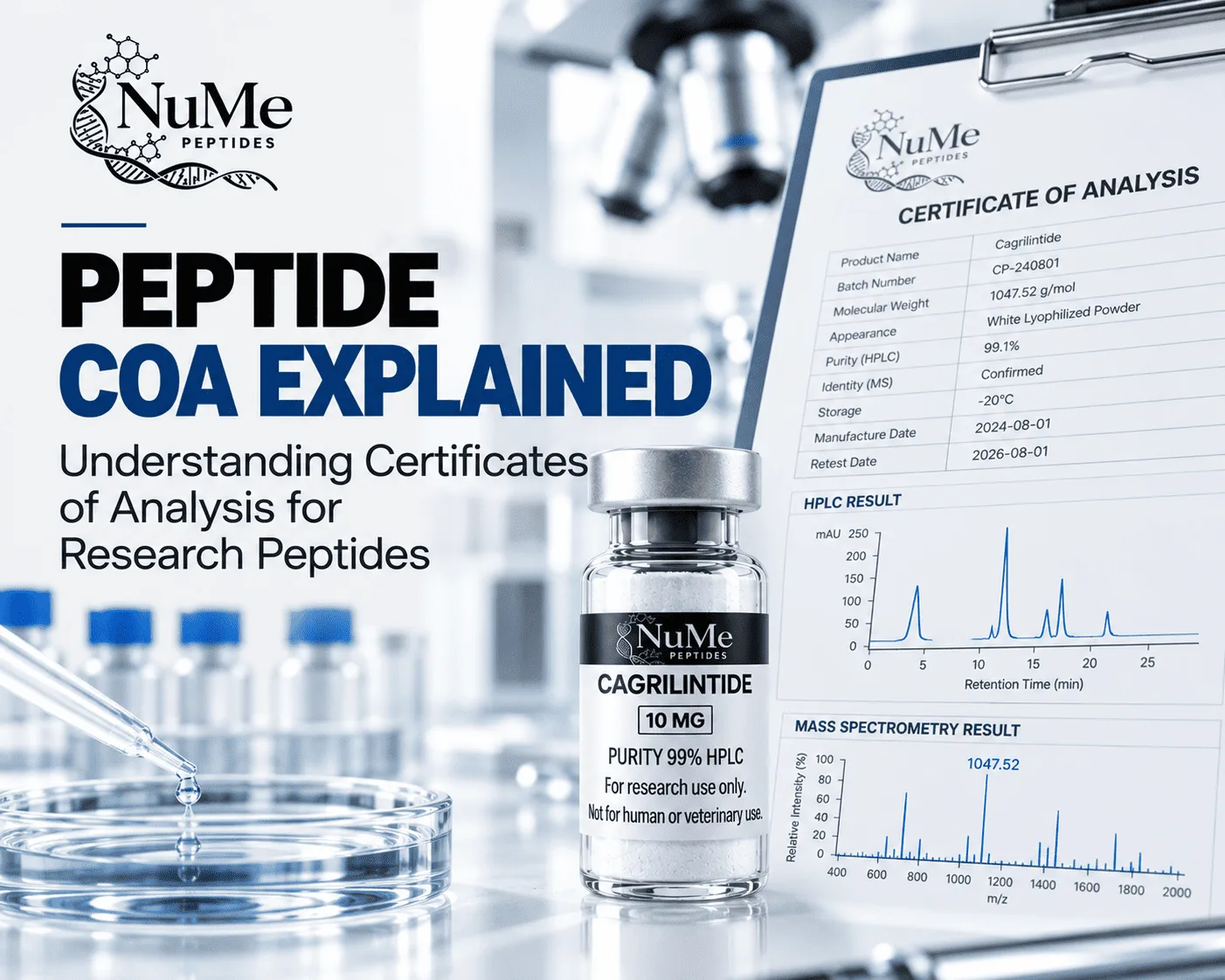
Peptide COA Explained: Understanding Certificates of Analysis for Research Peptides


A Certificate of Analysis, or COA, is one of the most important documents researchers may review when evaluating peptide materials. It can provide batch-specific information about identity, purity, testing methods, and other quality attributes associated with a particular sample.
However, a peptide COA should not be treated as a guarantee of every possible quality characteristic. Its usefulness depends on what was actually tested, which methods were used, whether the document corresponds to the correct lot, and whether the reported results are relevant to the intended experiment.
For researchers, the goal is not simply to confirm that a COA exists. The more important task is understanding what the document shows, how the analytical results were generated, and what additional information may still be needed.
Explore the NuMe Peptides US Shop to review research-focused peptide materials and supporting laboratory information for scientific investigation.
What Is a Certificate of Analysis for a Research Peptide?
A Certificate of Analysis is a quality document that reports analytical information about a specific material or production batch.
In regulated pharmaceutical manufacturing, FDA’s implementation of ICH Q7 states that authentic Certificates of Analysis should identify the intermediate or active ingredient, include the batch number and relevant release or retest information, list the tests performed, provide acceptance limits, and report numerical results where applicable. The certificate should also be dated and authorized by the responsible quality unit. (U.S. Food and Drug Administration, 2001)
For research peptides, the exact format may vary between suppliers because laboratory materials are not necessarily documented under the same pharmaceutical framework.
Nevertheless, a useful peptide COA typically connects three things:
- the peptide material being supplied;
- the batch or lot tested;
- the analytical results associated with that batch.
This connection is important because a generic purity statement or example chromatogram does not provide the same traceability as documentation linked to the actual material being used.
A COA can therefore help researchers determine whether the stated characteristics of a peptide are supported by analytical data rather than marketing language alone.
However, the document remains only as strong as the underlying testing. A certificate containing a 99% purity result is useful only if researchers understand what analytical method produced that percentage and whether the method could adequately detect relevant impurities.
Visit the NuMe Peptides US Shop to explore available research peptides and laboratory-focused products for scientific study.
Why Is a COA Important When Reviewing Peptide Samples?
Research reproducibility depends partly on knowing what material was used in an experiment.
If two laboratories use materials with the same peptide name but different impurity profiles, concentrations, counterions, or degradation histories, their experimental results may not be directly comparable.
A COA can improve traceability by documenting characteristics associated with a specific lot.
This is particularly useful when researchers need to:
- compare multiple peptide lots;
- investigate unexpected assay results;
- confirm molecular identity;
- examine reported purity;
- document material provenance;
- maintain laboratory quality records.
Analytical guidance for peptides used in mass-spectrometry-based assays recommends using suppliers that provide detailed specification and characterization data, including HPLC chromatograms and mass-spectrometry results for purified peptide materials. It also emphasizes linking quality-control procedures to the corresponding analytical data. (Hoofnagle et al., 2016)
Importantly, receiving a certificate does not eliminate the need for scientific judgment.
An independent study examining 98 synthetic peptides found that all samples arrived with Certificates of Analysis stating at least 95% purity, yet independent laboratory testing found that only 43 of the 98 peptides actually met the requested purity specification under the investigators’ analytical method. (Verbeke et al., 2018)
That study demonstrates an important principle: a peptide COA should be reviewed as analytical evidence, not accepted automatically as proof of complete quality.
Method differences may also contribute to discrepancies between supplier and independent testing. Chromatographic column, gradient, solvent composition, detector conditions, and integration strategy can all affect how impurities are separated and measured.
Therefore, researchers should evaluate both the reported result and the analytical context behind it.
Which Details Are Typically Included on a Peptide COA?
The exact contents of a COA vary, but several categories of information are particularly useful.
Product Identification
The document should clearly identify the material being analyzed.
Useful information may include:
- peptide name;
- amino-acid sequence;
- molecular formula;
- theoretical molecular weight;
- physical form;
- salt or counterion where relevant.
A peptide name alone may not provide enough information because sequence variants or different chemical forms can share similar naming conventions.
Lot or Batch Number
Lot identification is one of the most important parts of a peptide COA.
A batch number connects the analytical report to the actual material supplied. If the product label shows one lot number but the COA shows another, the document cannot reliably be assumed to represent that sample.
FDA’s ICH Q7 guidance likewise identifies batch information as a core element of an authentic Certificate of Analysis for pharmaceutical intermediates and active ingredients. (U.S. Food and Drug Administration, 2001)
Purity Result
Many research peptide certificates include an HPLC or UPLC purity value.
A result might be written as:
Purity by HPLC: 99.2%
Researchers should then determine whether the certificate also provides the underlying chromatogram, method conditions, or additional information explaining how that result was calculated.
Mass-Spectrometry Result
Mass spectrometry is often used to support molecular identity.
A COA may show expected molecular mass together with the experimentally observed result. More detailed documentation may include the actual spectrum or MS/MS data.
Published recommendations for peptide characterization specifically encourage both HPLC-UV chromatograms and mass-spectrometry data because these methods provide complementary information. (Hoofnagle et al., 2016)
Test and Release Information
Depending on the supplier, researchers may also see:
- test date;
- manufacture date;
- release date;
- storage conditions;
- retest or expiration information;
- quantity tested;
- analyst or quality authorization.
These details strengthen traceability and help researchers determine whether the data are current and applicable to their material.
Visit the NuMe Peptides US Shop to explore available research peptides and laboratory-focused products for scientific study.
How Are Analytical Results Reported on a Certificate of Analysis?
Understanding the numbers on a COA requires knowing what each analytical method actually measures.
HPLC Purity
High-performance liquid chromatography separates components in a sample according to their physicochemical behavior within the chromatographic system.
The resulting chromatogram contains peaks representing materials detected as they leave the column. A purity percentage is often calculated by comparing the area of the major peptide peak with the total area of relevant integrated peaks.
This can provide valuable information about relative chromatographic composition.
However, a value such as 99% does not automatically mean that 99% of the total vial mass consists of the desired peptide.
Well-characterized peptide reference standards are evaluated using multiple methods because water, counterions, residual solvents, inorganic residues, and peptide-related impurities can all contribute to sample composition. USP-associated research describes using chromatography, mass spectrometry, NMR, moisture testing, residual-solvent analysis, and other methods to establish different characteristics of peptide reference materials. (McCarthy et al., 2023)
Mass Spectrometry
Mass-spectrometry results are generally used to help establish molecular identity.
If the theoretical mass of a peptide and the observed mass closely agree, that result supports the conclusion that the material corresponds to the expected molecule.
MS/MS can provide further sequence-related information.
Research on USP peptide reference standards describes using high-resolution mass spectrometry to verify monoisotopic molecular mass and MS/MS fragmentation to confirm amino-acid sequence. (McCarthy et al., 2023)
Acceptance Criteria
Some certificates may show three separate pieces of information:
| Item | Example |
|---|---|
| Test | HPLC Purity |
| Specification | ≥98.0% |
| Result | 99.1% |
This format helps distinguish between what the material was required to meet and what the laboratory actually measured.
That distinction is important. A specification represents an acceptance threshold; the result represents the observed analytical value.
Researchers should avoid confusing the two.
What Can a Peptide COA Confirm and What Can It Not Confirm?
A COA can provide valuable evidence, but it has defined limits.
What a COA Can Help Confirm
When properly prepared and linked to the correct lot, a certificate can help researchers confirm:
- which batch was tested;
- the stated identity of the product;
- which analytical tests were performed;
- whether the sample met stated specifications;
- reported HPLC purity;
- reported mass-spectrometry results;
- relevant dates and storage information.
This information can make peptide selection and laboratory recordkeeping more transparent.
What It Cannot Automatically Confirm
A peptide COA cannot independently demonstrate every characteristic of the sample.
For example, a 99% HPLC purity result does not automatically confirm:
- exact peptide content by total weight;
- sterility;
- absence of every possible impurity;
- endotoxin status;
- pharmaceutical-grade manufacturing;
- long-term stability;
- biological activity;
- regulatory approval.
Unless those attributes were specifically tested and documented, researchers should not assume that the certificate covers them.
This is why method transparency matters.
The independent evaluation of synthetic research peptides by Verbeke and colleagues showed that supplier-provided COA purity values did not always match independent testing. The researchers found substantial differences among products, emphasizing the value of appropriate analytical verification when peptide quality is critical to an experiment. (Verbeke et al., 2018)
Researchers should also consider whether the analytical method is capable of resolving relevant impurities.
Hoofnagle and colleagues note that overly steep HPLC gradients can mask contaminants through co-elution and recommend detailed chromatographic characterization for purified peptide standards. (Hoofnagle et al., 2016)
Therefore, a strong COA should be viewed as one component of a broader quality assessment.
Read more about Research Peptide Quality to see how testing, purity, identity, and documentation work together.
FAQs About Peptide COAs
What is a peptide COA?
A peptide COA is a Certificate of Analysis reporting analytical information associated with a peptide sample or production lot. It may include identity, purity, molecular mass, batch information, storage conditions, and testing results.
Should a Certificate of Analysis include a lot number?
Yes. Lot identification helps connect the analytical results to the actual material being supplied. Without batch-specific traceability, researchers cannot easily determine whether the document represents their sample.
What does 99% purity on a COA mean?
If the result comes from HPLC, it usually refers to chromatographic area purity under a defined analytical method. It does not automatically mean that 99% of the total vial mass consists of peptide.
Should a peptide COA include mass spectrometry?
Mass-spectrometry data are valuable because they provide evidence supporting molecular identity. Guidance for well-characterized analytical peptide standards recommends both HPLC chromatograms and MS data. (Hoofnagle et al., 2016)
Can researchers rely only on a COA to determine quality?
Not always. The certificate should be evaluated alongside the analytical methods, lot traceability, experimental requirements, and other available quality information.
Can two COAs with the same purity percentage represent different samples?
Yes. Two peptides may both report 99% purity while having different impurity profiles, peptide content, storage history, or analytical conditions. The percentage alone cannot describe all of these characteristics.
Reading a Peptide COA as Analytical Evidence
A peptide COA can be an important part of research peptide evaluation, but the value of the document lies in the details behind the numbers.
Researchers should begin by confirming that the product and lot number on the certificate match the material being used. They can then review which tests were performed, which specifications applied, and what results were actually obtained.
HPLC can provide useful information about relative chromatographic composition, while mass spectrometry can support molecular identity. Additional tests may be necessary when researchers need information about content, residual solvents, moisture, counterions, stability, or other characteristics.
Most importantly, the existence of a COA should not replace critical review.
A strong laboratory assessment asks whether the document is lot-specific, whether the analytical methods are appropriate, whether the reported results answer the questions relevant to the experiment, and whether any important quality attributes remain untested.
Used this way, a Certificate of Analysis becomes more than a product attachment. It becomes part of a traceable analytical record that helps researchers understand the material entering their experiments.
Explore the NuMe Peptides US Shop to review research-focused peptide materials and supporting laboratory documentation for scientific studies.
Disclaimer: This content is provided for scientific and educational purposes only. Research peptides discussed here are presented in a laboratory research context and are not described as products for human consumption, diagnosis, treatment, cure, or prevention of disease.


This is a great introduction to understanding a peptide Certificate of Analysis (COA). I especially appreciate the explanation of why checking purity alone may not be enough to evaluate a sample properly. Could you share more tips on how researchers can verify whether a COA is reliable and matches the specific batch they’re reviewing?
I found this article clear and practical, especially the breakdown of the information typically included in a COA. The distinction between peptide identity, purity, and other quality indicators is particularly useful for beginners. Would a future article cover how to interpret HPLC chromatograms and mass spectrometry results together?