

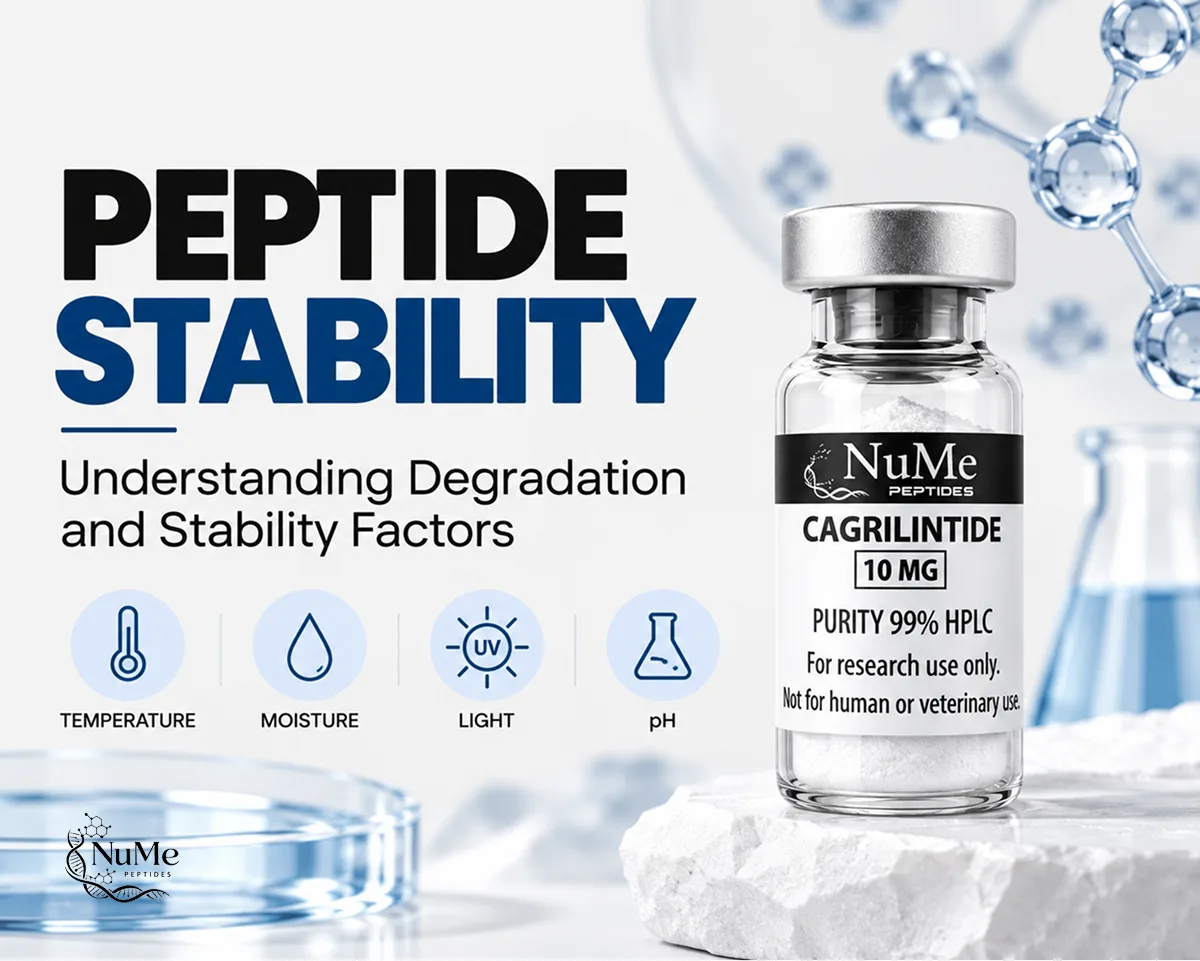
Peptide Stability: Understanding Degradation and Stability Factors


Peptides are dynamic molecules whose chemical and physical characteristics can change over time. Even when a peptide has been synthesized correctly and initially meets analytical specifications, environmental conditions and sequence-specific properties may influence its condition during preparation, storage, or experimental use.
For researchers, peptide stability describes the ability of a sample to retain relevant chemical and physical characteristics over a defined period under specified conditions. Loss of stability may involve chemical modification, fragmentation, aggregation, changes in solubility, or the appearance of new degradation products.
Understanding these processes is important because stability can influence analytical reproducibility. Rather than treating degradation as a single event, laboratories typically consider several interconnected factors, including amino-acid sequence, pH, temperature, moisture, oxidation exposure, concentration, and sample handling.
Explore the NuMe Peptides US Shop for research-focused peptide materials and supporting laboratory product information for scientific investigation.
What Does Peptide Stability Mean in Scientific Research?
In a laboratory context, stability is not simply a question of whether a peptide remains visually unchanged.
A sample can appear clear or remain as an intact lyophilized powder while chemical reactions occur at the molecular level. Researchers therefore distinguish between chemical stability and physical stability.
Chemical stability relates to whether the peptide retains its original molecular structure. Deamidation, oxidation, hydrolysis, epimerization, and bond cleavage can generate chemically modified forms.
Physical stability concerns changes such as aggregation, precipitation, adsorption, or altered solubility. Peptides may associate into larger structures without necessarily undergoing immediate covalent modification.
Research on peptide aggregation demonstrates that physical behavior may depend on sequence, concentration, pH, net charge, impurities, interfaces, temperature, agitation, and lyophilization. These variables can influence whether peptide molecules remain dispersed or associate into larger structures. (Zapadka et al., 2017)
These two categories can also interact.
Chemical degradation may alter peptide charge or hydrophobicity and subsequently increase aggregation risk. Conversely, aggregation can change the local environment surrounding peptide molecules and potentially influence further degradation.
For scientific studies, peptide stability should therefore be defined relative to a specific research purpose. A minor modification that has little effect on one analytical assay might become significant in another experiment requiring highly defined molecular composition.
That is why stability claims are most meaningful when they specify the peptide, physical state, formulation, temperature, duration, and analytical methods used to evaluate change.
Visit the NuMe Peptides US Shop to explore available research peptides and laboratory-focused products for scientific study.
Which Chemical Processes Can Contribute to Peptide Degradation?
Peptide degradation can occur through several chemical pathways. The dominant pathway depends strongly on amino-acid sequence and environmental conditions.
Hydrolysis
Hydrolysis involves cleavage reactions associated with water and can affect the peptide backbone or certain side-chain structures.
The rate of hydrolysis often depends on pH. Research on peptide formulations shows that both acid- and base-catalyzed pathways can occur, while the location of degradation within a sequence may depend on neighboring amino acids. (Nugrahadi et al., 2023)
Deamidation
Deamidation commonly affects asparagine and, less frequently, glutamine residues.
The reaction can convert asparagine into aspartic acid or isoaspartic acid, changing the chemical structure and potentially altering charge and conformation. Its rate depends on factors including pH, temperature, sequence context, and neighboring residues.
For asparagine-containing peptides, surrounding amino acids can significantly influence susceptibility to this pathway. (Zapadka et al., 2017)
Oxidation
Oxidative reactions can affect residues such as methionine, cysteine, tryptophan, tyrosine, and histidine.
Oxygen, light, trace metals, and oxidizing contaminants may increase oxidation risk. Consequently, a peptide containing oxidation-sensitive residues may behave differently from another sequence stored under the same conditions.
Comprehensive formulation reviews identify oxygen, temperature, pH, light, and metal ions as relevant variables for oxidative peptide degradation. (Nugrahadi et al., 2023)
Epimerization and Isomerization
Certain residues can undergo stereochemical or structural changes without large changes in molecular mass.
These modifications may be analytically challenging because a modified molecule can closely resemble the original sequence. This is one reason stability assessment may require more than a basic molecular-weight measurement.
Together, these pathways show that degradation is not synonymous with complete peptide destruction. More commonly, researchers monitor the gradual appearance of structurally related species alongside the decline of the original form.
How Can Temperature, pH and Moisture Affect Peptide Stability?
Environmental conditions strongly influence degradation kinetics.
Temperature
Increasing temperature generally increases molecular motion and can accelerate many chemical reactions.
As a result, elevated-temperature conditions are often used in stability research to investigate potential degradation pathways over shorter experimental periods. However, the relationship between temperature and instability remains sequence- and formulation-dependent.
Temperature can also influence physical behavior. Aggregation studies show that thermal conditions can alter peptide association and conformational behavior, particularly when combined with factors such as concentration, interfaces, or chemical modification. (Zapadka et al., 2017)
pH
pH is one of the most important variables in peptide solution stability because protonation state affects both molecular charge and chemical reaction rates.
Hydrolysis, deamidation, oxidation, disulfide exchange, and aggregation may all show pH dependence. A pH range that reduces one degradation pathway may not necessarily minimize another.
For this reason, formulation studies commonly evaluate stability across multiple pH conditions rather than assuming that neutral pH is universally optimal. Reviews of aqueous peptide formulations identify pH optimization and buffer selection among the most practical approaches for controlling degradation. (Nugrahadi et al., 2023)
Moisture
Water is especially important when comparing solution and solid-state stability.
Peptides in aqueous environments generally have greater molecular mobility and may experience hydrolysis or other reactions more readily than well-controlled dry materials. Nevertheless, lyophilized peptides are not completely protected from chemical change.
Research on solid-state peptide and protein stability has identified deamidation, oxidation, bond cleavage, aggregation, and other reactions that can still occur in dried materials. Temperature, residual moisture, excipients, and whether the solid is amorphous or crystalline can all influence reaction rates. (Lai & Topp, 1999)
Thus, peptide stability depends on interactions between conditions rather than on a single variable considered in isolation.
How Does Peptide Structure Influence Its Stability?
Two peptide samples stored under identical conditions may behave differently because their amino-acid sequences are different.
Sequence influences molecular charge, hydrophobicity, flexibility, secondary structure, oxidation susceptibility, and the likelihood of intermolecular association.
For example, peptides containing methionine or cysteine may require greater consideration of oxidation, while asparagine-containing sequences may be more vulnerable to deamidation under certain conditions.
Primary sequence can also influence aggregation.
Hydrophobic segments may promote peptide-peptide association, while overall charge can either encourage or discourage intermolecular interactions depending on pH and ionic conditions. Concentration is also important because higher peptide concentrations can increase the likelihood of molecular encounters and subsequent self-association. (Zapadka et al., 2017)
Structural behavior may change further as environmental conditions alter molecular conformation.
Researchers have shown that physicochemical peptide properties should ideally be considered early because structural characteristics can affect aggregation, solubility, and chemical stability under formulation conditions. Sequence modification can sometimes alter these behaviors substantially. (Wagner et al., 2019)
Peptide length is another variable.
Longer sequences provide more potential sites for chemical modification and may adopt more complex conformations. Shorter peptides can still be unstable, however, particularly when they contain reactive residues or strongly aggregation-prone motifs.
Researchers therefore cannot determine stability simply from peptide size or a general product category.
Instead, sequence-specific assessment is essential. This is particularly relevant when comparing different peptides within the same experimental workflow, because identical storage or preparation conditions do not guarantee identical rates of degradation.
How Do Researchers Assess Peptide Stability Over Time?
Stability assessment typically involves comparing analytical results collected at multiple time points under defined conditions.
Researchers may prepare samples and expose them to selected temperatures, pH environments, light conditions, moisture levels, or other controlled variables. Samples are then analyzed periodically to determine whether the original peptide decreases or new species appear.
Chromatographic Analysis
RP-HPLC is commonly used to monitor the target peptide and detect degradation-related peaks.
Researchers can compare chromatograms over time to determine whether the relative area of the original peak declines or additional components become detectable.
However, method design is important. A degradation product that co-elutes with the target peptide may not appear as a clearly separated peak. Reviews of peptide chromatography therefore emphasize method variables such as stationary phase, mobile phase, temperature, gradient, and detection technique when assessing degradation. (Sharma et al., 2022)
Mass Spectrometry
LC-MS can provide complementary molecular information.
If a degradation product differs in molecular mass, mass spectrometry may help identify the type of modification. High-resolution methods can also provide additional information about related peptide species that may be difficult to distinguish chromatographically.
Physical Stability Measurements
When aggregation is a concern, researchers may use techniques such as size-exclusion chromatography, light scattering, turbidity measurements, microscopy, or other biophysical approaches.
This is important because chemical purity and physical behavior are separate characteristics. A sample may experience increased aggregation without immediately producing a large change in conventional RP-HPLC purity.
Stability-Indicating Methods
Ideally, analytical procedures used for stability research should be capable of distinguishing the intact peptide from relevant degradation products.
Validated analytical approaches are important because inaccurate separation can make degradation appear slower or faster than it actually is. Reviews of analytical methods for peptide degradation emphasize that reliable stability interpretation depends on appropriate analytical methodology. (Sharma et al., 2022)
A stability study is therefore not simply a matter of recording how long a sample has been stored. Researchers need evidence showing what molecular or physical changes occurred during that period.
New to peptide research? Read our guide on What Are Research Peptides? to understand how research peptides are defined, studied, and evaluated before exploring proper storage practices.
FAQs About Peptide Stability
What does peptide stability mean?
It describes the ability of a peptide sample to maintain relevant chemical and physical characteristics under defined conditions over time.
What are common causes of peptide degradation?
Common pathways include hydrolysis, oxidation, deamidation, epimerization, bond cleavage, and aggregation. Which pathways dominate depends on peptide sequence and environmental conditions. (Nugrahadi et al., 2023)
Does low temperature prevent all peptide degradation?
No. Lower temperatures can slow many reactions, but they do not eliminate every degradation pathway. Stability remains dependent on sequence, physical state, moisture, formulation, and storage duration.
Why does pH matter for peptide samples?
pH affects molecular charge and can influence hydrolysis, deamidation, oxidation, aggregation, and other reactions. The most stable pH range varies among peptides.
Can lyophilized peptides still degrade?
Yes. Drying can improve stability by reducing molecular mobility and water-dependent reactions, but solid-state degradation can still occur through oxidation, deamidation, bond cleavage, aggregation, and related processes. (Lai & Topp, 1999)
How can laboratories monitor stability?
Researchers may use HPLC, LC-MS, size-exclusion chromatography, light-scattering techniques, and other analytical methods to monitor chemical and physical changes over time.
Understanding Stability as Part of Peptide Research
Peptide stability is best understood as the result of interactions between molecular structure and environmental conditions.
Temperature, pH, moisture, oxygen, light, concentration, and interfaces can influence degradation, while amino-acid sequence determines which pathways may be most important for a particular molecule.
Chemical reactions such as oxidation, hydrolysis, and deamidation can generate modified species. At the same time, physical processes such as aggregation or adsorption may change how much usable peptide remains in an experimental system.
For researchers, this means stability should be evaluated with appropriate analytical methods rather than inferred from appearance or storage duration alone.
Monitoring samples over time with chromatography, mass spectrometry, and relevant physical characterization techniques can help laboratories identify changes and determine whether a material remains suitable for its intended scientific application.
Ultimately, understanding degradation pathways provides a stronger foundation for designing reproducible peptide experiments and interpreting analytical results accurately.
Explore the NuMe Peptides US Shop to review research-focused peptide materials and laboratory information for scientific studies.
Disclaimer: This content is provided for scientific and educational purposes only. Research peptides discussed here are presented in a laboratory research context and are not described as products for human consumption, diagnosis, treatment, cure, or prevention of disease.


This is a really helpful overview of peptide stability and the factors that can influence it over time. I especially liked how the topic connects storage conditions with maintaining sample integrity in research. Are there particular analytical methods researchers use to monitor changes in peptide stability during long-term storage?
I enjoyed this article because it explains an important research topic in a clear and accessible way. The relationship between environmental conditions and peptide stability is particularly interesting, especially when considering how different samples may respond differently to storage. Would you consider covering the effects of repeated temperature changes in a future article?
A great introduction to a factor that can have a significant impact on the reliability of peptide research. I appreciated the focus on stability rather than assuming that a sample remains unchanged simply because it has been stored properly. How do researchers distinguish between peptide degradation and other changes that might affect their analytical results?