

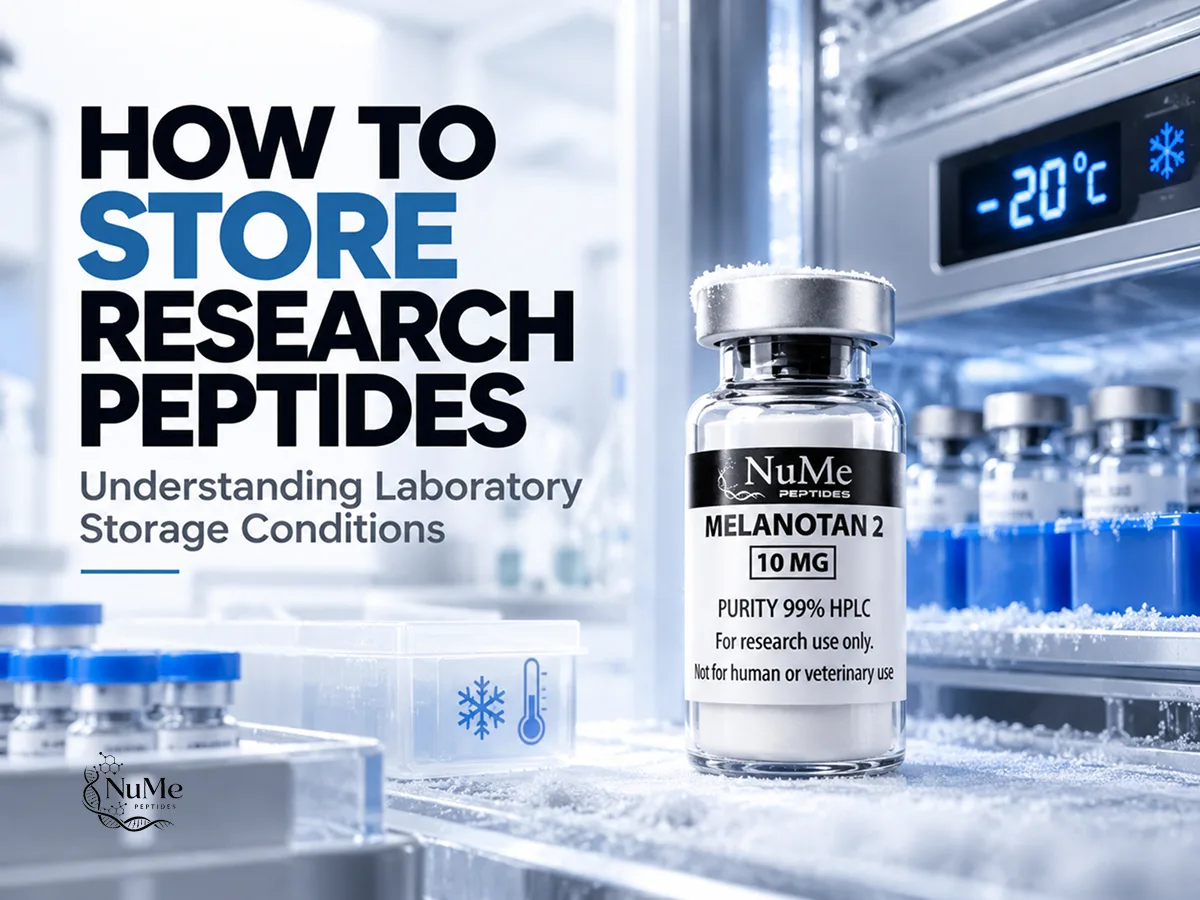
How to Store Research Peptides: Understanding Laboratory Storage Conditions


Proper storage is an important part of maintaining consistency in peptide-based laboratory research. A peptide may be correctly synthesized and characterized at the time of production, yet its condition can change afterward if it is exposed to inappropriate temperatures, moisture, light, oxygen, or repeated handling.
Storage requirements are also sequence-dependent. Some peptides are relatively stable under a given set of conditions, while others may be more susceptible to oxidation, hydrolysis, deamidation, aggregation, adsorption, or loss of solubility.
For this reason, understanding how to store research peptides involves more than placing every sample in the same freezer. Researchers should consider the peptide’s physical form, sequence, intended period of storage, container, environmental exposure, and supplier-specific documentation.
Explore the NuMe Peptides US Shop for research-focused peptide materials and supporting laboratory product information.
Why Are Storage Conditions Important for Research Peptides?
Storage conditions matter because peptide molecules can undergo both chemical and physical changes over time.
Chemical instability may involve oxidation, hydrolysis, deamidation, or other sequence-specific modifications. Physical changes can include aggregation, precipitation, loss of solubility, adsorption to container surfaces, or concentration changes caused by evaporation.
Guidance developed for synthetic peptides used in mass-spectrometry-based assays identifies storage and handling as important variables affecting quantitative reliability. Long-term changes may result from chemical modification, microbial degradation, evaporation, adsorption, secondary-structure formation, or reduced solubility. (Hoofnagle et al., 2016)
These effects may not always be visible.
A peptide can still appear as a normal lyophilized powder or clear solution while molecular modifications have occurred. As a result, visual inspection alone cannot establish that a stored sample retains exactly the same analytical characteristics it had when initially prepared.
Storage also matters for reproducibility. If one portion of an experiment uses freshly prepared peptide while another relies on material that has undergone repeated temperature cycling or extended solution storage, differences in sample condition may introduce additional experimental variability.
The goal is therefore not simply to keep material cold. A suitable storage strategy should minimize unnecessary chemical and physical change while preserving the characteristics needed for the intended research application.
Visit the NuMe Peptides US Shop to explore available research peptides and laboratory-focused products for scientific study.
Which Environmental Factors Can Affect Stored Peptide Samples?
Several environmental variables can influence peptide samples, and they often interact with one another.
Temperature
Temperature affects molecular motion and the rate of many chemical reactions.
Higher temperatures can accelerate certain degradation pathways, while low-temperature storage can help slow them. However, the optimal storage temperature varies with peptide sequence, formulation, physical state, and intended storage duration.
For analytical peptide standards, published recommendations distinguish between short-, medium-, and long-term storage. Long-term storage is generally favored in lyophilized form at approximately −20°C to −80°C, while frozen solutions may be appropriate for shorter periods depending on the peptide. (Hoofnagle et al., 2016)
These values are general research recommendations rather than universal instructions for every product.
Oxygen
Certain residues are more sensitive to oxidative modification.
Cysteine, methionine, and tryptophan are among the residues commonly associated with oxidation risk. Published guidance therefore recommends limiting air exposure for sensitive peptide solutions and, where appropriate, using an inert gas such as argon or nitrogen in storage vessels. (Hoofnagle et al., 2016)
Container Surfaces
Peptides may also interact with storage vessels.
Adsorption to glass or plastic surfaces can reduce the effective concentration of a solution, particularly when working at very low concentrations. The extent of adsorption can depend on peptide sequence, solvent, concentration, and the surface characteristics of the container.
For this reason, laboratory guidance may recommend suitable polypropylene or treated glass vessels and minimizing unnecessary transfers between containers. (Hoofnagle et al., 2016)
These examples show why researchers determining how to store research peptides should consider the complete storage environment rather than temperature alone.
How Should Lyophilized Research Peptides Be Stored?
Lyophilization removes much of the water from a peptide preparation and converts the material into a dry state.
This process can improve storage stability because many degradation reactions occur more readily when molecules are dissolved in water. Consequently, lyophilized peptide is commonly preferred for extended storage.
For long-term storage of peptide analytical standards, published recommendations favor keeping dry material at −20°C or below, with approximately −20°C to −80°C suggested for storage extending beyond several months. Dry peptide may also be maintained under inert atmosphere or within a desiccated environment when appropriate. (Hoofnagle et al., 2016)
Lyophilization, however, does not make a peptide permanently stable.
Residual moisture, oxygen, sequence-specific chemical reactions, and storage temperature may still influence the material. Studies of peptide reference standards therefore examine lyophilization alongside moisture, vial consistency, identity, purity, and stability rather than treating the dry state as sufficient evidence of long-term integrity. (McCarthy et al., 2023)
Keep Containers Properly Sealed
A sealed container helps reduce exposure to atmospheric moisture and oxygen.
Repeatedly opening a primary vial can introduce environmental variation. Where compatible with the laboratory protocol, appropriately sized aliquots may reduce repeated exposure of the main stock.
Avoid Opening a Very Cold Vial Immediately
Condensation is another consideration.
When a cold container is exposed to warmer, humid laboratory air, water can condense on its surfaces. Published peptide-handling guidance recommends allowing lyophilized material to equilibrate toward room temperature in a dry environment before opening to reduce unwanted water absorption. (Hoofnagle et al., 2016)
Follow Product-Specific Documentation
General recommendations should not replace lot- or product-specific storage instructions.
Sequence, salt form, modification, formulation, and packaging can all influence stability. Supplier documentation should therefore remain the primary reference for the actual material being handled.
How Can Temperature, Light and Moisture Influence Peptide Integrity?
Temperature, light, and moisture affect peptides through different mechanisms.
Temperature and Temperature Cycling
Low temperatures can slow chemical degradation, but repeatedly moving samples between frozen and warmer conditions can introduce another source of variability.
Experimental work involving peptide standards found greater analytical variability after repeated freeze-thaw cycles than under frozen storage conditions. The researchers concluded that frequent freeze-thaw cycling should be minimized and that frozen samples generally produced the most consistent results when thawed close to analysis. (Hoofnagle et al., 2016)
Importantly, freeze-thaw sensitivity is sequence-dependent. Therefore, a specific peptide’s validated stability information should take priority over a universal number of acceptable cycles.
Light
Some peptide sequences can undergo photochemical modification.
Aromatic amino acids, particularly tryptophan and phenylalanine, may be susceptible to light-related degradation under certain conditions. For photochemically sensitive sequences, dark or amber storage containers may help limit exposure. (Hoofnagle et al., 2016)
Researchers should also avoid assuming that ordinary laboratory lighting has the same effect on every peptide. Photosensitivity depends on sequence, concentration, formulation, exposure duration, and wavelength.
Moisture
Moisture is particularly relevant to lyophilized materials.
Residual water can increase molecular mobility and contribute to reactions that are otherwise slower in the solid state. However, peptide stability is formulation-specific, and the relationship between residual moisture and degradation is not identical for every molecule.
Reference-standard programs therefore evaluate lyophilized peptide characteristics using multiple analytical measurements and stability studies rather than assuming that any dry sample will behave identically over time. (McCarthy et al., 2023)
Together, these factors explain why a stable storage environment is generally preferable to repeated movement between different temperatures, humidity levels, and lighting conditions.
Which Laboratory Storage Practices Help Preserve Research Samples?
A good storage strategy should be reproducible and documented.
Maintain Clear Sample Records
Each stored peptide should be traceable.
Useful records can include:
- peptide identity and sequence;
- lot or batch number;
- date received;
- date first opened;
- specified storage temperature;
- preparation or reconstitution date;
- aliquot information;
- freeze-thaw history;
- relevant analytical documentation.
Consistent records make it easier to investigate unexpected experimental variation.
Use Aliquots Strategically
Dividing a stock into suitable working portions can reduce repeated opening of the original container and repeated freezing and thawing of the same solution.
For long-term analytical work, guidance recommends storing dry peptide in smaller aliquots where practical and preparing working solutions closer to the time they are required. (Hoofnagle et al., 2016)
Aliquot size should be based on experimental requirements rather than an arbitrary standard.
Minimize Air Exposure
Once reconstituted, some peptides may be increasingly susceptible to oxidation.
Keeping containers sealed, reducing unnecessary transfers, and limiting headspace exposure may be appropriate for sensitive sequences. In specialized applications, inert gases may provide additional protection.
Consider Adsorption
At low concentrations, peptide loss to tube or pipette surfaces can affect quantitative experiments.
Recommended practices for peptide standards include using appropriate vessels, conditioning pipette tips when necessary, avoiding unnecessary container transfers, and characterizing adsorption behavior when accurate concentration is critical. (Hoofnagle et al., 2016)
Separate Stock and Working Solutions
Maintaining a concentrated primary stock and preparing smaller working solutions as needed can reduce handling of the original material.
This practice can also make it easier to track storage history and minimize repeated temperature cycling.
Monitor Storage Equipment
Freezers and refrigerators used for research materials should maintain the range required by the laboratory protocol.
Where sample integrity is especially important, laboratories may use temperature monitoring, excursion records, backup procedures, and equipment-maintenance schedules.
Understanding how to store research peptides ultimately means creating a controlled workflow that reduces unnecessary environmental variation from the time a sample enters the laboratory until it is analyzed.
New to peptide research? Read our guide on What Are Research Peptides? to understand how research peptides are defined, studied, and evaluated before exploring proper storage practices.
FAQs About How to Store Research Peptides
What temperature should research peptides be stored at?
There is no single temperature appropriate for every peptide. Published analytical guidance recommends approximately −20°C to −80°C for long-term storage of many lyophilized peptide standards, but actual conditions should follow product-specific documentation.
Are lyophilized peptides more stable than peptide solutions?
Often, yes. Removing water can reduce several degradation pathways, making lyophilization useful for long-term storage. However, stability remains sequence- and formulation-dependent.
Should lyophilized peptides be kept away from moisture?
Yes. Moisture can influence solid-state stability and may alter the condition of lyophilized material. Containers should remain properly sealed and unnecessary exposure to humid air should be minimized.
Why should a cold vial equilibrate before opening?
Opening a very cold container in humid air can promote condensation and moisture uptake. Allowing the sealed vial to approach room temperature in a dry environment can reduce this risk.
Should researchers avoid freeze-thaw cycles?
Repeated cycles should generally be minimized because their effects can vary by sequence and may increase analytical variability or degradation for some peptides. Preparing appropriate aliquots can reduce repeated cycling of the main stock.
Does every research peptide require protection from light?
Not necessarily. Photosensitivity depends on molecular structure and formulation. However, light-sensitive sequences may benefit from amber or dark containers and limited exposure.
Maintaining Peptide Integrity During Laboratory Storage
Knowing how to store research peptides means recognizing that sample integrity depends on several connected variables.
Temperature is important, but so are moisture, oxygen, light exposure, container interactions, repeated handling, and the physical state of the peptide. Lyophilized material is generally advantageous for extended storage, yet even dry samples require controlled conditions and appropriate documentation.
Once peptides are placed into solution, additional variables—including concentration changes, adsorption, oxidation, microbial contamination, and freeze-thaw history—may become increasingly relevant.
For researchers, the most reliable approach is to combine product-specific instructions with documented laboratory procedures. Appropriate aliquoting, controlled storage equipment, sample traceability, limited environmental exposure, and careful handling can reduce avoidable variability.
Ultimately, storage should be treated as part of the analytical workflow rather than as an afterthought. A well-characterized peptide is most useful when its condition remains controlled between production, storage, preparation, and experimental analysis.
Explore the NuMe Peptides US Shop to review research-focused peptide materials and laboratory information designed for scientific investigation.
Disclaimer: This content is provided for scientific and educational purposes only. Research peptides discussed here are presented in a laboratory research context and are not described as products for human consumption, diagnosis, treatment, cure, or prevention of disease.


This is a really useful guide, especially for anyone who is new to handling research peptides. I liked the explanation of how temperature, light, moisture, and repeated handling can affect sample stability. Would storage recommendations change depending on whether the peptide is still in powder form or has already been reconstituted?
I found the section on protecting peptides from moisture and temperature changes particularly helpful. These details can easily be overlooked, but they seem important for maintaining sample quality during research. Are there any common storage mistakes that researchers should be especially careful to avoid?
Great practical overview of an aspect of peptide research that doesn’t always get much attention. I appreciated the reminder that proper storage is part of maintaining sample integrity, not just a matter of convenience. It would be interesting to see more information about how researchers monitor stability when storing peptides for longer periods.