

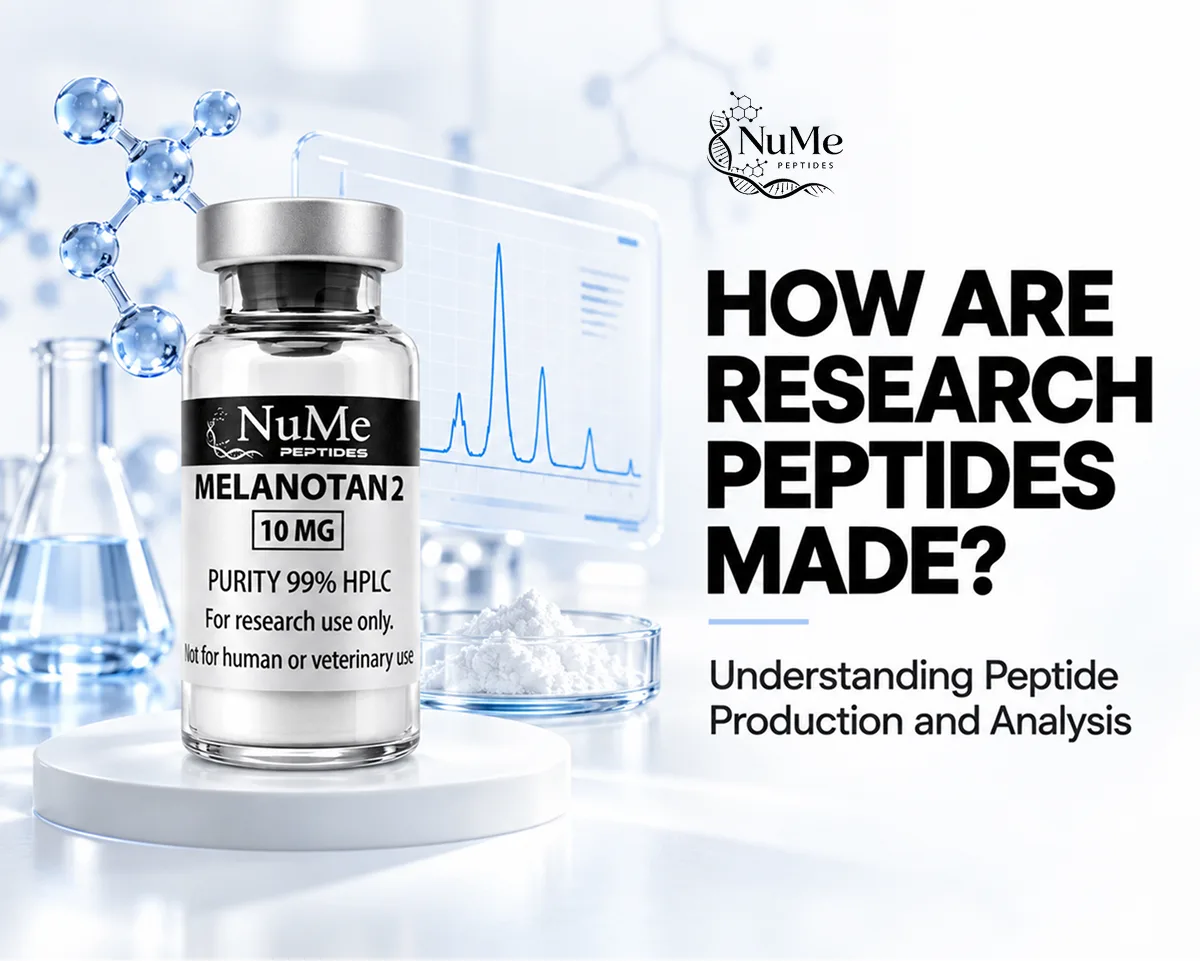
How Are Research Peptides Made? Understanding Peptide Production and Analysis


Research peptides are produced through carefully controlled chemical processes designed to assemble amino acids in a specific order and then isolate the desired sequence from reaction byproducts. Although the final material may appear simple, peptide production involves multiple stages, including sequence design, synthesis, cleavage, purification, drying, and analytical characterization.
For many synthetic peptides, solid-phase peptide synthesis, or SPPS, remains one of the most widely used production strategies. The method allows chemists to build a peptide step by step while it remains attached to a solid resin support. After assembly, the peptide is released, purified, and analyzed using techniques such as HPLC and mass spectrometry.
Understanding how are research peptides made therefore requires looking at both the chemistry used to construct the molecule and the analytical methods used to confirm that the final material matches the intended sequence.
Explore the NuMe Peptides US Shop to review research-focused peptide materials and laboratory product information for scientific investigation.
What Are the Main Steps in Research Peptide Production?
Most chemically synthesized research peptides move through several distinct stages.
The exact workflow varies according to peptide length, sequence, modifications, and production scale, but a typical process may include:
- sequence and synthesis planning;
- attachment of the first amino acid to a resin;
- repeated deprotection and coupling cycles;
- final cleavage from the solid support;
- removal of side-chain protecting groups;
- crude peptide isolation;
- purification;
- analytical characterization;
- drying or lyophilization;
- final documentation and storage.
Modern solid-phase peptide synthesis is especially useful because the growing peptide remains attached to an insoluble resin throughout most of the assembly process. Excess reagents and reaction byproducts can therefore be washed away between individual reaction cycles.
SPPS generally consists of three broad phases: chain elongation, cleavage, and purification. During elongation, repeated deprotection and coupling reactions add amino acids sequentially. Cleavage then separates the peptide from the resin and removes protecting groups, while purification removes malformed sequences and reaction byproducts. (Pradhan et al., 2025)
This stepwise design allows researchers and manufacturers to create a wide range of sequences, including linear peptides, cyclic peptides, modified peptides, and molecules containing non-standard amino acids.
Fmoc-based solid-phase synthesis has become particularly important because a broad range of Fmoc-protected amino-acid building blocks are commercially available and compatible with automated synthesis platforms. Advances in Fmoc SPPS have expanded access to increasingly complex peptide structures while improving synthesis efficiency and product quality. (Behrendt et al., 2016)
The production process does not end once the chain has been assembled. Purification and analytical characterization are essential because incomplete reactions or side reactions can generate closely related impurities that need to be separated from the target sequence.
Visit the NuMe Peptides US Shop to explore available research peptides and laboratory-focused products for scientific study.
How Are Amino Acids Assembled Into Peptide Chains?
A peptide consists of amino acids connected by peptide bonds.
In solution chemistry, selectively forming these bonds can become difficult because amino acids contain multiple reactive functional groups. Peptide synthesis solves this problem by temporarily protecting groups that should not react during a particular step.
Solid-phase synthesis takes this strategy further by attaching the first amino acid to an insoluble resin.
The peptide chain generally grows from its C-terminal end toward its N-terminal end. One protected amino acid is added at a time through repeated cycles.
A simplified Fmoc SPPS cycle includes:
- removing the temporary Fmoc protecting group;
- washing the resin;
- activating the next protected amino acid;
- coupling that amino acid to the growing peptide;
- washing away excess reagents;
- repeating the process for the next residue.
The concept of solid-phase peptide synthesis transformed peptide chemistry because the growing molecule stays anchored to a solid support while reagents can be added and removed efficiently. Automated systems can repeat these steps according to a programmed sequence, reducing some of the manual work involved in building longer peptides. (Mäde et al., 2014)
Protecting groups are essential during this process.
The Fmoc group temporarily protects the amino terminus of the growing chain, while additional protecting groups may shield reactive side chains. This controlled protection prevents unwanted bonds from forming at incorrect locations during synthesis.
However, each cycle introduces opportunities for error.
If an amino acid does not couple completely, the resulting material may contain a deletion sequence. Side reactions may also produce modified residues or other structurally related variants. Aspartimide formation, for example, remains a recognized challenge in Fmoc-based synthesis involving certain aspartic-acid-containing sequences. (Kumar et al., 2025)
This is why understanding how are research peptides made also requires understanding that successful synthesis is not simply about completing a sequence. Reaction efficiency during every individual step can influence the impurity profile of the final crude material.
What Happens During Peptide Cleavage and Purification?
Once all intended amino acids have been assembled, the peptide still remains attached to the resin and many side-chain protecting groups are still present.
The next major stage is cleavage.
In Fmoc-based solid-phase synthesis, strong acid treatment is commonly used to release the finished peptide from the resin while simultaneously removing many side-chain protecting groups. Cleavage formulations may also contain scavengers that react with highly reactive intermediates generated during deprotection. (Pradhan et al., 2025)
The material produced at this stage is generally referred to as the crude peptide.
Crude peptide does not consist solely of the target molecule. It may also contain:
- incomplete sequences;
- deletion products;
- chemically modified variants;
- protecting-group remnants;
- cleavage byproducts;
- residual reagents;
- other synthesis-related materials.
Purification is therefore one of the most important stages in peptide production.
Reversed-phase high-performance liquid chromatography is commonly used because peptide species can often be separated according to differences in hydrophobicity and interaction with the stationary phase.
As the crude mixture travels through the chromatographic column, different components elute at different times. Fractions containing the desired peptide can be collected, while less desirable components are separated.
Purification efficiency depends partly on how similar the impurities are to the target sequence. A peptide missing only one amino acid may behave very similarly to the desired molecule, making separation more challenging.
FDA guidance on synthetic peptide production notes that peptide-related impurities may arise from raw materials, reagents, solvents, synthesis conditions, and manufacturing processes. Control strategies may therefore include modifying the synthetic route or purification procedures to reduce these impurities. (U.S. Food and Drug Administration, 2021)
After purification, the peptide solution may be concentrated and lyophilized.
Freeze-drying removes water under controlled conditions, producing the dry material commonly seen in research peptide vials. The resulting material can then proceed to analytical testing and final documentation.
How Do Laboratories Confirm Peptide Identity and Purity?
Producing a peptide does not automatically confirm that the final material is the intended molecule.
Analytical testing provides the evidence needed to evaluate the finished sample.
HPLC Analysis
High-performance liquid chromatography is widely used to examine the relative composition of purified peptide material.
A chromatogram displays peaks representing compounds detected as they leave the analytical column. If the target peptide dominates the sample, the chromatogram will typically show a major peak associated with that material, together with smaller peaks representing detectable impurities.
HPLC can therefore provide useful information about chromatographic purity.
However, a dominant peak alone does not prove molecular identity. Closely related peptide species may have similar chromatographic behavior and can sometimes co-elute.
Mass Spectrometry
Mass spectrometry provides complementary information by measuring molecular mass.
Researchers can compare the experimentally observed mass with the expected mass calculated from the intended amino-acid sequence. A close match supports the identity of the synthesized peptide.
For more complicated impurity profiles, liquid chromatography combined with mass spectrometry can provide both separation and molecular information.
This becomes important because peptide synthesis may generate impurities that are very similar to the intended molecule. FDA guidance notes that incomplete coupling, truncations, and side reactions can produce peptide-related impurities that may be difficult to identify and quantify without sophisticated analytical methods. (U.S. Food and Drug Administration, 2026)
Laboratories may also use additional techniques depending on the intended application. These can include tandem MS, amino-acid analysis, NMR, moisture measurement, or other analytical approaches.
The combination of chromatographic and mass-based methods helps researchers distinguish between two separate questions:
Is the primary material relatively pure? and Is the primary material actually the intended peptide?
Both questions matter when examining how are research peptides made and evaluated before use in laboratory studies.
Which Factors Can Influence the Quality of a Research Peptide?
Peptide quality begins long before final testing.
Several parts of the manufacturing process can influence the characteristics of the finished material.
Sequence Complexity
Some sequences are more difficult to synthesize than others.
Hydrophobic residues, aggregation-prone sequences, sterically hindered amino acids, or difficult secondary structures can interfere with efficient coupling during SPPS. As the chain becomes longer, incomplete reactions can also become more difficult to avoid.
Advances in SPPS therefore focus partly on improving coupling chemistry, reaction conditions, protecting-group strategies, and synthesis efficiency for challenging sequences. (Behrendt et al., 2016)
Raw Material Quality
The quality of amino-acid building blocks, solvents, coupling reagents, and other starting materials can influence the final impurity profile.
FDA specifically notes that impurities in synthetic peptides may originate from starting materials, reagents, solvents, metals, and the manufacturing process itself. (U.S. Food and Drug Administration, 2021)
Coupling Efficiency
Each amino-acid addition must occur successfully.
An incomplete coupling step can leave a portion of the peptide population without the intended residue. If the chain continues growing afterward, a deletion sequence may result.
Manufacturers may use reaction monitoring, repeated coupling, adjusted reagent ratios, or optimized synthesis conditions to reduce such problems.
Cleavage Conditions
Cleavage must remove the finished peptide from the resin and eliminate protecting groups without causing excessive chemical damage.
Acid exposure, reaction time, scavenger composition, and sequence sensitivity can all affect the outcome.
Purification Strategy
Even a successful synthesis produces crude material that needs purification.
Chromatographic method design determines how effectively the target peptide can be separated from related impurities. Closely related molecules can require carefully optimized gradients or additional purification steps.
Analytical Sensitivity
The quality of the analytical method also influences what researchers know about the sample.
A method that cannot separate or detect a particular impurity cannot accurately describe that impurity. FDA guidance highlights the importance of modern analytical chemistry in characterizing structurally related peptide species. (U.S. Food and Drug Administration, 2021)
These factors show why peptide production and peptide analysis should not be considered separate topics. The final quality profile reflects decisions made throughout the entire synthesis, purification, and testing workflow.
New to peptide research? Read our guide on What Are Research Peptides? to understand how research peptides are defined, studied, and evaluated before exploring proper storage practices.
FAQs About How Research Peptides Are Made
How are research peptides made in laboratories?
Many synthetic research peptides are produced using solid-phase peptide synthesis. Amino acids are added sequentially to a growing chain attached to a resin, followed by cleavage, purification, analytical characterization, and drying.
What is solid-phase peptide synthesis?
SPPS is a chemical synthesis method in which the peptide remains attached to a solid resin while amino acids are added sequentially. Excess reagents can be washed away after each reaction step, making repeated synthesis cycles easier to manage. (Mäde et al., 2014)
Why are protecting groups used in peptide synthesis?
Protecting groups temporarily block reactive parts of amino acids so that peptide bonds form at the intended locations. They help reduce unwanted reactions during chain assembly.
Why does crude peptide need purification?
Crude material may contain deletion sequences, truncated peptides, modified variants, cleavage byproducts, and residual reagents. Purification separates the desired sequence from many of these unwanted components.
How is peptide identity confirmed?
Mass spectrometry is commonly used to compare the measured molecular mass of a sample with the mass expected from its intended sequence. More detailed MS-based techniques may provide additional structural information.
Does high HPLC purity prove that synthesis was successful?
Not by itself. HPLC can show that one component dominates a chromatographic profile, but molecular identity should be supported through complementary testing such as mass spectrometry.
Understanding Research Peptide Production
So, how are research peptides made in practice?
For many synthetic peptides, production begins with a planned amino-acid sequence and proceeds through repeated SPPS cycles. Each residue is added to a growing chain while protecting groups control chemical reactivity. Once assembly is complete, the peptide is cleaved from the resin, deprotected, purified, and prepared for analytical testing.
The process is iterative, and every stage can influence the final material.
Incomplete coupling can generate deletion sequences. Side reactions can produce modified peptides. Cleavage conditions can introduce additional byproducts, while purification determines how effectively these related compounds are removed.
Analytical testing then provides evidence about the resulting material. HPLC can evaluate chromatographic composition, while mass spectrometry can support molecular identity and reveal related species.
For researchers, understanding the production workflow provides useful context when reviewing peptide specifications and analytical documentation. A final purity percentage is only the endpoint of a much larger sequence of chemical and analytical steps.
Explore the NuMe Peptides US Shop to review research-focused peptide materials and supporting laboratory product information.
Disclaimer: This content is provided for scientific and educational purposes only. Research peptides discussed here are presented in a laboratory research context and are not described as products for human consumption, diagnosis, treatment, cure, or prevention of disease.


I found this article really helpful for understanding how research peptides are produced from synthesis through purification and testing. The step-by-step explanation makes a fairly technical process much easier to follow. I’d be interested in learning more about what factors can influence peptide quality during synthesis.
This was a great introduction to the peptide manufacturing process, especially for readers who don’t have a strong chemistry background. I liked the explanation of why purification and quality control are just as important as the synthesis itself. Are there common challenges researchers encounter when trying to achieve a high level of peptide purity?
Really enjoyed the breakdown of the different stages involved in making research peptides. The section on analytical testing was particularly interesting because it shows how researchers can verify the final product rather than relying only on the manufacturing process. It would be great to see a follow-up explaining how HPLC and mass spectrometry complement each other during quality testing.