

Growth Hormone Releasing Hormone Receptor Research: Signaling and Biological Regulation


Growth hormone-releasing hormone (GHRH) is a hypothalamic peptide that helps control the synthesis and pulsatile secretion of growth hormone (GH) from pituitary somatotroph cells. Its biological activity depends largely on interaction with the growth hormone-releasing hormone receptor, or GHRHR, a specialized G protein-coupled receptor expressed prominently within the anterior pituitary.
Modern growth hormone releasing hormone receptor research examines how ligand binding activates intracellular cyclic AMP signaling, calcium-dependent secretion, gene transcription, and somatotroph function. Researchers also investigate how receptor activity is modified by somatostatin, GH and IGF-1 feedback, receptor desensitization, and changes in the metabolic environment.
Peptides such as Sermorelin, CJC-1295, and shorter-acting modified GHRH(1-29) analogues provide experimental tools for studying different aspects of this pathway. However, their structures and pharmacokinetic properties differ, so results from one peptide should not automatically be applied to another.
Explore the NuMe Peptides US Shop for research-focused compounds associated with growth hormone secretion, endocrine signaling, and laboratory investigation.
What Is the Growth Hormone-Releasing Hormone Receptor?
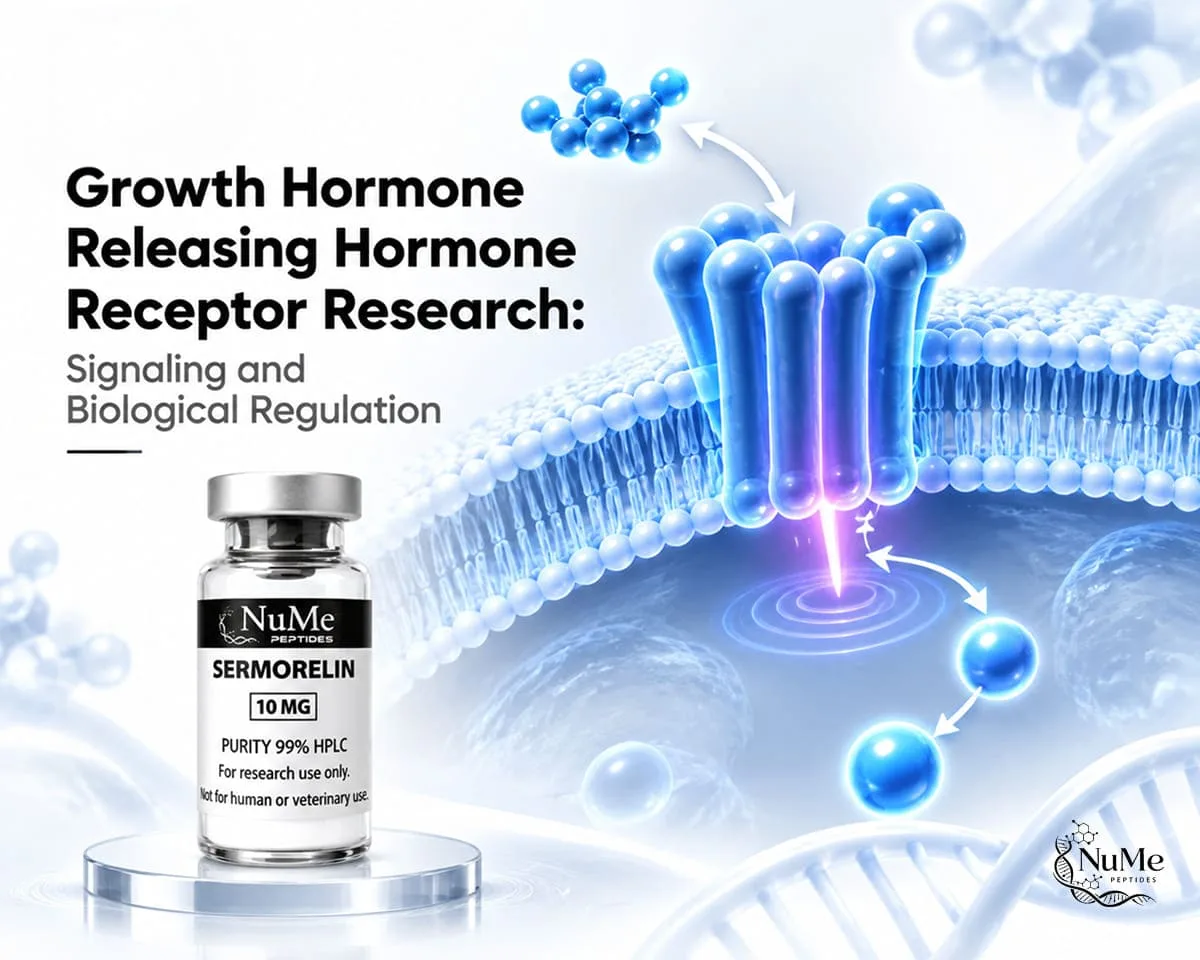
The growth hormone-releasing hormone receptor is a seven-transmembrane G protein-coupled receptor primarily associated with pituitary somatotroph cells.
Its principal physiological ligand is hypothalamic GHRH. When GHRH reaches the anterior pituitary through the hypothalamic-pituitary portal circulation, it binds GHRHR and promotes GH synthesis and secretion.
The receptor is required not only for acute GH release but also for normal somatotroph development and function. Human and animal mutations that reduce GHRHR function have been associated with impaired GH secretion, reduced growth, and pituitary abnormalities, demonstrating the receptor’s importance to the somatotropic axis. (Mayo, 2003)
More recent reviews classify the pituitary GHRHR as a G protein-coupled receptor with seven potential membrane-spanning domains and describe its central role in GH secretion through intracellular cAMP signaling. Researchers have also identified GHRHR splice variants outside the pituitary, including SV1, which can remain functionally responsive to GHRH in certain experimental tissues. (Halmos et al., 2025)
For endocrine research, however, the pituitary receptor remains particularly important.
Its activity sits upstream of GH release and therefore upstream of many subsequent GH receptor and IGF-1 responses.
This means researchers should distinguish three different levels:
- GHRH binding to GHRHR;
- released GH binding to the growth hormone receptor;
- downstream production and signaling of IGF-1.
These systems interact, but they are not the same receptor pathway.
Explore the Growth Hormone research collection for peptides associated with GH-axis, GHRH, and endocrine signaling studies.
How Does GHRH Receptor Signaling Regulate Growth Hormone Pathways?
GHRHR primarily couples to stimulatory G proteins, particularly Gs.
When GHRH binds the receptor, Gsα activates adenylyl cyclase. This enzyme converts ATP into cyclic adenosine monophosphate, or cAMP.
The increase in intracellular cAMP activates protein kinase A, commonly abbreviated PKA.
PKA then modifies several downstream targets associated with transcription, ion-channel function, intracellular calcium, and hormone secretion. Research on pituitary cAMP regulation describes this GHRH–GHRHR–Gs–adenylyl cyclase–cAMP–PKA sequence as a central pathway regulating somatotroph activity. (Bizzi et al., 2019)
An increase in intracellular calcium is especially relevant to acute hormone release.
GHRHR activation can modify voltage-dependent calcium currents, increasing intracellular Ca²⁺ and facilitating exocytosis of stored GH-containing secretory granules.
At the same time, GHRH signaling influences GH synthesis.
This distinction is important: receptor activation can affect both immediate secretion of existing GH and longer-term processes related to hormone production and somatotroph biology.
Current research also shows that GHRH signaling is embedded within a feedback-regulated endocrine system.
Somatostatin opposes GH secretion, while circulating GH and IGF-1 contribute negative feedback. Nutritional state, age, sex, metabolic conditions, and other neuroendocrine signals can further modify the response. (Luque et al., 2025)
Consequently, the same GHRH-receptor stimulus may not produce an identical GH response under every physiological or experimental condition.
Which Molecular Signals Are Associated With GHRH Receptor Activation?
The cAMP/PKA pathway is the best-characterized signaling mechanism downstream of GHRHR, but it is not the only molecular system associated with receptor activation.
Adenylyl Cyclase and cAMP
Activation of Gs stimulates adenylyl cyclase and raises intracellular cAMP.
Researchers often measure cAMP directly when evaluating whether a GHRH analogue activates its receptor.
Structure-activity studies using GHRH(1-29) analogues have shown that changes to specific amino acids can alter both receptor-binding affinity and cAMP production. This demonstrates that peptide sequence directly influences receptor activation.
Protein Kinase A
Increasing cAMP activates PKA.
PKA can alter proteins involved in gene transcription, ion channels, cell growth, and differentiation. Within pituitary somatotrophs, these changes contribute to both GH release and longer-term cellular responses.
Intracellular Calcium
GHRH signaling can increase calcium entry through voltage-gated channels.
Because secretion of stored GH depends on vesicle exocytosis, calcium provides an important connection between receptor signaling and actual hormone release.
MAPK Signaling
GHRHR activity may also engage mitogen-activated protein kinase pathways.
These signals are particularly relevant when researchers examine somatotroph proliferation and cellular growth rather than acute hormone release alone.
Reviews of pituitary signaling identify both cAMP-dependent pathways and MAPK-related responses following GHRHR activation. (Mitu et al., 2023)
These multiple signaling branches explain why researchers often measure more than circulating GH when studying receptor function.
How Is GHRH Receptor Function Studied in Experimental Research?
Researchers investigate GHRHR using several complementary experimental approaches.
Pituitary Cell Cultures
Cultured anterior pituitary cells allow researchers to expose somatotrophs to defined concentrations of GHRH or synthetic analogues.
Outcomes may include:
- GH release;
- intracellular cAMP;
- calcium signaling;
- receptor binding;
- GH gene expression.
These models are particularly useful for comparing how changes in peptide sequence affect receptor potency.
Receptor-Binding Studies
Radioligand and molecular-binding techniques can measure how strongly different analogues interact with GHRHR.
Researchers have systematically substituted individual amino acids within GHRH(1-29) to identify residues important for receptor recognition and biological activity. (Goudreau et al., 1994)
Genetic Models
Animal models in which GHRH signaling is removed can demonstrate the biological importance of the pathway.
For example, GHRH-knockout mice exhibit impaired growth and reduced pituitary GH activity. Researchers have used these animals to examine whether long-acting GHRH analogues can restore aspects of somatotroph activity and growth.
In one such study, CJC-1295 increased pituitary GH mRNA and produced somatotroph-related changes in GHRH-knockout mice, demonstrating biological activity through the GHRH pathway. (Alba et al., 2006)
Human Endocrine Studies
Human studies may measure GH concentration repeatedly after GHRH analogue administration.
Researchers can examine peak GH, mean GH, pulse characteristics, IGF-1, pharmacokinetics, and duration of stimulation.
This approach is particularly informative when comparing short- and long-acting receptor agonists.
Which Research Peptides Are Investigated in GHRH-Related Studies?
CJC-1295
CJC-1295 is a synthetic GHRH analogue designed for prolonged biological activity.
The classic form contains a Drug Affinity Complex, or DAC, that allows the molecule to form a stable bond with circulating albumin. This greatly extends exposure compared with native GHRH.
In randomized human studies, CJC-1295 produced dose-dependent increases in mean GH lasting six days or longer and increased IGF-1 for approximately 9–11 days after a single administration. Its estimated half-life was approximately 5.8–8.1 days. (Teichman et al., 2006)
Importantly, sustained GHRH-receptor stimulation did not eliminate normal GH pulsatility.
A separate human study found that CJC-1295 increased mean and trough GH concentrations while preserving secretory pulses. This suggests that continuous GHRHR stimulation can raise overall GH drive while endogenous hypothalamic-pituitary regulation remains active. (Ionescu & Frohman, 2006)
CJC-1295 No DAC
The term CJC-1295 No DAC requires more careful interpretation.
In the commercial research-peptide field, it is commonly used for shorter-acting modified GRF(1-29)-type peptides that do not contain the albumin-binding DAC found in classic CJC-1295.
Consequently, the multi-day half-life reported for DAC-containing CJC-1295 should not automatically be applied to a No-DAC preparation.
Research on modified GHRH(1-29) analogues predates the CJC terminology. Scientists have introduced amino-acid substitutions into the 1-29 fragment to increase receptor potency or resistance to enzymatic degradation while maintaining GHRHR activity. (Rivier et al., 1988)
Experimental work has also shown that specific substitutions within GHRH(1-29) can substantially modify biological potency while retaining the ability to stimulate GH secretion through the GHRH pathway.
For accurate laboratory interpretation, researchers should therefore verify the actual amino-acid sequence rather than relying solely on the label “CJC-1295 No DAC.”
Explore CJC-1295 No DAC 10 mg for laboratory research involving GHRH receptor signaling and growth hormone-axis regulation.
Sermorelin
Sermorelin corresponds to GHRH(1-29)-NH₂, the biologically active N-terminal fragment of endogenous GHRH.
Human dose-response research demonstrated that GHRH(1-29)-NH₂ can stimulate endogenous GH release with molar potency similar to longer GHRH fragments. (Gelato et al., 1985)
Its shorter structure retains the receptor-interacting region needed for GHRHR activation.
However, native GHRH(1-29) has a relatively short circulating half-life because it is susceptible to enzymatic degradation and renal clearance. Research reviews have estimated a human plasma half-life of roughly 10–20 minutes, helping explain why later analogues were designed for greater stability. (Esposito et al., 2003)
Sermorelin therefore provides an important reference molecule for comparing modified GHRH analogues.
CJC-1295 with DAC represents prolonged GHRHR stimulation, whereas modified short-acting GHRH fragments allow researchers to investigate receptor activation without the same albumin-binding mechanism.
Explore Sermorelin 10 mg for laboratory research involving GHRH receptor signaling and endogenous growth hormone regulation.
FAQs About Growth Hormone-Releasing Hormone Receptor Research
What does the GHRH receptor do?
GHRHR receives hypothalamic GHRH signals at pituitary somatotrophs and activates pathways that promote GH synthesis and secretion. Its major intracellular signaling mechanism involves Gs, adenylyl cyclase, cAMP, and PKA. (Halmos et al., 2025)
Is the GHRH receptor the same as the growth hormone receptor?
No. GHRHR is activated by GHRH primarily at pituitary somatotrophs. The growth hormone receptor is activated later by released GH in peripheral and other target tissues.
What is the main intracellular signal produced by GHRHR activation?
Increased cAMP is a central signal. cAMP activates PKA and contributes to calcium-dependent GH secretion and gene-regulatory responses.
Does CJC-1295 directly activate the growth hormone receptor?
No. CJC-1295 is a GHRH analogue and acts upstream through GHRHR. The endogenous GH released afterward can then activate growth hormone receptors.
Is CJC-1295 No DAC pharmacologically identical to CJC-1295 with DAC?
No. Classic CJC-1295 contains an albumin-binding DAC responsible for prolonged exposure. The “No DAC” term generally describes shorter-acting modified GHRH(1-29)-type research peptides and should not inherit the pharmacokinetic data of DAC-containing CJC-1295.
How does Sermorelin relate to GHRH?
Sermorelin is GHRH(1-29)-NH₂, the active N-terminal fragment of human GHRH. It retains the ability to stimulate GH secretion through the GHRH receptor. (Gelato et al., 1985)
Current growth hormone releasing hormone receptor research shows that GHRHR is a critical regulatory link between hypothalamic signaling and pituitary GH secretion.
Receptor activation stimulates Gs, adenylyl cyclase, cAMP, PKA, intracellular calcium, and additional signaling networks that influence both immediate GH secretion and longer-term somatotroph biology.
Sermorelin provides a relatively direct model of the active GHRH(1-29) sequence. Modified short-acting GHRH fragments allow researchers to investigate how sequence changes influence potency and stability, while CJC-1295 with DAC demonstrates how prolonged GHRHR stimulation changes GH and IGF-1 exposure without necessarily eliminating physiological GH pulsatility.
These distinctions matter when interpreting experimental results.
Researchers should identify the exact peptide sequence, receptor target, and pharmacokinetic design rather than treating every GHRH-related compound as equivalent.
Explore the NuMe Peptides US Shop for research-focused compounds associated with growth hormone secretion, endocrine signaling, and laboratory investigation.
Disclaimer: This content is provided for scientific and educational purposes only. Research peptides discussed here are presented in a laboratory research context and are not described as products for human consumption, diagnosis, treatment, cure, or prevention of disease.