

Growth Hormone IGF Axis Research: Hormonal Signaling and Current Evidence


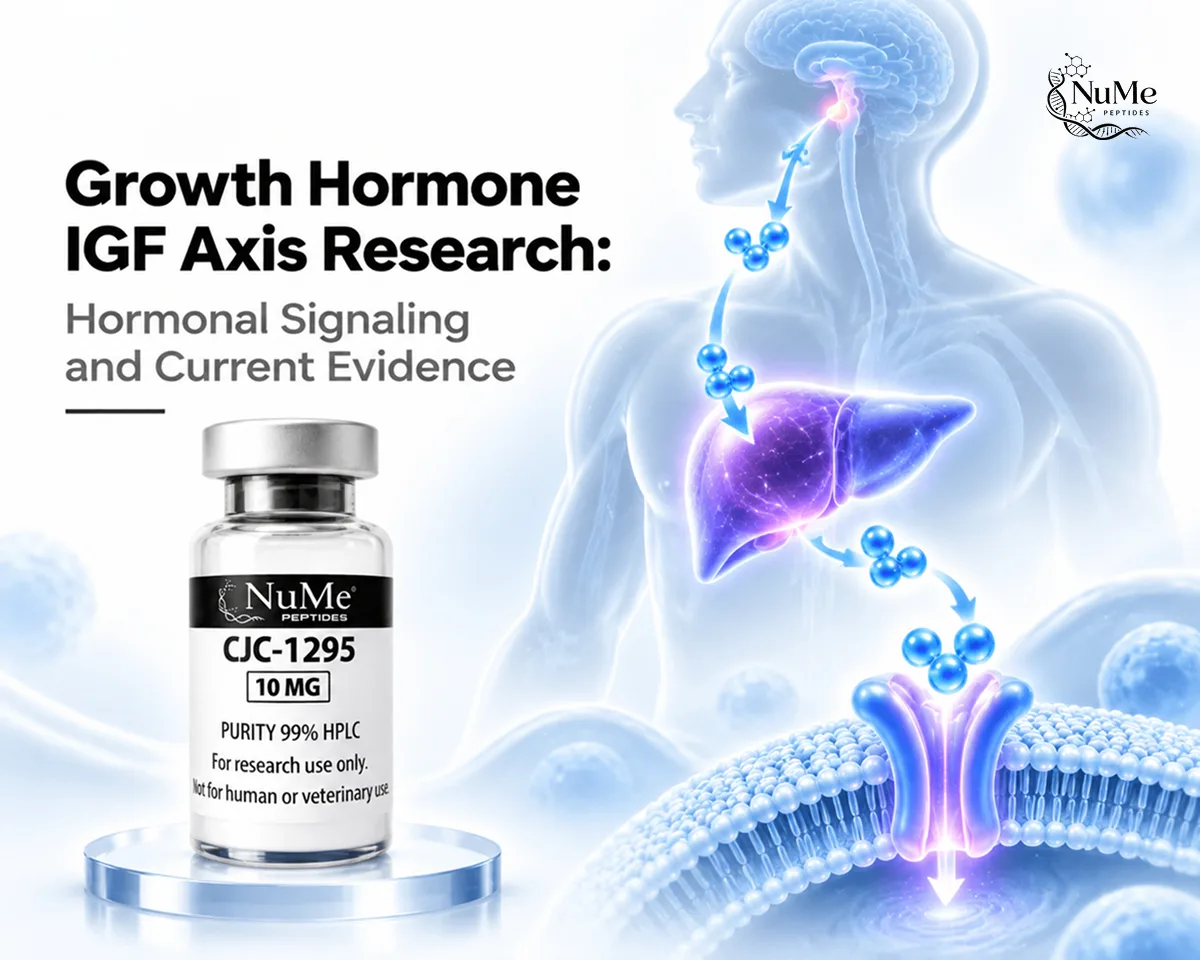
The growth hormone–insulin-like growth factor axis is one of the major endocrine systems involved in postnatal growth, skeletal development, metabolism, and tissue homeostasis. Growth hormone (GH) is secreted by the anterior pituitary, acts directly on target tissues, and stimulates production of insulin-like growth factor 1 (IGF-1), particularly in the liver.
Modern growth hormone IGF axis research investigates more than circulating hormone concentrations. Researchers examine hypothalamic control of GH secretion, growth hormone receptor signaling, hepatic and local IGF-1 production, IGF-1 receptor activity, binding proteins, and feedback mechanisms that regulate the entire system.
Peptides such as Tesamorelin, CJC-1295, Sermorelin, and Ipamorelin are relevant because they can influence endogenous GH secretion through different upstream pathways. Their effects on the GH–IGF system should therefore be interpreted according to receptor mechanism, pharmacokinetics, and the experimental population being studied.
Explore the NuMe Peptides US Shop for research-focused compounds associated with growth hormone secretion, endocrine signaling, and laboratory investigation.
What Is the Growth Hormone–IGF Axis?
The GH–IGF axis describes the interconnected signaling system involving hypothalamic regulators, pituitary GH, growth hormone receptors, IGF-1, IGF-binding proteins, and IGF receptors.
GH secretion begins with neuroendocrine control.
Growth hormone-releasing hormone stimulates pituitary somatotrophs, while somatostatin suppresses GH release. Ghrelin and growth hormone secretagogue receptor signaling provide another stimulatory input. GH and IGF-1 then participate in negative feedback that helps maintain endocrine balance.
A 2026 review describes this system as the principal endocrine network regulating postnatal growth while also contributing to skeletal development, metabolism, cellular differentiation, protein synthesis, and tissue homeostasis. (Tite Haro et al., 2026)
Once released, GH binds the growth hormone receptor, or GHR, in tissues including the liver.
Activation of hepatic GHR stimulates production of circulating IGF-1. However, the liver is not the only source. Many peripheral tissues produce IGF-1 locally, allowing paracrine and autocrine signaling in addition to the classical endocrine pathway.
This distinction has changed the traditional view that essentially all GH actions are mediated through liver-derived IGF-1.
Current evidence instead supports a more integrated model in which GH can act directly, stimulate systemic IGF-1, and modify local IGF-1 signaling within individual tissues. (Iglesias & Guerrero-Pérez, 2026)
Explore the Growth Hormone research collection for peptides associated with GH-axis, GHRH, and endocrine signaling studies.
How Are Growth Hormone and IGF Signaling Connected?
The relationship begins when GH activates GHR.
GHR signaling involves intracellular pathways including JAK2–STAT5, MAPK/ERK, and PI3K–Akt–mTOR. In the liver, STAT5 activation contributes strongly to IGF-1 gene expression and subsequent release of IGF-1 into circulation. (Tite Haro et al., 2026)
Circulating IGF-1 then interacts with the IGF-1 receptor, or IGF1R.
IGF1R is a receptor tyrosine kinase structurally related to the insulin receptor. Its activation can initiate signaling through PI3K/Akt and MAPK pathways associated with cellular survival, growth, differentiation, and protein synthesis.
GH and IGF-1 therefore share some downstream signaling networks but are not interchangeable hormones.
Their metabolic actions can even differ.
A recent Endocrine Reviews analysis emphasized that GH and IGF-1 may produce opposing effects in some metabolic contexts. GH promotes lipolysis and can reduce insulin sensitivity, whereas IGF-1 has insulin-like actions in several tissues. (Laron & Werner, 2025)
Feedback is another major connection.
Higher IGF-1 concentrations can reduce pituitary GH output through hypothalamic and pituitary mechanisms. GH itself also contributes to short-loop feedback.
Experimental research published in 2025 showed that IGF1R signaling in GHRH neurons contributes importantly to regulation of the hypothalamic-pituitary-somatotropic axis, illustrating how downstream IGF-1 can feed back to upstream control centers. (GH-Releasing Hormone Neuron Study, 2025)
The axis is therefore better represented as a feedback loop than a one-directional GH-to-IGF pathway.
Which Biological Processes Are Studied Within the GH–IGF Axis?
Postnatal Growth
Linear growth is one of the best-established biological functions of the GH–IGF system.
GH promotes IGF-1 signaling within growth plates, where chondrocyte proliferation and differentiation contribute to longitudinal bone growth.
Human disorders involving GH deficiency, GHR defects, or IGF-1 abnormalities have provided important natural models for understanding this pathway.
A 2026 systematic review involving more than 18,000 children across growth hormone deficiency, idiopathic short stature, and small-for-gestational-age groups demonstrated that baseline IGF-1 status and GH-axis characteristics differ among growth disorders and are associated with variation in growth responses. (Soliman et al., 2026)
Protein and Tissue Metabolism
GH signaling can influence protein synthesis and nitrogen balance, while IGF-1 regulates anabolic cellular pathways through IGF1R.
Researchers examine these mechanisms in muscle, bone, liver, and other tissues.
Lipid Metabolism
GH has significant effects on adipose tissue and lipolysis.
This area is particularly relevant to Tesamorelin research, where stimulation of endogenous GH has been investigated in relation to visceral adipose tissue.
Glucose Regulation
The GH–IGF axis interacts closely with insulin signaling.
Because GH and IGF-1 can have different metabolic effects, researchers often evaluate glucose, insulin sensitivity, and IGF-1 alongside GH-related endpoints rather than assuming that higher activity across the axis produces one uniform metabolic response.
Tissue and Organ Signaling
GH, GHR, IGF-1, and IGF1R are found across many tissues.
Recent research has expanded beyond growth to examine cardiovascular, neurological, metabolic, and tissue-homeostasis functions. For example, GH and IGF-1 receptors in cardiovascular tissues connect the axis with endothelial biology and myocardial structure. (Cardiovascular GH Review, 2026)
This broader research illustrates why the somatotropic axis cannot be evaluated solely through height or circulating GH measurements.
How Do Researchers Investigate GH–IGF Signaling in Experimental Models?
Researchers study the axis at several biological levels.
Hormone Sampling
GH secretion is pulsatile, meaning concentrations can vary substantially over short periods.
Researchers may therefore use repeated blood sampling to measure:
- GH pulse frequency;
- peak GH;
- mean GH;
- trough GH;
- GH area under the curve.
IGF-1 is generally more stable in circulation and may provide a complementary marker of longer-term GH-axis activity.
Cell-Based Models
Researchers can expose GHR- or IGF1R-expressing cells to defined ligands and evaluate:
- receptor phosphorylation;
- STAT activation;
- PI3K/Akt signaling;
- MAPK/ERK activity;
- gene transcription;
- protein synthesis.
These systems help distinguish direct GH signaling from secondary IGF-1-mediated effects.
Genetic Models
GHR knockout, IGF-1 knockout, IGF1R disruption, and tissue-specific genetic models allow researchers to determine which biological functions depend on each component of the axis.
Human growth hormone insensitivity has also been especially informative.
Individuals with defective GHR signaling may have high circulating GH but markedly reduced IGF-1, demonstrating that GH concentration alone cannot predict downstream biological activity. (Tite Haro et al., 2026)
Peptide Stimulation Studies
Upstream peptide analogues provide another experimental approach.
Researchers can stimulate endogenous GH secretion and subsequently monitor GH, IGF-1, metabolic variables, and physiological responses.
CJC-1295 is a clear example. In randomized studies of healthy adults, the long-acting GHRH analogue increased mean GH approximately two- to ten-fold for six days or longer and increased IGF-1 approximately 1.5- to three-fold for nine to eleven days after a single dose. (Teichman et al., 2006)
Interestingly, subsequent research showed that CJC-1295 increased mean and trough GH while preserving pulsatile GH secretion.
These experiments demonstrate how investigators can modify upstream signaling while observing downstream changes across the axis.
Which Peptides Are Relevant to Growth Hormone–IGF Research?
Tesamorelin
Tesamorelin is a stabilized GHRH analogue that activates the pituitary GHRH receptor and stimulates endogenous GH secretion.
Its downstream relevance to the GH–IGF axis is clearly demonstrated in human research.
In a randomized controlled trial involving adults with HIV-associated abdominal fat accumulation, Tesamorelin significantly increased IGF-1 while reducing visceral adipose tissue compared with placebo. (Falutz et al., 2010)
An earlier randomized study similarly reported an approximately 81% increase in IGF-1 over 26 weeks in the studied population. (Falutz et al., 2007)
Tesamorelin therefore illustrates how upstream GHRH stimulation can produce measurable downstream IGF-1 and metabolic responses.
Explore Tesamorelin 10 mg for laboratory research involving GHRH signaling and the growth hormone–IGF axis.
CJC-1295
CJC-1295 is another GHRH analogue, but the classic DAC-containing molecule was specifically engineered for prolonged activity.
Its albumin-binding design substantially extends exposure.
Human research demonstrated sustained increases in both GH and IGF-1, making CJC-1295 particularly useful for examining how prolonged GHRH-receptor stimulation changes downstream somatotropic signaling. (Teichman et al., 2006)
Additional proteomic research has used CJC-1295 as an experimental method for activating the GH/IGF-1 axis and studying serum protein changes associated with altered endocrine signaling.
Ipamorelin
Ipamorelin targets a different upstream pathway.
It is a synthetic pentapeptide growth hormone secretagogue associated with the ghrelin/GHS-R1a receptor system rather than the GHRH receptor.
Early studies found potent GH-releasing activity in pituitary-cell and animal models, with comparatively selective GH stimulation relative to some earlier GHRPs. (Raun et al., 1998)
Ipamorelin’s relationship with IGF-1 is therefore indirect: GHS-R stimulation can increase endogenous GH, and GH can subsequently drive downstream GHR and IGF-1 signaling.
Researchers should not describe Ipamorelin as a direct IGF1R ligand.
Explore Ipamorelin 10 mg for laboratory research involving growth hormone secretagogue signaling and the GH–IGF axis.
Sermorelin
Sermorelin corresponds to the active GHRH(1-29) fragment.
Human studies with GHRH(1-29)-NH₂ demonstrated stimulation of endogenous GH secretion, confirming that the shortened peptide retains the receptor-active portion of native GHRH. (Barron et al., 1985)
Unlike long-acting CJC-1295, GHRH(1-29)-based peptides are shorter-acting.
This makes Sermorelin relevant for research examining relatively brief GHRH receptor stimulation and subsequent changes in pituitary GH output.
Together, these compounds demonstrate that the GH–IGF axis can be investigated from several upstream entry points without the peptides themselves directly activating IGF1R.
Explore Sermorelin 10 mg for laboratory research involving GHRH receptor signaling and endogenous growth hormone regulation.
FAQs About Growth Hormone–IGF Axis Research
What is the GH–IGF axis?
It is an endocrine signaling network connecting hypothalamic regulation, pituitary GH secretion, GHR activation, IGF-1 production, IGF1R signaling, and hormonal feedback.
Does growth hormone directly increase IGF-1?
GH stimulates IGF-1 production through GHR signaling, especially in the liver, although IGF-1 is also produced locally in peripheral tissues.
Are GH and IGF-1 the same type of signal?
No. They bind different receptors and can have distinct biological and metabolic effects, even though their pathways are closely connected.
How does CJC-1295 affect the GH–IGF system?
CJC-1295 stimulates GHRH receptors upstream, increasing endogenous GH and subsequently circulating IGF-1.
How does Ipamorelin differ from Tesamorelin?
Ipamorelin acts through the growth hormone secretagogue receptor pathway, while Tesamorelin acts through the GHRH receptor. Both act upstream of GH release but use different receptor systems.
Does Sermorelin directly activate IGF-1 receptors?
No. Sermorelin stimulates the GHRH receptor at the pituitary, promoting endogenous GH release. Downstream GH signaling may subsequently increase IGF-1 production.
Current growth hormone IGF axis research shows that somatotropic signaling is best understood as an interconnected feedback network.
Hypothalamic signals regulate pituitary GH. GH then activates GHR in liver and peripheral tissues, stimulating both direct cellular responses and IGF-1 production. IGF-1 signals through its own receptor while also contributing feedback to the hypothalamic-pituitary system.
Tesamorelin, CJC-1295, Ipamorelin, and Sermorelin allow researchers to modify different upstream regulatory pathways and observe how GH and IGF-1 respond.
Their mechanisms should remain distinct. Tesamorelin, CJC-1295, and Sermorelin relate primarily to GHRH receptor signaling, whereas Ipamorelin investigates the growth hormone secretagogue receptor system.
This receptor-level distinction makes experimental interpretation more precise and prevents all GH-releasing peptides from being treated as biologically equivalent.
Explore the NuMe Peptides US Shop for research-focused compounds associated with growth hormone secretion, endocrine signaling, and laboratory investigation.
Disclaimer: This content is provided for scientific and educational purposes only. Research peptides discussed here are presented in a laboratory research context and are not described as products for human consumption, diagnosis, treatment, cure, or prevention of disease.