

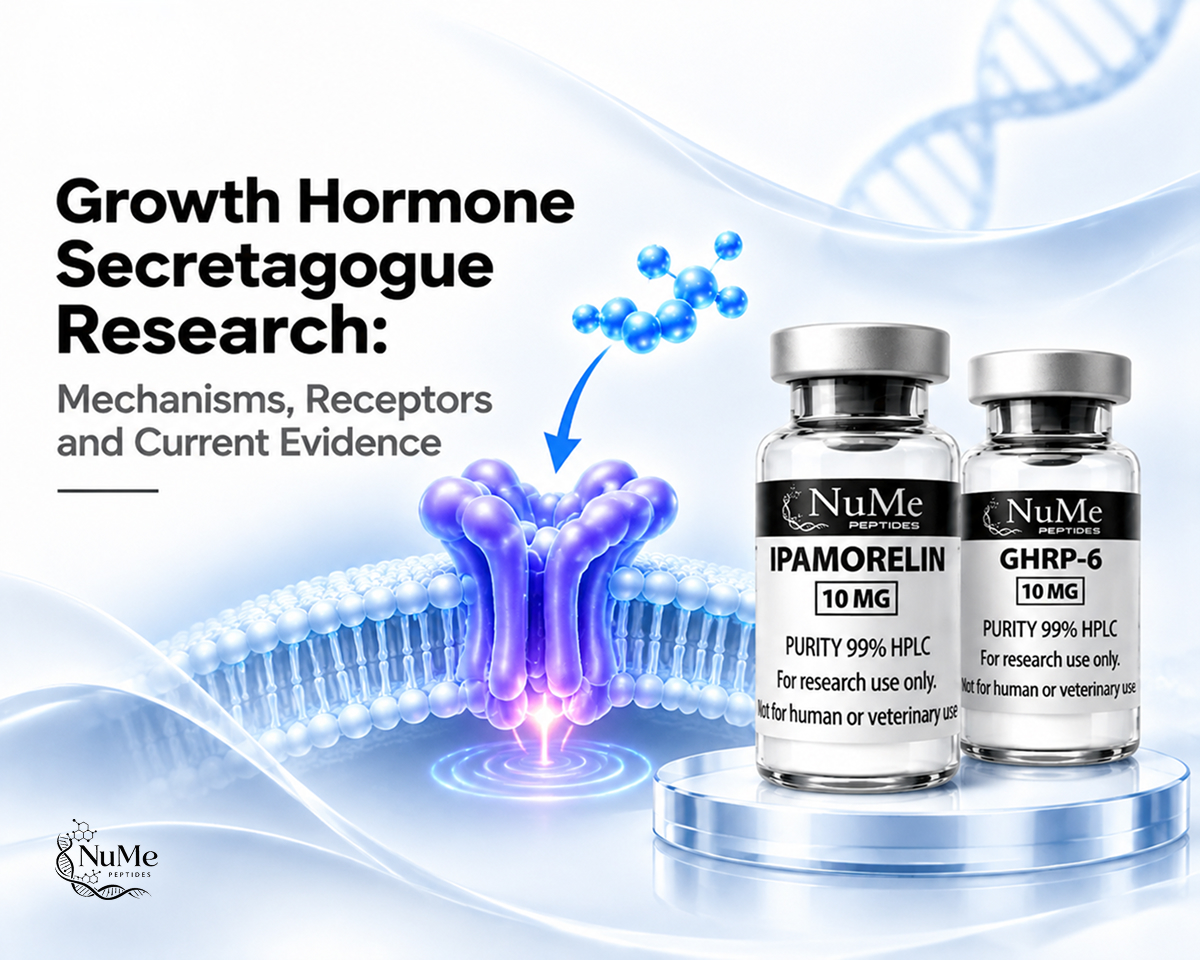
Growth Hormone Secretagogue Research: Mechanisms, Receptors and Current Evidence


Growth hormone secretagogues are compounds investigated for their ability to stimulate endogenous growth hormone (GH) release through mechanisms that differ from the classical growth hormone-releasing hormone (GHRH) pathway. Their study contributed to the identification of a distinct receptor system, now closely associated with ghrelin signaling, and helped researchers understand how multiple regulatory pathways interact to control pulsatile GH secretion.
Modern growth hormone secretagogue research therefore focuses on more than whether GH concentrations increase. Researchers examine growth hormone secretagogue receptor activity, hypothalamic-pituitary interactions, endogenous GHRH dependence, somatostatin tone, receptor signaling, and the selectivity of different experimental compounds.
Ipamorelin and GHRP-6 are two peptide secretagogues frequently investigated within this field. Although both can stimulate GH release, they differ in structure, pharmacological profile, and effects on other pituitary hormones.
Explore the NuMe Peptides US Shop for research-focused compounds associated with growth hormone secretion, endocrine signaling, and laboratory investigation.
What Are Growth Hormone Secretagogues in Scientific Research?
Growth hormone secretagogues, or GHSs, are a group of synthetic peptidyl and non-peptidyl compounds capable of stimulating endogenous GH secretion.
They were originally identified experimentally before the natural ligand for their receptor was known. Early peptide compounds such as GHRP-6 demonstrated that GH could be released through a pathway different from the classical hypothalamic GHRH system.
This distinction became clearer when researchers cloned a specific receptor expressed in the pituitary and hypothalamus that responded to synthetic growth hormone secretagogues. The receptor was named the growth hormone secretagogue receptor, or GHS-R. (Howard et al., 1996)
At that time, the receptor had no known endogenous ligand.
In 1999, researchers isolated a 28-amino-acid acylated peptide from the stomach and named it ghrelin. Ghrelin strongly stimulated GH secretion through GHS-R, establishing that the synthetic secretagogues were effectively interacting with a naturally occurring endocrine signaling system. (Kojima et al., 1999)
This discovery significantly expanded the scientific meaning of GHS research.
Rather than viewing secretagogues only as artificial GH-releasing agents, researchers could now study them as tools for examining the ghrelin–GHS-R system.
Secretagogues may influence GH secretion through interactions involving:
- pituitary somatotrophs;
- hypothalamic signaling;
- endogenous GHRH;
- somatostatin tone;
- ghrelin receptor activity;
- endocrine feedback.
This network-based perspective is essential because a GH response to a secretagogue is not generated by a single isolated receptor event.
Explore research compounds studied in tissue repair and regeneration through our Healing & Recovery collection.
How Do Growth Hormone Secretagogues Differ From Growth Hormone-Releasing Factors?
Growth hormone secretagogues and GHRH-related peptides can both increase GH secretion, but they act through different receptor systems.
GHRH is a hypothalamic peptide that activates the GHRH receptor on pituitary somatotrophs.
Secretagogues such as GHRP-6 and Ipamorelin act primarily through the growth hormone secretagogue receptor system.
Experimental pituitary studies demonstrated this distinction before the GHS receptor had been fully characterized. Rat pituitary cells exposed repeatedly to GHRH or GHRP-6 showed separate patterns of desensitization, while cells that became less responsive to one compound could still respond to the other. These findings supported the existence of distinct receptor-linked pathways. (Cheng et al., 1991)
However, separate receptors do not mean independent endocrine systems.
GHRP-6 research shows that endogenous GHRH contributes strongly to the GH response generated by a secretagogue.
In healthy men, researchers administered a GHRH antagonist before GHRP-6. Blocking endogenous GHRH eliminated most of the GH response to the peptide, indicating that GHRP-6 relies substantially on endogenous GHRH signaling for its maximal effect. (Popovic et al., 1998)
This interaction helps explain why secretagogues and GHRH can produce strong combined responses.
The two pathways can be summarized as follows:
| Research Pathway | Primary Receptor |
|---|---|
| GHRH and GHRH analogues | GHRH receptor |
| GHRP-6 | GHS-R1a-related pathway |
| Ipamorelin | GHS-R1a-related pathway |
| Ghrelin | GHS-R1a |
Researchers should therefore avoid grouping every GH-releasing peptide under the same mechanism.
Secretagogue studies are specifically useful because they allow investigation of a receptor system distinct from—but functionally connected with—the GHRH pathway.
Which Receptors Are Studied in Growth Hormone Secretagogue Research?
The primary receptor of interest is GHS-R1a.
GHS-R belongs to the G protein-coupled receptor family. Two major forms have been described: GHS-R1a and GHS-R1b.
GHS-R1a is the functional receptor capable of binding acyl-ghrelin and activating intracellular signaling. GHS-R1b does not function as a conventional ghrelin receptor but may influence GHS-R1a trafficking and signaling through receptor interactions. (Laviano et al., 2012)
GHS-R1a is expressed in both the pituitary and hypothalamus, which helps explain why secretagogue activity can involve more than direct pituitary stimulation.
The receptor is also found in other tissues, reflecting the broader biological activities of ghrelin signaling.
Ghrelin as the Endogenous Ligand
The identification of ghrelin established the physiological context of the receptor.
Ghrelin contains an unusual acyl modification at serine 3 that is essential for high-affinity GHS-R1a activation. (Kojima et al., 1999)
Modern structural work has further demonstrated that GHS-R1a can respond to peptide and small-molecule ligands through a complex binding pocket, while showing constitutive activity and context-dependent signaling. (Beyond Hunger Review, 2025)
Interaction With Other Endocrine Signals
Although secretagogues activate GHS-R-related pathways, the resulting GH response is influenced by surrounding neuroendocrine conditions.
Somatostatin can suppress secretagogue-induced GH secretion. Conversely, GHRH activity can substantially amplify the response.
This makes GHS-R1a particularly interesting as a research target: its biological output reflects receptor activation plus the state of the broader hypothalamic-pituitary axis.
How Are Secretagogue Effects Investigated in Experimental Models?
Researchers use several model types to determine how a growth hormone secretagogue affects the GH axis.
Pituitary Cell Cultures
Cultured pituitary cells allow researchers to test whether a compound can directly stimulate GH release.
Ipamorelin was characterized using primary rat pituitary cells and animal models. It produced strong GH release in vitro and in vivo and displayed a pharmacological profile consistent with a GHRP-like receptor mechanism. (Raun et al., 1998)
Receptor Antagonist Studies
Antagonists can help determine which endogenous pathways contribute to a secretagogue response.
The GHRP-6/GHRH-antagonist study is an important example because blocking GHRH dramatically reduced GHRP-6-induced GH release. (Popovic et al., 1998)
Such experiments show whether a compound works independently or depends partly on other endocrine signals.
Repeated-Stimulation Studies
Researchers may administer a secretagogue repeatedly to investigate responsiveness and desensitization.
Animal studies comparing repeated GHRP-6 stimulation with other secretagogues have examined whether repeated receptor activation changes subsequent GH responses. (Fairhall et al., 1995)
Hormone Profiling
A compound’s selectivity can be evaluated by measuring more than GH.
Researchers may also examine:
- ACTH;
- cortisol;
- prolactin;
- LH;
- FSH;
- glucose-related variables.
This is particularly relevant when comparing Ipamorelin with earlier GHRPs.
Pulsatility Studies
Because endogenous GH secretion is pulsatile, researchers may monitor repeated GH measurements over time instead of relying on a single concentration.
Secretagogues can increase GH while leaving elements of physiological feedback intact. Reviews of human GHS research note that secretagogue-induced GH release remains subject to endocrine feedback mechanisms rather than functioning like unrestricted exogenous GH administration. (Sigalos & Pastuszak, 2018)
These experimental designs allow researchers to distinguish potency, receptor mechanism, endocrine selectivity, and physiological regulation.
Which Research Peptides Are Classified as Growth Hormone Secretagogues?
Ipamorelin
Ipamorelin is a synthetic pentapeptide developed as a potent growth hormone secretagogue.
Its original pharmacological characterization compared its activity with GHRP-6 and other GH-releasing peptides.
Ipamorelin demonstrated strong GH-releasing activity in rat pituitary cells as well as animal models. Importantly, the researchers found that the compound produced comparatively selective GH release. In the tested models, Ipamorelin produced less stimulation of ACTH and cortisol than GHRP-6 and GHRP-2. (Raun et al., 1998)
This selectivity is one of the main reasons Ipamorelin remains relevant in experimental secretagogue research.
Its structure also differs from the earlier GHRP peptides. Ipamorelin is a pentapeptide and was developed through medicinal-chemistry programs investigating structural features needed for potent secretagogue activity. (Ankersen et al., 1998)
Researchers can use Ipamorelin to investigate questions such as:
- GHS-R-mediated GH release;
- receptor selectivity;
- pituitary responsiveness;
- endocrine feedback;
- differences between GH and ACTH/cortisol responses.
However, its laboratory classification as a relatively selective secretagogue should not be interpreted as evidence of approved therapeutic use.
Explore Ipamorelin 10 mg for laboratory research involving growth hormone secretagogue signaling and GH-axis regulation.
GHRP-6
GHRP-6 is a synthetic hexapeptide and one of the foundational compounds in growth hormone secretagogue research.
Its importance extends beyond its ability to stimulate GH.
Experiments using GHRP-6 helped establish that synthetic secretagogues operate through a regulatory pathway different from the GHRH receptor. (Cheng et al., 1991)
Later human studies showed that its activity is closely connected with endogenous GHRH signaling.
Blocking GHRH reduced the maximal GH response from approximately 33.8 to 6.2 µg/L in the study population, demonstrating that endogenous GHRH is required for much of the GHRP-6 response. (Popovic et al., 1998)
GHRP-6 has also been useful for studying interactions with somatostatin.
In pituitary-cell experiments, somatostatin could suppress the response to either GHRH or GHRP-6 individually. When the two stimulatory pathways were activated together, however, the inhibitory effect was less complete. (Cheng et al., 1991)
These findings demonstrate why GHRP-6 is particularly valuable as a mechanistic research tool.
It allows investigators to examine the interaction among:
- GHS-R signaling;
- endogenous GHRH;
- somatostatin;
- pituitary responsiveness;
- pulsatile GH secretion.
Ipamorelin and GHRP-6 therefore belong to the same broad secretagogue category but should not be treated as pharmacologically identical.
Explore GHRP-6 10 mg for laboratory research involving growth hormone secretagogue signaling and GH-axis regulation.
FAQs About Growth Hormone Secretagogue Research
What is a growth hormone secretagogue?
A growth hormone secretagogue is a compound that stimulates endogenous GH release, typically through the growth hormone secretagogue receptor system rather than directly through the GHRH receptor.
What receptor do Ipamorelin and GHRP-6 act through?
Both are associated with the GHS-R1a/ghrelin receptor pathway. GHS-R1a is a G protein-coupled receptor expressed prominently in the pituitary and hypothalamus. (Laviano et al., 2012)
Is ghrelin a growth hormone secretagogue?
Ghrelin is the endogenous ligand for GHS-R1a and has strong GH-releasing activity. Its discovery clarified the physiological signaling system targeted by synthetic secretagogues. (Kojima et al., 1999)
How are secretagogues different from GHRH peptides?
They activate different receptors. GHRH-related compounds act through the GHRH receptor, while GHRP-6 and Ipamorelin primarily investigate GHS-R-related signaling.
Does GHRP-6 require endogenous GHRH?
Human antagonist studies indicate that endogenous GHRH contributes substantially to the GH response produced by GHRP-6. (Popovic et al., 1998)
Why is Ipamorelin considered more selective than some earlier GHRPs?
In its original preclinical characterization, Ipamorelin stimulated GH strongly while producing less ACTH and cortisol release than GHRP-6 and GHRP-2 under the tested conditions. (Raun et al., 1998)
Current growth hormone secretagogue research demonstrates that GH release can be regulated through more than the classical GHRH receptor pathway.
The discovery of GHS-R and its endogenous ligand ghrelin established a distinct signaling system linking the hypothalamus, pituitary, and peripheral metabolic signals. Synthetic peptide secretagogues provide experimental tools for exploring this system.
GHRP-6 has been particularly valuable for defining the interaction between GHS-R signaling and endogenous GHRH. Ipamorelin provides a different research profile because early pharmacological studies found relatively selective GH stimulation compared with several earlier secretagogues.
The most informative research therefore examines more than the peak GH concentration. Receptor identity, somatostatin tone, endogenous GHRH activity, pulsatility, additional pituitary hormones, and experimental timing can all influence the observed response.
These distinctions make it possible to study GH secretagogues as components of a complex endocrine regulatory network rather than simply labeling them as compounds that increase growth hormone.
Explore the NuMe Peptides US Shop for research-focused compounds associated with growth hormone secretion, endocrine signaling, and laboratory investigation.
Disclaimer: This content is provided for scientific and educational purposes only. Research peptides discussed here are presented in a laboratory research context and are not described as products for human consumption, diagnosis, treatment, cure, or prevention of disease.