

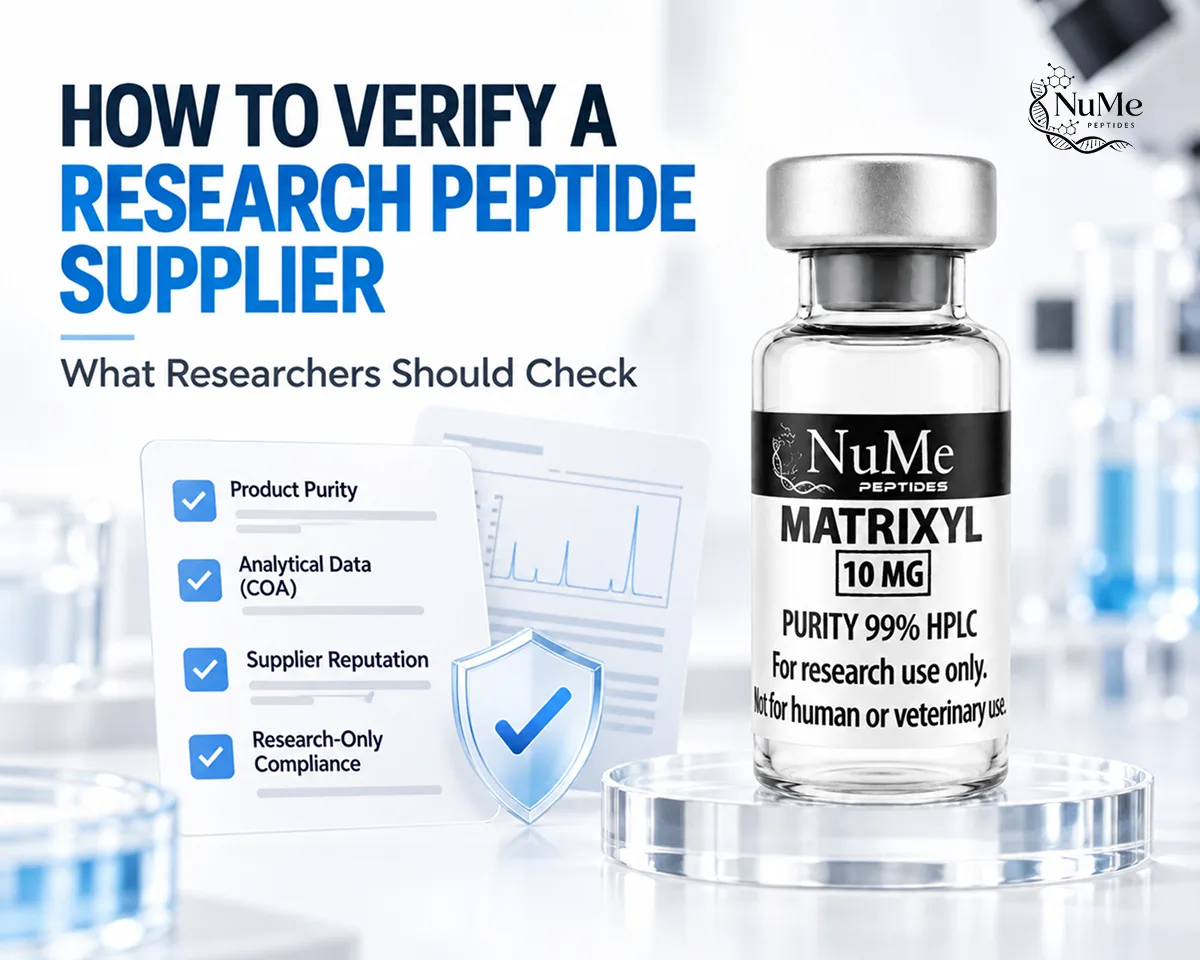
How to Verify a Research Peptide Supplier: What Researchers Should Check


Understanding how to verify a research peptide supplier requires more than comparing product names or headline purity percentages. Researchers need to determine whether the available documentation, analytical testing, batch information, and product claims provide enough evidence to evaluate the material for its intended scientific application.
A supplier may advertise high purity or provide a Certificate of Analysis, but those elements should still be examined critically. Useful verification involves connecting a specific product lot with appropriate testing, checking whether analytical methods are disclosed, reviewing whether results are internally consistent, and identifying documentation gaps that may require further clarification.
For laboratories in the United States, researchers should also distinguish legitimate research-focused information from claims that imply human therapeutic use. FDA enforcement actions have shown that simply displaying “research use only” language does not override other website content that establishes an intended drug use. (U.S. Food and Drug Administration, 2026)
Explore the NuMe Peptides US Shop to review research-focused peptide materials and supporting laboratory information for scientific investigation.
What Information Should Researchers Review Before Choosing a Supplier?
A useful supplier review begins with transparency.
Researchers should be able to identify what material is being offered, which analytical specifications apply, and whether the supporting information is connected to an identifiable production lot.
Useful information may include:
- peptide name and amino-acid sequence;
- expected molecular mass;
- stated purity;
- physical form;
- lot or batch number;
- storage recommendations;
- analytical methods used;
- Certificate of Analysis;
- HPLC chromatogram;
- mass-spectrometry data;
- date of testing.
The key issue is not simply whether these items appear somewhere on a website. Researchers should determine whether they are specific enough to evaluate the actual material being purchased.
For example, a generic statement such as “99% purity” provides less information than a lot-specific report showing the analytical method, measured result, batch number, and associated chromatogram.
Formal pharmaceutical quality guidance provides a useful model for understanding traceability, even though research materials do not automatically fall under the same regulatory framework. FDA’s ICH Q7 guidance states that laboratory records should identify the sample and batch, reference the testing method, retain raw analytical data such as graphs and spectra, and document actual results against established acceptance criteria. (U.S. Food and Drug Administration, 2001)
Researchers can apply the same general principle when reviewing peptide suppliers: quality claims become more informative when they are supported by identifiable, traceable analytical evidence.
Explore the NuMe Peptides US Shop to review research-focused peptide materials and supporting laboratory information for scientific investigation.
How Can Testing and Quality Documentation Be Evaluated?
Testing should be interpreted according to what each method can actually demonstrate.
For research peptides, two of the most common analytical techniques are HPLC and mass spectrometry.
HPLC can provide information about chromatographic composition. A dominant peak may indicate that the target material represents most of the detected signal under the stated method.
Mass spectrometry addresses a different question. It provides molecular-mass information that can help researchers determine whether the detected material is consistent with the expected peptide.
Guidance for peptides used in mass-spectrometry-based assays recommends evaluating suppliers according to available specification and characterization information. It also notes that purity can vary between suppliers and that laboratories may need to perform their own analysis when peptide quality is important to an assay. (Hoofnagle et al., 2016)
Researchers should therefore ask:
- Is the reported purity based on HPLC, UPLC, or another method?
- Is the actual chromatogram available?
- Was molecular identity assessed separately?
- Is mass-spectrometry information available?
- Are the analytical results linked to a specific batch?
- Are acceptance criteria distinguished from measured values?
A supplier stating “≥99% purity” is communicating a specification. A batch report showing “99.3% by HPLC” is reporting an observed analytical result.
Those statements are related, but they are not interchangeable.
Documentation becomes more useful when researchers can see both the specification and the actual measured value associated with the batch they are reviewing.
Why Are Batch and Lot Details Important for Supplier Verification?
Lot traceability connects analytical evidence to the physical material entering an experiment.
If a supplier provides one generic COA for every vial of the same peptide, researchers may not know whether that report represents the batch they actually received.
A more useful system assigns a distinctive lot or batch identifier to the product and displays that same identifier on the relevant analytical documentation.
FDA’s Q7 guidance emphasizes this principle in pharmaceutical manufacturing. Each batch should have a distinctive identifying number, while certificates should include the material name, batch number, test results, and applicable release information. (U.S. Food and Drug Administration, 2001)
FDA also notes that a Certificate of Analysis should identify the applicable batch or lot and list the tests performed, acceptance limits, and numerical results where appropriate. (U.S. Food and Drug Administration, 2022)
Although a research peptide supplier may operate under a different framework, lot-specific documentation still provides practical scientific value.
It allows researchers to:
- connect analytical results to the material used;
- compare one batch with another;
- investigate unexpected experimental outcomes;
- track changes in specifications;
- maintain better laboratory records.
Lot traceability becomes especially important when experiments extend over several months and researchers receive multiple shipments of the same peptide.
If results differ between experimental runs, knowing whether the material came from different lots can help identify one possible source of variation.
For that reason, batch information is an important part of understanding how to verify a research peptide supplier, rather than merely an administrative detail.
How Can Researchers Review Laboratory Test Results From a Supplier?
Analytical reports should be read as scientific data rather than treated simply as quality badges.
Review the HPLC Information
If a supplier reports chromatographic purity, researchers should look for the actual result and, where available, the corresponding chromatogram.
Useful details may include:
- principal peak;
- minor peaks;
- retention time;
- reported area percentage;
- detection wavelength;
- column information;
- mobile phase or gradient.
Method details matter because analytical conditions can influence how effectively peptide-related impurities are separated.
An independent quality evaluation of 98 synthetic research peptides illustrates this issue. All samples arrived with Certificates of Analysis stating at least 95% purity, yet independent testing found that only 43 of the 98 peptides met the requested purity specification under the investigators’ analytical method. The supplier and independent laboratory also used different chromatographic conditions. (Verbeke et al., 2018)
This does not mean every difference between supplier and independent testing indicates inaccurate documentation. It demonstrates why researchers should understand the analytical method behind the reported number.
Review Mass-Spectrometry Results Separately
A mass spectrum can support molecular identity when the measured mass agrees with the expected mass of the peptide.
However, a correct molecular mass should not be interpreted as proof of chromatographic purity.
Purity and identity answer different analytical questions.
A peptide sample could contain the intended molecule along with related impurities. Conversely, an HPLC chromatogram may show one dominant peak without independently establishing that the peak corresponds to the intended sequence.
Look for Complementary Evidence
Well-characterized peptide reference materials may require several analytical techniques rather than a single test.
Published work on synthetic peptide reference standards describes the use of chromatography, mass spectrometry, NMR, residual-solvent testing, quantitative content determination, moisture analysis, and stability studies to characterize different attributes of peptide materials. (McCarthy et al., 2023)
Routine research materials may not require this entire analytical package. However, the example demonstrates why one purity percentage cannot represent every aspect of peptide quality.
Researchers should focus on whether the available tests are appropriate for the scientific question they need to answer.
Which Documentation Gaps May Require Further Verification?
Missing information does not automatically mean that a supplier is unsuitable. However, several documentation gaps should encourage researchers to investigate further.
No Lot Number
Without a batch identifier, researchers cannot easily determine whether analytical results correspond to the actual material received.
A lot number also helps laboratories compare different shipments and investigate potential batch-to-batch variability.
Purity Percentage Without a Method
A statement such as “99% pure” is difficult to interpret if the analytical technique is not identified.
Researchers should ideally know whether the result was generated using HPLC, UPLC, or another method.
HPLC Result Without Identity Testing
A dominant chromatographic peak does not independently establish that the material is the expected peptide.
Mass spectrometry or another suitable identity method can provide complementary evidence.
Generic COAs Reused Across Lots
Analytical documentation becomes more useful when it is specific to the relevant material and batch.
FDA’s Q7 framework describes authentic COAs as batch-specific documents that contain tests performed, acceptance limits, and observed results. (U.S. Food and Drug Administration, 2001)
Missing Test Dates
Dates help researchers understand when testing occurred and whether the analytical information reasonably corresponds with the production or release timeline.
Inconsistent Molecular Information
Researchers should compare the product name, amino-acid sequence, stated molecular mass, and analytical results.
If these details do not correspond logically, additional verification may be needed before the material is used in an experiment.
Claims That Conflict With Research-Only Positioning
For U.S. suppliers, website messaging should also be reviewed for consistency with laboratory research positioning.
FDA enforcement actions provide clear examples of why this matters. In June 2026, FDA stated that products marketed as “RESEARCH USE ONLY” were nevertheless considered intended for human drug use because other website content and labeling established therapeutic intent. (U.S. Food and Drug Administration, 2026)
Similar warning letters issued in August 2026 addressed suppliers whose research-use disclaimers appeared alongside claims or materials that FDA considered evidence of human drug use. (U.S. Food and Drug Administration, 2026)
Researchers should therefore evaluate supplier documentation and website positioning as a complete system rather than relying on a single disclaimer.
Read more about Research Peptide Quality to see how testing, purity, identity, and documentation work together.
FAQs About How to Verify a Research Peptide Supplier
What should researchers check first when reviewing a peptide supplier?
Start with product identification, lot information, reported purity, analytical methods, COA availability, HPLC data, mass-spectrometry results, test dates, and storage information. The key question is whether those records can be connected to the actual material being supplied.
Does a Certificate of Analysis prove peptide quality?
Not by itself. A COA reports specific analytical results, but researchers should examine whether it is lot-specific, which methods were used, and whether those measurements address the requirements of the experiment.
Why is a batch number important?
A batch number links analytical documentation to the physical material received. It also allows researchers to compare production lots and investigate potential lot-related variation.
Should suppliers provide HPLC and mass-spectrometry data?
Both can be valuable because they answer different questions. HPLC provides information about chromatographic composition, while mass spectrometry can support molecular identity. Guidance for peptide analytical standards recommends reviewing both chromatographic and mass-spectrometry characterization when appropriate. (Hoofnagle et al., 2016)
Is a 99% purity claim enough to choose a supplier?
No. Researchers should determine how that percentage was measured, whether the result is lot-specific, whether molecular identity was independently assessed, and whether supporting analytical documentation is available.
Can researchers independently verify supplier results?
Yes. Independent or in-house testing may be appropriate when experimental requirements justify additional confirmation. FDA’s Q7 framework similarly notes that supplier COA reliability should be evaluated and periodically checked within regulated pharmaceutical supply chains. (U.S. Food and Drug Administration, 2001)
Building a Stronger Supplier Verification Process
Understanding how to verify a research peptide supplier ultimately means connecting supplier claims with verifiable evidence.
A high purity percentage can be useful, but researchers should ask how that number was generated. A COA can improve transparency, but its value increases when it is linked to the specific batch being used. HPLC can provide information about chromatographic composition, while mass spectrometry can offer complementary evidence about molecular identity.
Researchers should also look for consistency across the documentation.
Product name, sequence, molecular mass, batch number, analytical reports, test dates, and storage information should correspond logically with one another.
When information is incomplete, laboratories can identify which missing details are relevant to the experiment and request clarification rather than relying on assumptions.
Independent testing may also be appropriate in higher-control research environments. Published evidence shows that supplier COA results and independent analytical measurements do not always agree, reinforcing the importance of method transparency and appropriate quality control when peptide characteristics are critical to a study. (Verbeke et al., 2018)
A strong supplier assessment therefore does not depend on one label, percentage, or certificate. It combines traceability, analytical evidence, documentation quality, consistency, and the specific requirements of the scientific work being performed.
Explore the NuMe Peptides US Shop to review research-focused peptide materials and supporting analytical documentation for laboratory studies.
Disclaimer: This content is provided for scientific and educational purposes only. Research peptides discussed here are presented in a laboratory research context and are not described as products for human consumption, diagnosis, treatment, cure, or prevention of disease.