

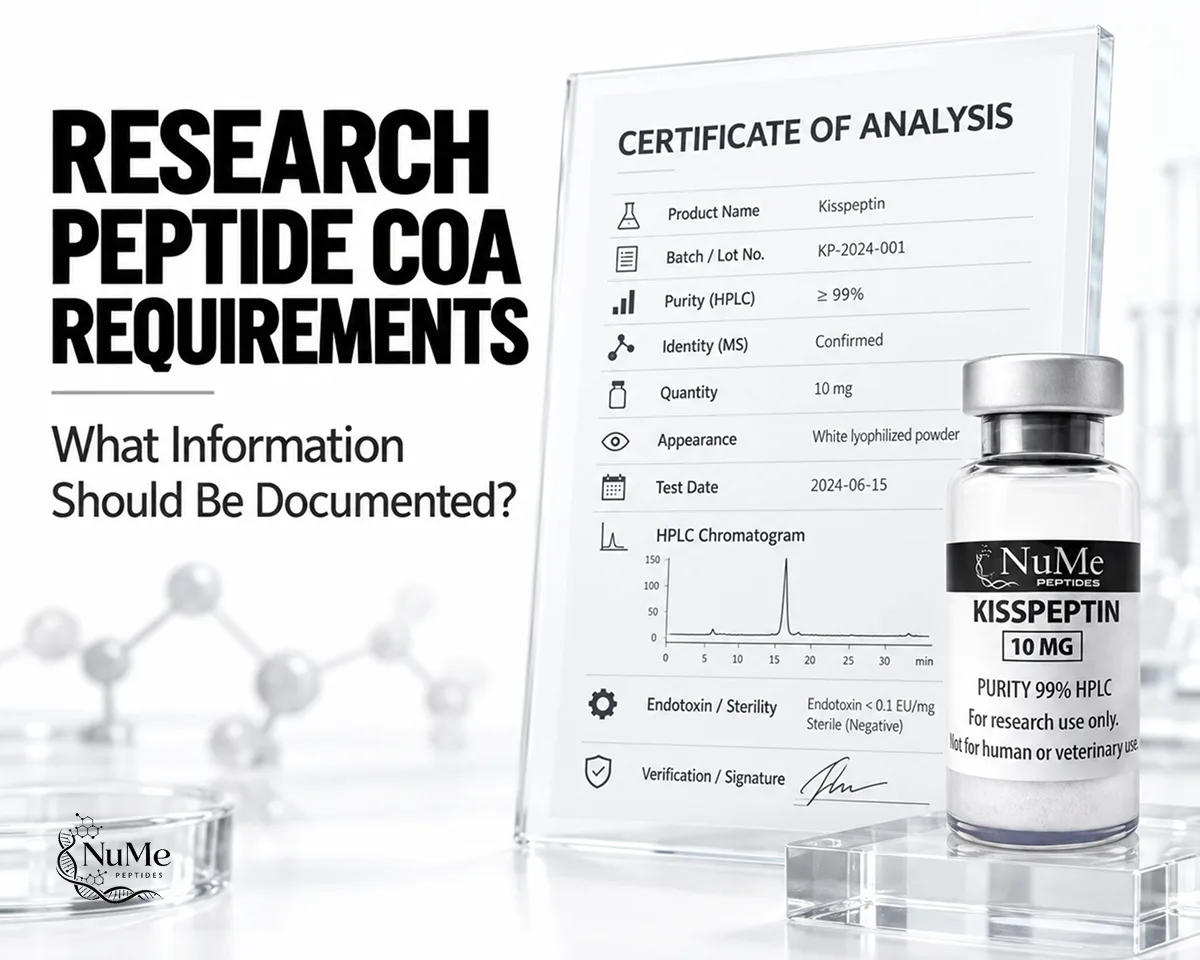
Research Peptide COA Requirements: What Information Should Be Documented?


A Certificate of Analysis can help researchers determine whether a peptide sample is supported by traceable analytical information. However, the value of a COA depends on more than its existence. Researchers need to know what product was tested, which batch the results apply to, which analytical methods were used, and whether the reported measurements address the characteristics relevant to the experiment.
Unlike a simple product specification, a useful COA connects a defined sample with actual test results. This distinction becomes especially important when peptide purity, molecular identity, or lot-to-lot consistency could influence laboratory findings.
There is no single universal U.S. regulatory template specifically establishing mandatory research peptide COA requirements for all materials sold solely for laboratory research. Nevertheless, established pharmaceutical quality guidance and published peptide-characterization research provide useful principles for evaluating whether a certificate contains meaningful and traceable information.
Explore the NuMe Peptides US Shop to review research-focused peptide materials and supporting laboratory documentation.
What Product Information Should a Research Peptide COA Include?
A useful COA should begin by clearly identifying the material that was analyzed.
At a minimum, researchers should be able to connect the document with a defined peptide and production lot. Information may include:
- peptide or product name;
- amino-acid sequence;
- lot or batch number;
- molecular formula where applicable;
- theoretical molecular mass;
- physical form;
- quantity or concentration where relevant;
- salt or counterion form, if specified;
- storage conditions.
Product identification matters because peptide names alone may not fully describe a sample. Modified sequences, different salt forms, or closely related variants can sometimes share similar naming conventions.
Batch identification is particularly important. FDA’s ICH Q7 guidance for active pharmaceutical ingredients states that authentic Certificates of Analysis should identify the material, include its batch number, and provide relevant release, retest, or expiration information. Although research peptides do not automatically fall under this pharmaceutical framework, the guidance offers a useful model for traceable laboratory documentation. (U.S. Food and Drug Administration, 2001)
The product label and COA should also correspond logically.
If a vial carries one lot number while its certificate lists another, researchers cannot confidently assume that the analytical results describe the material in hand. Similarly, molecular mass, sequence, and product designation should not conflict with one another.
Clear sample identification is therefore the foundation of a useful certificate. Without it, even detailed analytical results may have limited value because researchers cannot reliably connect the data to the material used in an experiment.
Which Analytical Tests Should Be Documented on a COA?
The appropriate tests depend on the peptide and intended research application, but several analytical methods are commonly relevant.
HPLC or UPLC Analysis
Chromatographic analysis is frequently used to evaluate relative peptide purity.
A COA may report a result such as:
Purity by HPLC: 99.1%
Ideally, the certificate or associated documentation should make clear which method generated that number. A chromatogram can provide additional context by showing the principal peak and detectable minor components.
Published recommendations for peptides used in mass-spectrometry assays advise obtaining HPLC-UV chromatograms for purified peptide materials. The authors also warn that overly steep gradients can mask contaminants through co-elution, illustrating why the method behind a purity result matters. (Hoofnagle et al., 2016)
Mass Spectrometry
Mass spectrometry is commonly used to support peptide identity.
The measured molecular mass can be compared with the theoretical value calculated from the intended amino-acid sequence. More detailed workflows may use MS/MS to provide additional sequence-related information.
The same analytical recommendations advise that purified peptide characterization include MS data and, preferably, MS/MS information where appropriate. (Hoofnagle et al., 2016)
Other Tests
Depending on the material and research purpose, documentation may also include:
- peptide content;
- water or moisture;
- residual solvents;
- counterion content;
- appearance;
- solubility;
- stability-related results;
- additional impurity characterization.
USP work on synthetic peptide reference standards demonstrates why multiple techniques may be needed when highly characterized material is required. Researchers used mass spectrometry, chromatography, moisture measurements, residual-solvent testing, and other procedures to evaluate different quality attributes rather than relying on one assay. (McCarthy et al., 2023)
This does not mean every research-use COA must contain the full analytical package used for a pharmaceutical reference standard. Instead, the documentation should be sufficient for the scientific purpose of the material.
How Should Peptide Purity and Identity Results Be Reported?
Purity and identity should be treated as separate analytical characteristics.
A chromatographic purity result answers a question such as:
How much of the detected chromatographic signal corresponds to the principal component?
An identity result addresses a different question:
Is that principal component consistent with the intended peptide?
For purity, a useful COA should ideally indicate:
- analytical technique;
- specification or acceptance criterion;
- actual measured value;
- corresponding chromatogram when available.
For example:
| Test | Specification | Result |
|---|---|---|
| HPLC Purity | ≥98.0% | 99.2% |
This distinction between specification and result is important. “≥98%” describes what the sample is expected to meet. “99.2%” reports what was actually measured.
FDA’s ICH Q7 guidance follows the same documentation principle: certificates should list the tests performed, acceptance limits, and numerical results when tests generate numerical values. (U.S. Food and Drug Administration, 2001)
For identity, the certificate may report theoretical and observed molecular mass.
A close match can support the conclusion that the analyzed material is consistent with the expected peptide. However, mass alone may not distinguish every structurally related species.
Researchers should also avoid assuming that HPLC purity equals total peptide content by weight.
USP peptide-reference-standard research shows that water, counterions, residual solvents, inorganic residues, and peptide-related impurities may need separate evaluation when determining actual material composition. (McCarthy et al., 2023)
For this reason, clear research peptide COA requirements should distinguish what each analytical number represents instead of combining all measurements under a generic “quality” label.
Visit the NuMe Peptides US Shop to explore available research peptides and laboratory-focused products for scientific study.
Why Are Batch Numbers, Dates and Sample Details Important?
Analytical results have limited value if researchers cannot determine which material they describe.
A batch or lot number provides the connection between a physical sample and its supporting documentation.
FDA’s Q7 guidance states that each batch should receive a distinctive identifying number and that certificates should report the applicable batch number. The same framework also calls for dates and authorized quality information to support traceability. (U.S. Food and Drug Administration, 2001)
For research laboratories, lot traceability offers several practical benefits.
It allows researchers to:
- confirm that analytical data correspond to the sample received;
- compare results across production lots;
- investigate unexpected experimental changes;
- document materials in laboratory records;
- identify whether different experiments used different batches.
Testing dates can also provide useful context.
A certificate may include a manufacturing date, test date, release date, retest date, or other time-related information. Researchers can use these details alongside storage documentation to understand when the sample was characterized.
Sample details matter for another reason: peptide preparations can vary in physical form and composition.
A lyophilized sample may contain counterions and residual moisture, while a solution introduces variables such as solvent composition and concentration. Documentation should therefore make clear what type of material was actually tested.
Lot-specific records become especially valuable when a project continues across several shipments. Without batch information, researchers may unknowingly combine analytical results from different production runs.
Thus, traceability is not merely administrative. It supports reproducibility.
How Can Researchers Assess Whether a COA Is Complete?
A complete COA does not necessarily need to be long. It needs to provide enough information to understand what was tested, how it was tested, and which sample the results represent.
Researchers can review several categories.
1. Sample Identification
Does the certificate clearly identify:
- product name;
- sequence or relevant molecular description;
- batch number;
- theoretical molecular mass?
2. Analytical Methods
Are the reported results connected to recognizable methods such as HPLC or MS?
A percentage without an identified method is difficult to interpret scientifically.
3. Measured Results
Does the document provide actual results rather than only specifications?
For example:
Better: HPLC purity: 99.3%
Less informative: Purity specification: ≥98%
The first reports a measurement; the second only states an acceptance threshold.
4. Identity Evidence
If the COA reports peptide identity, does it show what analytical approach supported that conclusion?
Mass spectrometry can provide useful evidence, while more detailed peptide characterization may require additional techniques depending on the application.
5. Lot Traceability
Does the lot number on the certificate match the material being used?
6. Dates
Does the certificate identify when testing or release occurred?
7. Internal Consistency
Do molecular weight, sequence, analytical results, and sample details agree with one another?
Researchers should also remember that a professionally formatted COA does not prove that every result is correct.
An independent study of 98 synthetic research peptides found substantial differences between supplier COA purity claims and the investigators’ own quality-control testing. All samples reportedly arrived with certificates stating at least 95% purity, but only 43 of 98 met that specification under the researchers’ analytical workflow. (Verbeke et al., 2018)
The researchers also observed differences caused partly by chromatographic methodology, reinforcing the importance of reviewing how purity was measured rather than relying only on the reported percentage.
FDA’s Q7 guidance follows a similar principle in regulated supplier qualification: the reliability of supplier Certificates of Analysis should be evaluated and checked at appropriate intervals rather than accepted indefinitely without verification. (U.S. Food and Drug Administration, 2001)
A COA should therefore be treated as analytical evidence to review, not merely as a badge attached to a product.
Read more about Research Peptide Quality to see how testing, purity, identity, and documentation work together.
FAQs About Research Peptide COA Requirements
What information should a peptide COA include?
Useful information generally includes product identification, lot number, analytical tests, acceptance criteria, actual results, molecular-mass data where applicable, test dates, and relevant storage or sample information.
Should every COA include a batch number?
Lot or batch identification is highly valuable because it links the analytical results with the physical material being supplied. Without it, traceability becomes much weaker.
Should HPLC purity be reported as an actual number?
Ideally, yes. Researchers gain more information from an actual measured result than from a specification alone. The method used to generate the percentage should also be identifiable.
Does an HPLC purity result confirm peptide identity?
No. Chromatographic purity and molecular identity are separate attributes. Mass spectrometry can provide complementary evidence regarding molecular mass and identity. (Hoofnagle et al., 2016)
Does a COA confirm total peptide content?
Not unless peptide content was specifically measured. HPLC area purity does not automatically represent total peptide content because other components such as water, counterions, or residual materials may contribute to sample mass. (McCarthy et al., 2023)
Is a supplier COA enough for every research application?
Not necessarily. The level of verification should reflect the experiment. Some projects may require independent or in-house analytical confirmation when sample characteristics could materially affect results.
Building Better COA Documentation for Research Peptides
Useful research peptide COA requirements center on traceability, analytical clarity, and appropriate reporting.
A strong certificate should identify the peptide and its lot, show what analytical tests were performed, distinguish acceptance criteria from measured results, and provide enough methodological context for researchers to understand what each value represents.
Purity and identity should remain separate.
HPLC can describe chromatographic composition, while mass spectrometry can support molecular identity. Other tests may be required when researchers need information about actual peptide content, moisture, residual solvents, counterions, or stability.
The certificate should also connect directly to the material being used. Batch numbers, test dates, sample details, and internally consistent product information make the analytical record more meaningful.
Most importantly, researchers should evaluate a COA rather than simply confirm that one exists.
A well-designed certificate helps answer what was tested and what the laboratory observed. It should not be interpreted as proof of characteristics that were never measured.
Explore the NuMe Peptides US Shop to review research-focused peptide materials and supporting laboratory documentation.
Disclaimer: This content is provided for scientific and educational purposes only. Research peptides discussed here are presented in a laboratory research context and are not described as products for human consumption, diagnosis, treatment, cure, or prevention of disease.