

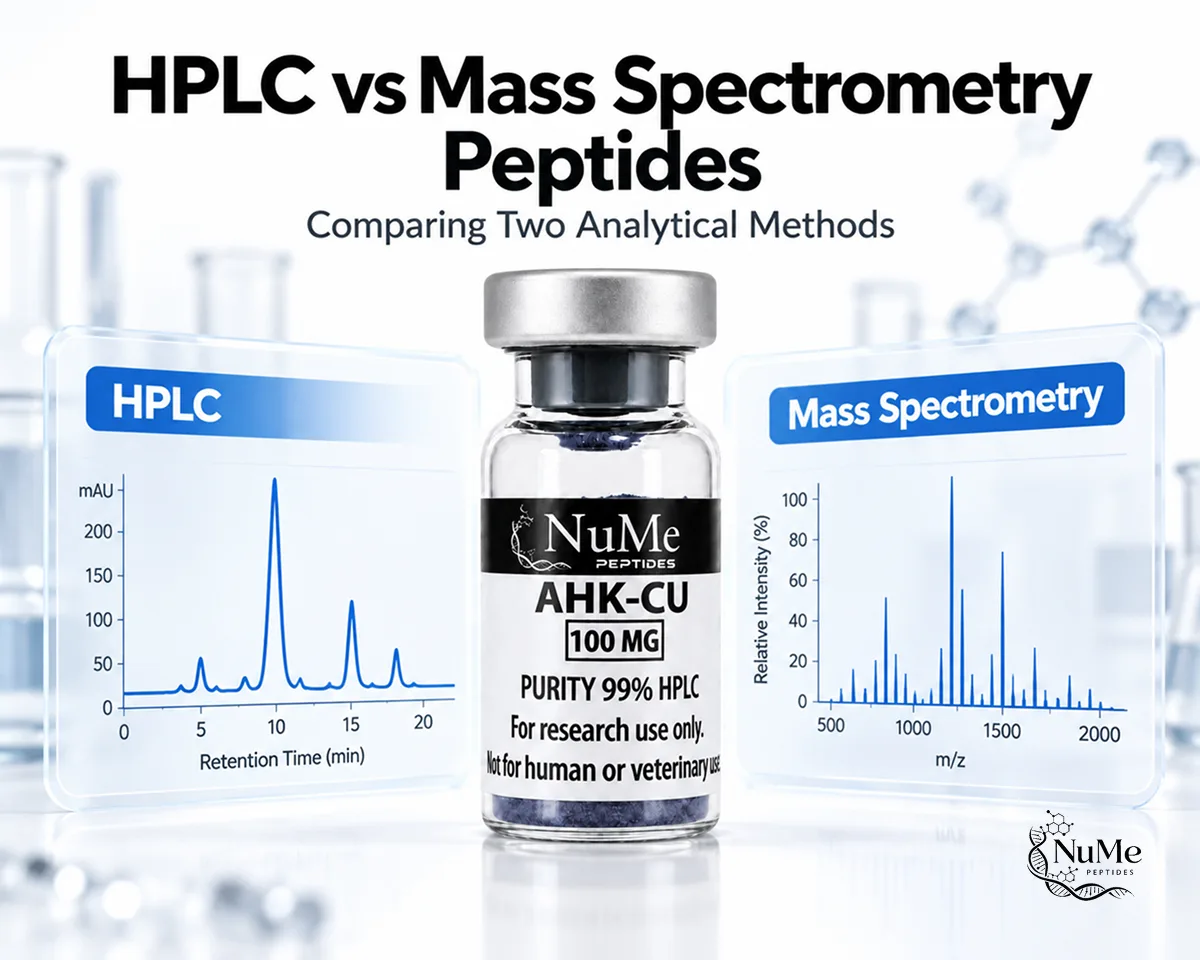
HPLC vs Mass Spectrometry Peptides: Comparing Two Analytical Methods


Peptide analysis rarely depends on a single measurement. Researchers often need to answer several separate questions: Is the target peptide the dominant component in the sample? Does its molecular mass match the expected sequence? Are related impurities present? Can those impurities be separated and identified?
This is where high-performance liquid chromatography and mass spectrometry play complementary roles. HPLC primarily separates components within a sample and can provide information about chromatographic composition. Mass spectrometry, by contrast, examines ions according to their mass-to-charge ratios and can provide evidence about molecular identity and related molecular species.
Understanding HPLC vs mass spectrometry peptides analysis therefore means recognizing that the two techniques do not simply compete with one another. They address different analytical questions, and combining them can provide considerably more information than either technique alone.
Explore the NuMe Peptides US Shop to review research-focused peptide materials and supporting analytical information for laboratory investigation.
How Do HPLC and Mass Spectrometry Analyze Peptides Differently?
The fundamental difference between the two techniques lies in what they measure.
HPLC is primarily a separation method.
A peptide sample is introduced into a liquid mobile phase and passed through a chromatographic column. Different molecules interact with the column material to different degrees, causing them to travel through the system at different rates. The resulting chromatogram displays peaks corresponding to components detected as they leave the column.
Reversed-phase liquid chromatography is particularly common for peptide analysis because differences in hydrophobic behavior can be used to separate peptide species. Column chemistry, gradient design, flow rate, temperature, and mobile-phase composition can all influence retention and resolution. (Lenčo et al., 2022)
Mass spectrometry works differently.
Instead of separating compounds primarily according to chromatographic interaction, MS converts molecules into ions and measures those ions according to their mass-to-charge ratio, or m/z. For synthetic peptides, researchers can compare measured molecular information with values predicted from the known amino-acid sequence.
Modern MS methods are particularly useful for evaluating the authenticity and integrity of synthetic peptides. Techniques including LC-MS and MALDI-TOF-MS can support identity assessment and reveal additional peptide-related molecular species. (Chrone et al., 2024)
A simplified comparison looks like this:
| Analytical Question | HPLC | Mass Spectrometry |
|---|---|---|
| Can components be separated? | Strong capability | Usually paired with LC when separation is needed |
| Can relative chromatographic purity be estimated? | Yes | Not its primary standalone role |
| Can molecular mass be measured? | No | Yes |
| Can peptide identity be supported? | Limited by retention behavior | Yes, through mass and potentially MS/MS |
| Can impurities be investigated? | Detects separated impurity peaks | Can provide molecular information about impurities |
| Can co-eluting species be distinguished? | Sometimes difficult | LC-MS can often provide additional information |
This difference is central when comparing HPLC vs mass spectrometry peptides analysis: separation and molecular identification are related, but they are not the same analytical task.
Visit the NuMe Peptides US Shop to explore available research peptides and laboratory-focused products for scientific study.
What Can HPLC Reveal About a Peptide Sample?
HPLC provides a visual representation of how detectable sample components behave under a defined chromatographic method.
A typical chromatogram plots detector response against retention time. When a component leaves the column, it generates a peak.
For research peptides, laboratories often examine three important features.
Retention Time
Retention time indicates how long a component takes to travel through the chromatographic system.
Under controlled analytical conditions, the target peptide may show reproducible retention behavior. However, matching retention time alone does not conclusively establish molecular identity because different compounds may behave similarly under the same conditions.
Peak Area
Peak area represents the integrated detector response associated with a chromatographic component.
Researchers commonly estimate purity by comparing the area of the principal peak with the total integrated area of relevant detected peaks.
For example, if the primary peak represents 99% of the integrated signal, the material may be reported as approximately 99% pure by that HPLC method.
This value represents chromatographic area purity, not necessarily 99% peptide by total sample mass.
Impurity Peaks
Additional peaks may indicate peptide-related impurities, degradation products, or other detectable components.
This is one reason HPLC is valuable for both purification and analytical quality assessment. Peptides varying considerably in source, quantity, and complexity can be separated using reversed-phase, ion-exchange, size-exclusion, or other chromatographic modes. (Mant et al., 2007)
However, the quality of this information depends on resolution.
Structurally similar peptide impurities may elute near the target molecule. If two components overlap substantially, a conventional chromatogram may display them as one apparent peak.
Research into peptide peak purity has highlighted this challenge, especially when impurities involve substitutions, chain cleavage, or stereochemical variants that behave similarly during reversed-phase separation. (Stoll et al., 2023)
Therefore, HPLC provides strong information about how components separate, but additional analytical evidence may be needed to establish what those components actually are.
How Can Mass Spectrometry Help Confirm Peptide Identity?
Mass spectrometry addresses an important limitation of chromatography: molecular identity.
For a synthetic peptide, researchers generally know the intended amino-acid sequence before testing begins. That sequence can be used to calculate an expected molecular mass.
During MS analysis, the peptide is ionized and detected according to m/z. Depending on the ionization technique, the same peptide may appear in multiple charge states. Software can then deconvolute those signals to estimate the molecular mass of the original molecule.
If the measured value agrees closely with the expected mass, the result provides evidence supporting peptide identity.
This is one reason MS is widely used for synthetic peptide characterization. Current methodological guidance emphasizes that because the intended sequence is already known, analysis can focus on verifying authenticity and molecular integrity. (Chrone et al., 2024)
More detailed analysis can use tandem mass spectrometry, or MS/MS.
In MS/MS, a selected peptide ion is fragmented. Researchers then analyze the resulting fragment ions to obtain additional sequence-related information.
Mass differences can also help identify certain modifications.
For example, oxidation, deletion of an amino acid, truncation, or other chemical changes can produce characteristic shifts in measured molecular mass. High-resolution instruments can detect relatively small mass differences and help researchers investigate related molecular species.
Still, mass alone does not solve every identity question.
Structural or stereochemical isomers can have identical or extremely similar molecular masses. Enantiomeric peptide impurities are particularly challenging because D- and L-isomeric forms can share many physicochemical characteristics while differing in stereochemical configuration. (Badgujar et al., 2024)
Therefore, MS provides powerful identity evidence, but its results remain strongest when interpreted alongside chromatographic separation and other analytical data.
Why Are HPLC and Mass Spectrometry Often Used Together?
The limitations of one technique frequently correspond to the strengths of the other.
HPLC can separate components effectively, but a peak does not inherently reveal molecular mass.
Mass spectrometry can provide detailed molecular information, but complex samples often benefit from chromatographic separation before ions enter the mass spectrometer.
Combining them creates LC-MS.
In an LC-MS workflow, liquid chromatography first separates the sample. Components then enter the mass spectrometer, where molecular information can be collected for individual chromatographic regions.
This approach can help researchers answer multiple questions within one analytical workflow:
- When does a component elute?
- What molecular mass is associated with it?
- Are multiple ions present beneath one chromatographic feature?
- Do minor peaks correspond to peptide-related impurities?
- Does the dominant component match the expected peptide mass?
LC-MS has become especially important for detailed peptide impurity characterization.
A review of synthetic peptide therapeutics describes how LC-MS can identify process-related modifications, structural isomers, stereoisomers, and degradation products associated with starting materials, manufacturing, or storage. (Lian et al., 2021)
FDA research provides a practical illustration.
A data-dependent LC-MS/MS approach applied to calcitonin products identified more than 120 peptide impurities. Analysts evaluated monoisotopic mass, charge states, extracted-ion chromatograms, and mass spectra to characterize the related species. (U.S. Food and Drug Administration, 2026)
FDA has also reported that UPLC coupled with high-resolution mass spectrometry can provide greater resolution for peptide-related impurity analysis than conventional HPLC-UV in certain applications. (U.S. Food and Drug Administration, 2020)
This illustrates why the comparison should not be framed simply as one method being better. In many analytical settings, chromatography and MS are most useful when they work together.
Which Method Addresses Different Research and Quality Questions?
Choosing an analytical method should begin with the research question.
If the main goal is to determine whether a sample contains one dominant chromatographic component, HPLC may provide the most directly relevant information.
If the goal is to determine whether the detected molecule has the expected molecular mass, MS is more appropriate.
If the experiment requires both separation and molecular characterization, LC-MS may be more informative.
Question 1: What Is the Chromatographic Purity?
HPLC is generally the primary tool.
The chromatogram can show the relative distribution of detectable peaks and provide an area-based purity estimate.
Question 2: Is the Main Component the Expected Peptide?
Mass spectrometry provides stronger evidence.
Measured molecular mass can be compared with the theoretical value calculated from the expected amino-acid sequence.
Question 3: What Are the Minor Peaks?
HPLC may show that additional components exist, but MS can provide molecular information that helps investigate what those components may represent.
Question 4: Could an Impurity Be Hidden Under the Main Peak?
This question demonstrates the value of combined methods.
FDA guidance for certain synthetic peptide drug products recommends sensitive high-resolution methods such as UHPLC-HRMS for detecting and characterizing peptide-related impurities because these related species can be difficult to identify and quantify. (U.S. Food and Drug Administration, 2021)
Question 5: Does Either Method Establish Complete Quality?
No.
Neither HPLC nor MS independently establishes every characteristic researchers may need to evaluate.
For example:
| Quality Attribute | HPLC | MS |
|---|---|---|
| Chromatographic purity | Strong | Complementary |
| Molecular mass | No | Strong |
| Identity confirmation | Limited | Strong supporting evidence |
| Impurity separation | Strong when resolution is adequate | Improved when combined with LC |
| Structural impurity information | Limited | Stronger |
| Moisture content | No | No |
| Residual solvents | Not usually | Not usually |
| Sterility | No | No |
| Endotoxin | No | No |
| Peptide content by total weight | Not automatically | Not automatically |
Therefore, researchers comparing HPLC vs mass spectrometry peptides should focus on which analytical question each technique answers rather than looking for one universal “best” method.
Read more about Research Peptide Quality to see how testing, purity, identity, and documentation work together.
FAQs About HPLC vs Mass Spectrometry for Peptides
What is the main difference between HPLC and mass spectrometry?
HPLC primarily separates components according to their chromatographic behavior, while mass spectrometry measures ions according to mass-to-charge ratio and can provide molecular information.
Can HPLC confirm peptide identity?
Not by itself. Retention time can support comparison under controlled conditions, but a chromatographic peak does not independently prove molecular identity.
Can mass spectrometry measure peptide purity?
MS can detect and characterize related molecular species, but conventional chromatographic area purity is generally evaluated using a separation method such as HPLC. LC-MS can combine both types of information.
Why are HPLC and MS often combined?
Chromatography separates components before MS provides molecular information. This helps researchers connect individual chromatographic features with specific molecular species. (Lian et al., 2021)
Does a correct molecular mass prove that a peptide is pure?
No. A sample may contain the intended peptide along with impurities. Identity and purity are separate analytical characteristics.
Does a 99% HPLC result prove peptide identity?
No. It indicates that the principal peak represents approximately 99% of the relevant integrated chromatographic signal under that method. Additional evidence, such as mass spectrometry, can support identity.
Understanding HPLC and Mass Spectrometry as Complementary Tools
The comparison of HPLC vs mass spectrometry peptides is most useful when each method is connected to the question it is designed to answer.
HPLC excels at separation. It can show whether a sample contains one dominant chromatographic component, reveal detectable minor peaks, and provide an area-based purity estimate.
Mass spectrometry adds molecular information. It can compare measured molecular mass with theoretical values, investigate modifications, and provide sequence-related evidence through MS/MS.
Neither method replaces the other.
A clean chromatogram does not independently establish molecular identity, while a matching molecular mass does not demonstrate that the entire sample is chromatographically pure.
Combining liquid chromatography with mass spectrometry helps bridge this gap by linking separation behavior with molecular evidence. That makes LC-MS particularly valuable when laboratories need to investigate related impurities or complex peptide samples.
Ultimately, stronger peptide characterization comes from choosing analytical techniques according to the scientific question rather than expecting one measurement to answer every aspect of quality.
Explore the NuMe Peptides US Shop to review research-focused peptide materials and supporting analytical information for scientific studies.
Disclaimer: This content is provided for scientific and educational purposes only. Research peptides discussed here are presented in a laboratory research context and are not described as products for human consumption, diagnosis, treatment, cure, or prevention of disease.