

Somatostatin Growth Hormone Research: Regulatory Pathways and Current Evidence


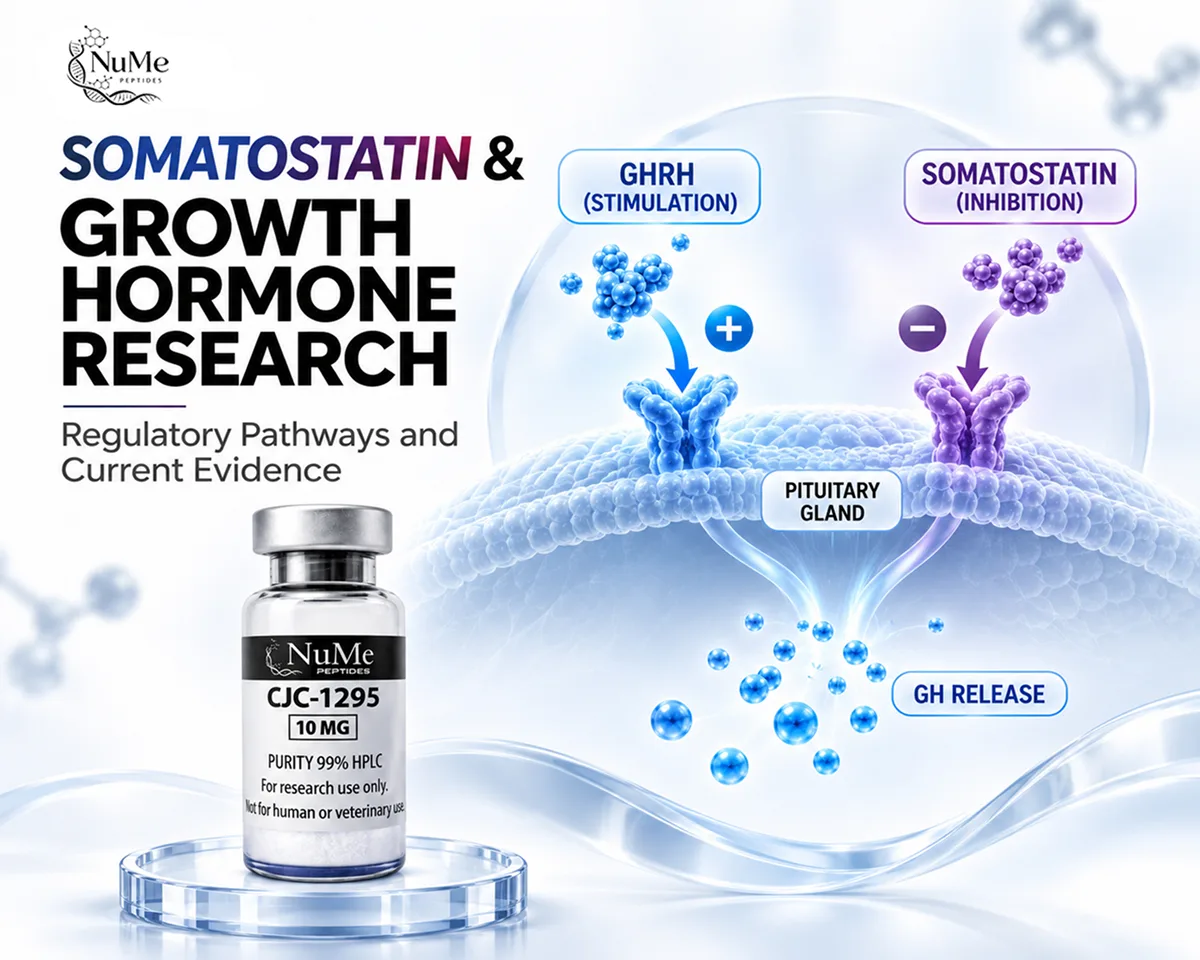
Growth hormone (GH) secretion is governed by a dynamic balance between stimulatory and inhibitory signals rather than by a continuously active pituitary system. Growth hormone-releasing hormone (GHRH) stimulates pituitary somatotrophs, while somatostatin provides an important inhibitory signal that helps control the timing and magnitude of GH release.
Modern somatostatin growth hormone research therefore focuses heavily on pulsatility. Researchers investigate how somatostatin tone changes between secretory bursts, how it interacts with GHRH and ghrelin-related signaling, and how experimental secretagogues modify this regulatory balance.
Ipamorelin, GHRP-6, and CJC-1295 are useful research examples because they influence different upstream components of the GH axis. GHRP-6 and Ipamorelin act through growth hormone secretagogue pathways, whereas CJC-1295 is a long-acting GHRH analogue. None should be interpreted simply as “overriding” somatostatin under every experimental condition.
Explore the NuMe Peptides US Shop for research-focused compounds associated with growth hormone secretion, endocrine signaling, and laboratory investigation.
What Is Somatostatin’s Role in Growth Hormone Regulation?
Somatostatin, historically called somatotropin-release inhibitory factor, is a peptide hormone and neuropeptide with powerful inhibitory effects on endocrine secretion.
Within the GH axis, hypothalamic somatostatin reaches anterior pituitary somatotrophs through the hypophyseal portal circulation and reduces GH release.
Its actions are mediated through five G protein-coupled somatostatin receptor subtypes, designated SST1 through SST5. These receptors share several signaling characteristics but differ in tissue distribution, regulation, and physiological function. SST2 and SST5 are particularly relevant in pituitary biology. (Günther et al., 2018)
Somatostatin should not be viewed simply as an “off switch.”
GH secretion is strongly pulsatile. Classical human studies indicate that changing somatostatin tone contributes to when GH secretory bursts occur and how strongly pituitary somatotrophs respond to stimulatory GHRH signals.
A modern neuroendocrine view similarly describes GH pulsatility as the result of interacting excitatory and inhibitory signals. GHRH neurons stimulate GH release, while somatostatin inhibits both pituitary secretion and aspects of GHRH neuronal activity. GH and IGF-1 then contribute additional feedback regulation. (The Gatekeepers of Growth, 2025)
This helps explain why GH concentrations can remain low for extended periods before rising rapidly during a secretory pulse.
Explore research compounds studied in tissue repair and regeneration through our Healing & Recovery collection.
How Does Somatostatin Influence Growth Hormone Signaling?
Somatostatin primarily influences the GH system by regulating hormone secretion upstream of peripheral growth hormone receptor signaling.
When somatostatin receptors on pituitary somatotrophs are activated, inhibitory G-protein signaling reduces processes involved in GH secretion. This can lower the pituitary response to GHRH and other stimulatory inputs.
Human experiments have demonstrated this effect directly.
When researchers altered somatostatin tone while administering GHRH, increased somatostatin exposure reduced GH responses to the releasing hormone. Conversely, experimental conditions that lowered effective somatostatin tone could increase the GH response to GHRH. (The Effect of Changing Somatostatin Tone, 1992)
Somatostatin also contributes to pulsatility.
Early physiological models proposed that GH pulses emerge when GHRH stimulation increases while somatostatin inhibition falls. Later research suggests that regulation is more complex, involving additional hypothalamic, metabolic, and pituitary signals.
Nevertheless, somatostatin remains a major component of pulse timing.
A review of normal GH control concluded that GHRH is important for initiating GH pulses while somatostatin modifies their amplitude and timing.
GH itself can participate in this feedback loop.
After a GH burst, central GH signaling can stimulate somatostatinergic activity and reduce GHRH output. IGF-1 provides a slower additional feedback signal. These interactions help prevent continuous GH secretion and support a pulsatile endocrine pattern. (Veldhuis et al., 2001)
Thus, the biological significance of somatostatin lies not only in suppressing total GH output but also in shaping when GH is released.
How Do Researchers Study Somatostatin Within the Growth Hormone Axis?
Researchers study somatostatin using several complementary experimental approaches.
Frequent GH Sampling
Because GH secretion is pulsatile, a single blood measurement provides limited information.
Researchers may collect blood every 10–20 minutes over many hours and use mathematical analysis to estimate:
- pulse frequency;
- pulse amplitude;
- basal GH secretion;
- secretory burst mass;
- total GH output.
This approach helped establish the importance of somatostatin in controlling the timing of GH secretory episodes. (Thorner et al., 1990)
GHRH Stimulation Models
Researchers can administer GHRH while experimentally changing somatostatin tone.
If the same GHRH stimulus produces different GH responses under different conditions, investigators can infer how inhibitory tone changes pituitary responsiveness.
Somatostatin Analogues
Longer-acting somatostatin analogues can be used experimentally to increase inhibitory signaling.
In an animal study, central administration of a long-acting somatostatin analogue blocked the GH response produced by centrally administered GHRP-6. The findings suggested that somatostatin can oppose secretagogue activity at hypothalamic as well as pituitary levels. (Dickson et al., 1995)
GHRH Antagonists
Researchers can also block GHRH signaling to determine how much a secretagogue depends on endogenous GHRH.
A human study found that a GHRH antagonist eliminated most of the GH response to GHRP-6, demonstrating that endogenous GHRH contributes substantially to maximal GHRP-6-induced GH secretion. (Popovic et al., 1998)
These models show that the GH axis is best studied as an interacting regulatory network rather than as isolated stimulatory and inhibitory pathways.
What Is the Relationship Between Growth Hormone-Releasing Signals and Somatostatin?
GHRH and somatostatin were historically viewed as opposing signals: one stimulates GH and the other inhibits it.
That framework remains useful, but experimental evidence shows a more complex interaction.
GHRH stimulates pituitary somatotrophs, increasing GH synthesis and secretion. Somatostatin reduces somatotroph responsiveness and contributes to the intervals between GH pulses.
A recent review of hypothalamic GHRH describes GHRH as a principal regulator of pulsatile GH secretion that is counterbalanced by somatostatin, GH, IGF-1, and other physiological signals.
GH secretagogues add another regulatory layer.
GHRP-6 does not simply mimic GHRH. Human experiments found that combined GHRH and GHRP-6 can produce much stronger GH responses than either compound alone, indicating complementary mechanisms. (Peñalva et al., 1993)
Some experiments also suggest that GHRP-6 can functionally reduce the influence of somatostatin signaling under specific conditions.
In healthy subjects, combined GHRH and GHRP-6 produced a strong GH response that was not substantially enhanced by additional experimental reduction of somatostatin tone. Researchers interpreted this as evidence that GHRP-6 may behave partly as a functional antagonist of somatostatin influence.
However, this does not mean GHRP-6 universally blocks somatostatin receptors.
Other experiments show that central somatostatin signaling can suppress GHRP-6-induced GH release. The interaction therefore depends on the hypothalamic-pituitary context and should not be simplified into one direct receptor relationship.
Which Peptides Are Investigated in Growth Hormone Regulatory Research?
Ipamorelin
Ipamorelin is a synthetic pentapeptide growth hormone secretagogue.
Early pharmacological research compared Ipamorelin with GHRP-6 and other secretagogues in pituitary cells and animal models.
Ipamorelin stimulated GH release with potency and efficacy comparable to GHRP-6 in several experimental systems. Importantly, it did not significantly increase ACTH or cortisol under conditions where GHRP-6 and GHRP-2 did, leading researchers to characterize Ipamorelin as a relatively selective GH secretagogue. (Raun et al., 1998)
Ipamorelin acts through a growth hormone secretagogue receptor pathway rather than through the pituitary GHRH receptor.
Its relevance to somatostatin research is therefore indirect but important: it allows investigators to examine GH secretion generated through a secretagogue pathway while endogenous GHRH and somatostatin regulation remain present.
Researchers should not describe Ipamorelin as a direct somatostatin antagonist without compound-specific evidence supporting that mechanism.
Explore Ipamorelin 10 mg for laboratory research involving growth hormone secretagogue signaling and GH-axis regulation.
GHRP-6
GHRP-6 has been particularly useful for understanding interactions among GHRH, somatostatin, and secretagogue signaling.
Human research demonstrated that blocking endogenous GHRH eliminated most of the GH response to GHRP-6, indicating a strong dependence on endogenous GHRH for maximal stimulation. (Popovic et al., 1998)
Other experimental work examined whether GHRP-6 acts by stimulating GHRH release, suppressing somatostatin, or both.
In bovine hypothalamic tissue, GHRP-6 increased GHRH secretion but did not significantly change measured somatostatin secretion. Researchers concluded that GHRP-6 acted partly through hypothalamic GHRH release and by increasing pituitary responsiveness to GHRH.
Human experiments investigating different somatostatinergic conditions also demonstrated that GH responses to GHRP-6 vary according to the surrounding regulatory state. (Peñalva et al., 1993)
GHRP-6 is therefore particularly valuable as an experimental tool for studying interactions among multiple GH-regulatory systems.
Explore GHRP-6 10 mg for laboratory research involving growth hormone secretagogue signaling and GH-axis regulation.
CJC-1295
CJC-1295 approaches the GH axis differently.
It is a long-acting GHRH analogue designed to extend exposure to GHRH-receptor stimulation. In healthy adults, CJC-1295 produced sustained increases in mean GH and IGF-1 concentrations for several days.
A particularly informative study examined whether prolonged GHRH stimulation would eliminate normal GH pulsatility.
It did not.
One week after CJC-1295 administration, researchers observed higher mean and trough GH concentrations while the pulsatile pattern remained detectable. Pulse frequency and pulse magnitude were not substantially altered, even though overall GH and IGF-1 increased. (Ionescu & Frohman, 2006)
This finding is highly relevant to somatostatin growth hormone research because it demonstrates that persistent GHRH-receptor stimulation does not necessarily remove the endogenous mechanisms that organize GH secretion into pulses.
Somatostatin and other regulatory signals can continue shaping secretory patterns even when GHRH drive remains elevated.
Explore CJC-1295 No DAC 10 mg for laboratory research involving GHRH signaling and growth hormone-axis regulation.
FAQs About Somatostatin and Growth Hormone Research
What does somatostatin do to growth hormone?
Somatostatin provides inhibitory control over GH secretion from pituitary somatotrophs and helps shape the timing and amplitude of pulsatile GH release.
Does somatostatin completely stop growth hormone production?
No. GH secretion results from changing interactions among GHRH, somatostatin, secretagogue signaling, metabolic inputs, GH feedback, and IGF-1 feedback.
How does GHRH interact with somatostatin?
GHRH stimulates somatotroph GH secretion, while somatostatin reduces that response. Their changing relative activity contributes to GH pulsatility.
Does GHRP-6 block somatostatin?
Not in a simple direct sense. Some human experiments suggest GHRP-6 can functionally counter somatostatin influence, while other studies show that somatostatin can suppress GHRP-6-induced GH release. Its mechanism also depends strongly on endogenous GHRH.
How is Ipamorelin different from GHRP-6?
Both are GH secretagogues, but early pharmacology characterized Ipamorelin as more selective for GH release because it produced less ACTH and cortisol stimulation than GHRP-6 under the tested conditions.
Does CJC-1295 eliminate normal GH pulses?
Experimental human evidence indicates that GH remained pulsatile during prolonged CJC-1295 stimulation, although mean and trough GH concentrations increased.
Current somatostatin growth hormone research demonstrates that GH regulation depends on balance rather than one dominant hormone.
GHRH supplies an important stimulatory signal, while somatostatin applies inhibitory control and helps shape secretory timing. GH and IGF-1 provide feedback, while secretagogue pathways add another level of regulation.
Ipamorelin allows researchers to investigate relatively selective GH-secretagogue signaling. GHRP-6 has been particularly informative for understanding interactions among secretagogue pathways, endogenous GHRH, and somatostatin tone. CJC-1295 shows how prolonged GHRH-receptor stimulation can elevate GH and IGF-1 without necessarily eliminating the endogenous pulsatile architecture of GH secretion.
These distinctions are important because GH-axis peptides do not all act at the same receptor or regulatory level.
The most informative research therefore measures not only how much GH is released, but when it is released, which pathway generated the response, and how inhibitory feedback modifies that response over time.
Explore the NuMe Peptides US Shop to review research-focused peptide materials for laboratory and scientific investigation.
Disclaimer: This content is provided for scientific and educational purposes only. Research peptides discussed here are presented in a laboratory research context and are not described as products for human consumption, diagnosis, treatment, cure, or prevention of disease.