


Growth Hormone Receptor Research: Signaling Mechanisms and Experimental Models


Growth hormone receptor biology sits at the center of the GH–IGF-1 axis. Growth hormone (GH) can circulate throughout the body, but many of its cellular effects depend on successful interaction with the growth hormone receptor (GHR), a membrane-associated receptor expressed across multiple tissues. Once activated, GHR initiates intracellular signaling that influences gene transcription, metabolism, protein synthesis, growth, and differentiation.
Modern growth hormone receptor research therefore goes beyond measuring circulating GH. Researchers investigate receptor structure, ligand binding, JAK2 activation, STAT signaling, receptor trafficking, feedback regulation, and downstream pathways such as MAPK/ERK and PI3K/Akt.
Peptides such as Tesamorelin, CJC-1295, and Ipamorelin are also relevant to this field, but an important distinction is necessary: these peptides do not directly bind and activate GHR. Instead, they stimulate upstream pathways that can increase endogenous GH secretion, allowing researchers to examine how changing GH exposure influences receptor-mediated signaling.
Explore the NuMe Peptides US Shop to review research-focused peptide materials for laboratory and scientific investigation.
What Is the Growth Hormone Receptor?
The growth hormone receptor is a cell-surface protein that belongs to the class I cytokine receptor family.
It contains an extracellular region that interacts with GH, a single transmembrane segment, and an intracellular domain responsible for recruiting signaling proteins. Unlike receptors with their own intrinsic kinase domains, GHR relies heavily on associated intracellular kinases—particularly Janus kinase 2, or JAK2—to transmit the signal.
Earlier models proposed that GH caused two separate receptor molecules to dimerize. More detailed structural research now supports a model in which GHR can already exist as a receptor dimer before ligand binding. GH binding alters the orientation of the receptor subunits, bringing associated signaling machinery into an active configuration. (Brooks & Waters, 2010)
The receptor is especially important because circulating GH concentrations alone do not determine biological activity.
A tissue must also express functional GHR and maintain the intracellular machinery required to respond to receptor activation.
Human growth hormone insensitivity provides an important natural research model. When receptor function is impaired, high or normal GH concentrations cannot generate normal downstream signaling, demonstrating that GHR is a critical link between hormone availability and biological response.
Current reviews of the GH–IGF axis emphasize GHR as a major molecular determinant of GH action and highlight its role in growth, metabolism, differentiation, and IGF-1 regulation. (GH–IGF Axis Review, 2026)
How Does Growth Hormone Interact With Its Receptor?
Growth hormone interacts with the extracellular portion of GHR through an asymmetric binding arrangement.
One GH molecule interacts with two receptor subunits. Structural studies of the hormone-receptor complex helped establish how one ligand can engage two GHR molecules and initiate the conformational changes necessary for intracellular signaling. (de Vos et al., 1995)
The process is more sophisticated than simple attachment.
Modern receptor models suggest that GH binding changes the relative position and rotation of GHR subunits. These movements alter the arrangement of their transmembrane helices and the intracellular regions associated with JAK2.
This conformational change helps release inhibitory interactions between JAK2 domains, allowing kinase activation and phosphorylation of intracellular targets. (Brooks et al., 2014)
Once active, JAK2 phosphorylates both itself and tyrosine residues within the receptor.
Those phosphorylated regions become docking sites for additional signaling proteins.
The biological response therefore depends on several steps:
- GH reaches the target cell.
- GH binds the extracellular GHR complex.
- Receptor conformation changes.
- Associated JAK2 molecules become activated.
- Receptor and intracellular proteins are phosphorylated.
- Downstream signaling pathways alter gene expression and cellular behavior.
This explains why research on GH secretion and research on GHR activity are related but not identical.
A peptide that increases endogenous GH changes the amount of ligand available to the receptor. It does not necessarily interact with GHR itself.
Which Intracellular Signaling Pathways Are Activated by Growth Hormone Receptors?
GHR activation initiates several interconnected intracellular pathways.
JAK2/STAT5 Signaling
The JAK2/STAT5 pathway is one of the best-characterized mechanisms downstream of GHR.
After receptor activation, JAK2 phosphorylates STAT proteins. STAT5 can then move into the nucleus and regulate transcription of GH-responsive genes.
Modern receptor research identifies STAT5 as a major mediator of the genomic effects of GH. (Waters, 2016)
Experimental work continues to use this pathway as a marker of GHR activation. For example, recent cellular research demonstrated GH-dependent STAT5B activation through the GHR/JAK/STAT pathway while examining regulation of the transcription factor GATA2. (Emori et al., 2024)
MAPK/ERK Signaling
Growth hormone signaling can also activate the mitogen-activated protein kinase pathway.
MAPK/ERK signaling participates in cellular proliferation, differentiation, and other responses to extracellular signals.
Classic mechanistic work showed that activated GHR/JAK2 complexes recruit several signaling proteins capable of connecting GH stimulation to MAP kinase activity. (Argetsinger & Carter-Su, 1996)
PI3K/Akt Signaling
The PI3K/Akt pathway is another important branch.
This pathway participates in metabolic regulation, protein synthesis, cellular survival, and interactions with insulin-related signaling systems.
Current GH-axis reviews commonly identify JAK2–STAT5, MAPK/ERK, and PI3K–Akt–mTOR as three major downstream networks associated with receptor activation. (GH–IGF Axis Review, 2026)
Negative Regulation
Receptor signaling must also be controlled.
SOCS proteins, phosphatases, receptor internalization, and feedback through the GH–IGF-1 axis help prevent unrestricted signaling.
Consequently, receptor activity depends not only on how strongly GHR is activated but also on how efficiently the signal is terminated.
How Are Growth Hormone Receptors Studied in Research Models?
Researchers examine GHR using models ranging from engineered cell systems to animals and human endocrine studies.
Cell-Based Receptor Models
Cultured cells can be engineered to express GHR and then exposed to defined concentrations of GH.
Researchers can measure:
- receptor phosphorylation;
- JAK2 activation;
- STAT5 phosphorylation;
- MAPK/ERK signaling;
- PI3K/Akt activity;
- gene transcription;
- receptor internalization.
These systems allow specific signaling mechanisms to be isolated from the complexity of whole-body endocrine regulation.
Structural and Molecular Models
Crystallography, molecular modeling, mutational analysis, and fluorescence-based techniques have helped define how receptor subunits change position after GH binding.
A major mechanistic study combined fluorescence resonance energy transfer, engineered receptor constructs, molecular modeling, and structural information to demonstrate how changes in GHR transmembrane orientation can activate JAK2. (Brooks et al., 2014)
Genetic Models
Researchers can alter or remove GHR in animal models to determine which biological processes require receptor signaling.
Human growth hormone insensitivity syndromes also offer valuable information because reduced receptor function separates circulating GH from its normal downstream effects.
Upstream Stimulation Models
Another approach is to change endogenous GH secretion and then monitor receptor-dependent outputs.
Rather than directly activating GHR, researchers can stimulate the pituitary through GHRH or growth hormone secretagogue pathways and subsequently measure GH, IGF-1, receptor-related signaling, or physiological responses.
This is where peptides such as Tesamorelin, CJC-1295, and Ipamorelin become relevant.
They represent different upstream tools for changing the hormonal signal presented to GHR.
Which Peptides Are Investigated in Growth Hormone Receptor Research?
The most important distinction in this section is between direct GHR ligands and peptides that modify GH secretion upstream.
Tesamorelin, CJC-1295, and Ipamorelin belong to the second group.
Tesamorelin
Tesamorelin is a synthetic analogue of growth hormone-releasing hormone.
It stimulates the pituitary through the GHRH receptor, increasing endogenous GH secretion and subsequently affecting the downstream GH–IGF-1 axis.
In a randomized trial involving individuals with reduced GH secretion and abdominal obesity, Tesamorelin increased IGF-1 while producing measurable metabolic changes, demonstrating activation of endogenous GH-axis signaling. (Makimura et al., 2012)
Tesamorelin does not directly activate GHR.
Instead, its relevance to receptor research comes from increasing endogenous GH—the ligand that subsequently binds GHR.
This distinction is particularly useful experimentally because researchers can examine receptor signaling while preserving upstream pituitary GH production.
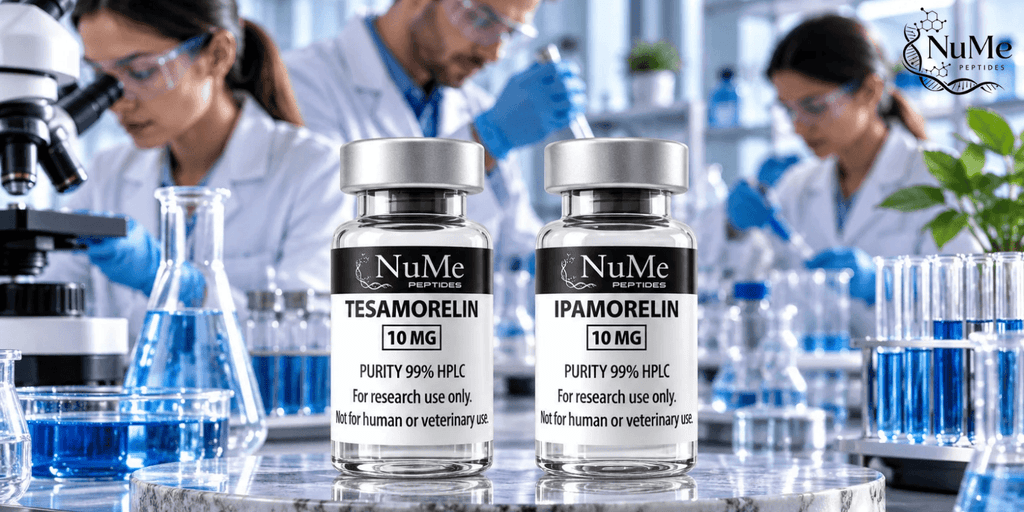
Explore Tesamorelin 10 mg for laboratory research involving GHRH signaling and the growth hormone axis.
CJC-1295
CJC-1295 is a long-acting GHRH analogue designed to prolong stimulation of pituitary GH secretion.
Preclinical research showed that CJC-1295 activates the growth hormone-releasing factor receptor in anterior pituitary systems and produces extended GH secretion due partly to its ability to bind serum albumin. (Jetté et al., 2005)
Human studies demonstrated prolonged increases in circulating GH and IGF-1 following CJC-1295 exposure. (Teichman et al., 2006)
Another study found that GH secretion remained pulsatile despite continuous stimulation by the long-acting analogue, although mean and trough GH concentrations increased. (Ionescu & Frohman, 2006)
These properties make CJC-1295 useful for investigating how prolonged changes in endogenous GH availability may alter downstream receptor signaling without treating CJC-1295 itself as a GHR agonist.
Ipamorelin
Ipamorelin acts through a different upstream receptor system.
It is a synthetic pentapeptide growth hormone secretagogue originally characterized through pituitary-cell and animal experiments.
Pharmacological antagonist studies demonstrated that Ipamorelin stimulated GH release through a GHRP-like receptor rather than the GHRH receptor. (Raun et al., 1998)
Current terminology generally associates this secretagogue pathway with the ghrelin receptor/GHS-R1a system.
Explore Ipamorelin 10 mg for laboratory research involving growth hormone secretagogue signaling and GH-axis regulation.
Again, Ipamorelin does not directly stimulate GHR.
Its experimental relevance is that secretagogue-receptor activation can increase pituitary GH release, after which endogenous GH can engage GHR in peripheral tissues.
The distinction between Ipamorelin and CJC-1295 is therefore mechanistically important:
- CJC-1295: upstream GHRH-receptor pathway.
- Ipamorelin: upstream growth hormone secretagogue receptor pathway.
- GH: direct ligand for the growth hormone receptor.
This separation makes it possible to investigate different regulatory layers within the same endocrine axis.
Explore research compounds studied in tissue repair and regeneration through our Healing & Recovery collection.
FAQs About Growth Hormone Receptor Research
What is the growth hormone receptor?
GHR is a single-pass cell-surface cytokine receptor that translates extracellular GH binding into intracellular signaling involving JAK2, STAT proteins, MAPK/ERK, and PI3K/Akt pathways.
Does GH directly bind the growth hormone receptor?
Yes. Growth hormone is the physiological ligand for GHR. One GH molecule interacts with a receptor complex and produces conformational changes that initiate intracellular signaling. (Brooks & Waters, 2010)
What is the main signaling pathway downstream of GHR?
JAK2/STAT5 is one of the principal pathways. GHR activation can also engage MAPK/ERK, PI3K/Akt, Src-family signaling, and other regulatory networks. (Waters, 2016)
Does Tesamorelin bind directly to GHR?
No. Tesamorelin is a GHRH analogue that acts upstream at the pituitary GHRH receptor, promoting endogenous GH secretion.
Does CJC-1295 directly activate the growth hormone receptor?
No. CJC-1295 is a long-acting GHRH analogue. It increases endogenous GH availability, which can subsequently activate GHR. (Jetté et al., 2005)
How is Ipamorelin different from CJC-1295?
Ipamorelin acts through a growth hormone secretagogue receptor pathway, while CJC-1295 acts through the GHRH receptor pathway. Both can affect endogenous GH release upstream of GHR. (Raun et al., 1998)
Current growth hormone receptor research shows that GHR is more than a passive docking site for circulating hormone.
GH binding produces structural changes within an existing receptor complex, activates associated JAK2, and initiates signaling through STAT5 and additional pathways such as MAPK/ERK and PI3K/Akt. Researchers investigate these mechanisms using molecular structures, receptor-expressing cells, genetic models, and endocrine stimulation studies.
Tesamorelin, CJC-1295, and Ipamorelin provide useful examples of how peptide research can intersect with GHR biology without directly targeting GHR itself.
Tesamorelin and CJC-1295 act through GHRH-related mechanisms, whereas Ipamorelin acts through the growth hormone secretagogue pathway. The resulting endogenous GH can then interact with GHR and produce downstream receptor-dependent effects.
Keeping these receptor levels separate is essential for accurate interpretation. A change in GH secretion is an upstream endocrine event; GHR activation and intracellular signaling are subsequent cellular events.
This distinction allows researchers to investigate the GH axis with greater mechanistic precision while avoiding the assumption that all GH-releasing peptides are themselves growth hormone receptor agonists.
Explore the NuMe Peptides US Shop to review research-focused peptide materials for laboratory and scientific investigation.
Disclaimer: This content is provided for scientific and educational purposes only. Research peptides discussed here are presented in a laboratory research context and are not described as products for human consumption, diagnosis, treatment, cure, or prevention of disease.