

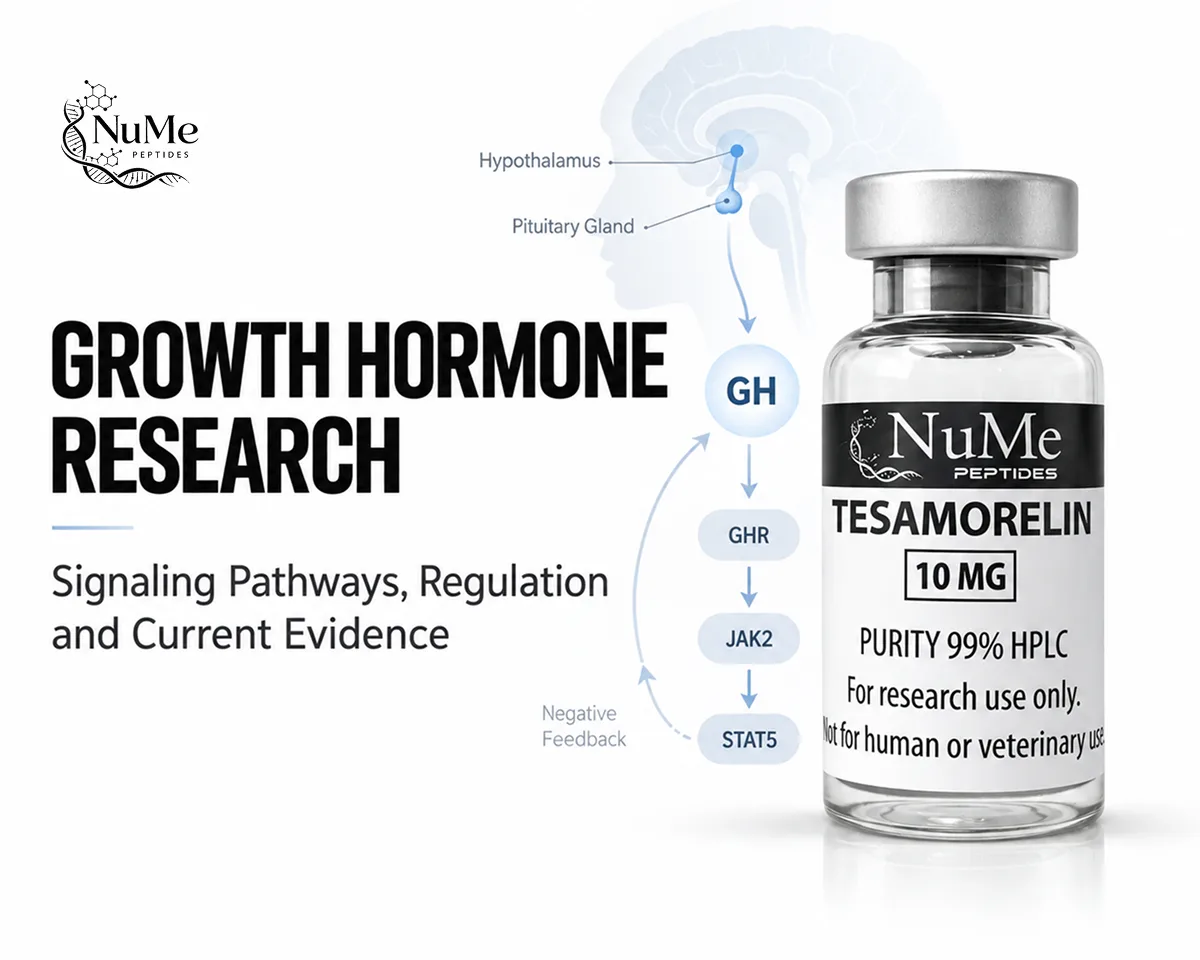
Growth Hormone Research: Signaling Pathways, Regulation and Current Evidence


Growth hormone (GH) is a peptide hormone produced by somatotroph cells in the anterior pituitary. It participates in postnatal growth, metabolism, body composition, and the regulation of insulin-like growth factor 1 (IGF-1). Rather than being released continuously, GH is secreted in pulses controlled by interactions among the hypothalamus, pituitary gland, peripheral tissues, nutritional signals, sleep, and feedback from GH and IGF-1.
Modern growth hormone research therefore examines an entire endocrine network rather than GH concentration alone. Researchers study growth hormone-releasing hormone (GHRH), somatostatin, ghrelin signaling, the GH receptor, intracellular JAK2/STAT pathways, and downstream IGF-1 responses.
Peptides including CJC-1295, CJC-1295 No DAC, Ipamorelin, Sermorelin, GHRP-6, and Tesamorelin are investigated because they interact with different parts of this regulatory system. Importantly, they do not have identical mechanisms, pharmacokinetics, or levels of clinical evidence.
Explore the NuMe Peptides US Shop to review research-focused peptide materials for laboratory and scientific investigation.
What Is Growth Hormone and Why Is It Studied in Research?
Growth hormone is synthesized and secreted by somatotroph cells of the anterior pituitary gland.
GH acts directly on multiple tissues and also stimulates production of IGF-1, particularly in the liver. Together, GH and IGF-1 form the somatotropic axis, which contributes to growth, protein metabolism, lipid metabolism, glucose regulation, bone biology, and tissue development.
A recent review describes GH activity as the result of interacting endocrine, paracrine, and autocrine signals rather than one isolated hormonal pathway. GH secretion is highly pulsatile and varies according to age, sex, sleep, nutritional status, metabolic conditions, and physiological stress. (Iglesias & Guerrero-Pérez, 2026)
This pulsatility is particularly important experimentally.
A single blood measurement may not represent overall GH secretion because concentrations can rise sharply during a secretory pulse and then decline to very low levels between pulses. Researchers therefore use repeated sampling, stimulation tests, GH area-under-the-curve measurements, IGF-1 concentrations, or experimental receptor assays depending on the scientific question.
GH is also studied because both insufficient and excessive signaling can alter physiology.
Research involving GH deficiency, acromegaly, GH resistance, aging, metabolic disorders, and experimental secretagogues has helped define how tightly the system is regulated.
This regulatory complexity is also why compounds that stimulate endogenous GH release should be evaluated differently from direct administration of recombinant GH.
Explore research compounds studied in tissue repair and regeneration through our Healing & Recovery collection.
How Is the Growth Hormone Axis Regulated?
The hypothalamus and pituitary provide the central regulatory framework for GH secretion.
Three major signals are particularly important: GHRH, somatostatin, and ghrelin-related signaling.
Growth Hormone-Releasing Hormone
GHRH is produced primarily in the hypothalamus and travels through the hypothalamic-pituitary portal circulation to the anterior pituitary.
There, GHRH binds receptors on somatotroph cells and stimulates GH synthesis and secretion.
Recent research emphasizes that GHRH activity is regulated not only at the pituitary but through feedback from GH and IGF-1, metabolic signals, age-related changes, and interactions with somatostatin. (Luque et al., 2025)
Somatostatin
Somatostatin provides an important inhibitory signal.
The balance between GHRH stimulation and somatostatin inhibition contributes to the pulsatile pattern of GH release.
This explains why secretory responses can differ substantially depending on physiological conditions at the time an experimental compound is introduced.
Ghrelin and the Growth Hormone Secretagogue Receptor
Ghrelin and synthetic growth hormone secretagogues act through the growth hormone secretagogue receptor, commonly called GHS-R1a.
This pathway differs from the GHRH receptor pathway but interacts with endogenous hypothalamic control.
GHRP-6 research provides a useful example. In healthy men, blockade of endogenous GHRH eliminated most of the GH response to GHRP-6, demonstrating that the secretagogue pathway and endogenous GHRH signaling interact rather than operating completely independently. (Popovic et al., 1998)
GH and IGF-1 Feedback
GH stimulates IGF-1 production, while GH and IGF-1 can feed back on the hypothalamic-pituitary system.
This feedback helps prevent unrestricted stimulation of the axis and is one reason researchers often measure both GH and IGF-1 when studying GHRH analogues.
Which Receptors and Signaling Pathways Are Involved in Growth Hormone Research?
GH exerts many of its effects through the growth hormone receptor, or GHR.
GHR belongs to the cytokine receptor superfamily. When GH activates the receptor, intracellular signaling involves Janus kinase 2, or JAK2, together with several downstream pathways.
JAK2/STAT Signaling
JAK2 activation leads to phosphorylation of STAT proteins, particularly STAT5.
Activated STAT proteins can move into the nucleus and influence gene transcription.
This pathway is central to many classical GH responses.
PI3K/Akt Signaling
GH receptor activation can also interact with phosphatidylinositol 3-kinase and Akt signaling.
These pathways contribute to metabolic and cellular responses in different tissues.
MAPK/ERK Signaling
The mitogen-activated protein kinase pathway provides another route through which GH can influence cellular behavior.
A detailed review of GH receptor biology describes JAK2, STATs, PI3K, ERK, Src-family kinases, phosphatases, and SOCS proteins as important components of classical and regulatory GHR signaling. (Frank, 2020)
Researchers also distinguish the GH receptor from receptors targeted by GH-releasing peptides.
GHRH analogues such as Sermorelin, Tesamorelin, and CJC-1295 primarily investigate the GHRH receptor pathway at the pituitary.
By contrast, Ipamorelin and GHRP-6 belong to the growth hormone secretagogue research category and act through GHS-R-associated mechanisms.
This receptor distinction helps explain why combining different experimental secretagogues can produce responses that differ from increasing the concentration of only one compound.
How Are Growth Hormone Pathways Investigated in Experimental Models?
Researchers use several approaches to investigate the GH axis.
Pituitary Cell Models
Cultured pituitary cells allow researchers to determine whether a compound directly stimulates GH release.
Ipamorelin, for example, was characterized using primary rat pituitary cells as well as animal models. The peptide produced potent GH release through a GHRP-like receptor pathway. (Raun et al., 1998)
Receptor and Signaling Studies
Cell systems can be used to examine receptor binding, intracellular phosphorylation, gene expression, and pathway activation.
These experiments help distinguish GHRH-receptor signaling from growth hormone secretagogue receptor activity.
Animal Models
Animal studies are useful for examining pulsatile secretion, pharmacokinetics, endocrine feedback, and interactions between hypothalamic and pituitary signaling.
They also allow researchers to study compounds before human investigation, although species differences can affect endocrine responses.
Human Stimulation Studies
Controlled human studies can measure GH pulses, peak concentrations, GH area under the curve, and IGF-1 responses after a defined experimental stimulus.
CJC-1295 provides an example. In randomized, placebo-controlled studies involving healthy adults, long-acting CJC-1295 produced dose-dependent elevations in mean GH and IGF-1 concentrations. Its estimated half-life was approximately 5.8–8.1 days, reflecting the extended exposure created by its albumin-binding design. (Teichman et al., 2006)
Researchers should therefore compare peptide studies according to pharmacokinetics as well as receptor mechanism.
Explore research compounds studied in tissue repair and regeneration through our Healing & Recovery collection.
Which Peptides Are Studied in Growth Hormone Research?
CJC-1295
CJC-1295 was developed as a long-acting analogue of human growth hormone-releasing factor.
Its Drug Affinity Complex, or DAC, allows covalent interaction with serum albumin, substantially extending circulating exposure.
Preclinical research demonstrated albumin binding and prolonged activity, while subsequent human studies showed sustained increases in GH and IGF-1. (Jetté et al., 2005)
These properties make CJC-1295 useful experimentally for investigating prolonged GHRH-receptor stimulation rather than only short secretory pulses.
CJC-1295 No DAC
The term CJC-1295 No DAC is widely used in the research-compound market for shorter-acting modified GRF(1-29)-type peptides that lack the albumin-binding DAC component.
This distinction is important because the classic human CJC-1295 studies involved the long-acting DAC-containing molecule.
Research on modified GHRH(1-29) fragments demonstrates that substitutions can improve resistance to degradation while retaining GHRH-receptor activity, but researchers should avoid assuming that pharmacokinetic findings from CJC-1295 with DAC apply directly to a No-DAC preparation. (Rivier et al., 1988)
Compound identity and sequence should therefore be confirmed when interpreting No-DAC research.
Sermorelin
Sermorelin corresponds to the biologically active 1–29 amino-acid fragment of GHRH.
Human research demonstrated that GHRH(1-29)-NH2 can stimulate pituitary GH secretion with activity comparable on a molar basis to longer endogenous GHRH forms. (Gelato et al., 1985)
Because it acts upstream at the pituitary GHRH receptor, Sermorelin is useful for investigating endogenous secretory capacity rather than replacing GH directly.
Ipamorelin
Ipamorelin is a synthetic pentapeptide growth hormone secretagogue.
In early pharmacological studies, it produced potent GH release in pituitary-cell and animal models. Compared with some earlier GHRPs, the study found relatively selective GH release without significant increases in several other pituitary hormones in the tested models. (Raun et al., 1998)
Its mechanism differs from GHRH analogues because it acts through the growth hormone secretagogue receptor pathway.
GHRP-6
GHRP-6 is a synthetic hexapeptide secretagogue with a long history in experimental GH research.
Human studies showed that GHRP-6 can produce substantial GH release and that endogenous GHRH contributes strongly to its maximum effect. (Popovic et al., 1998)
Earlier research also demonstrated interactions among GHRP-6, GHRH, somatostatin tone, and physiological stimuli, highlighting the integrated nature of GH regulation.
Tesamorelin
Tesamorelin is a stabilized GHRH analogue and has a considerably different evidence base from many research-only secretagogues.
It is FDA-approved in the United States for reducing excess abdominal fat in adults with HIV-associated lipodystrophy. Its mechanism involves stimulation of endogenous GH production with subsequent increases in IGF-1. (U.S. Food and Drug Administration, 2025)
Randomized clinical research demonstrated reductions in visceral adipose tissue together with increased IGF-1 in the studied HIV population.
Tesamorelin therefore provides a useful example of how GHRH-pathway research can progress from endocrine mechanism to a specific clinically evaluated indication.
FAQs About Growth Hormone Research
What controls growth hormone secretion?
GH secretion is regulated primarily through GHRH, somatostatin, ghrelin-related signaling, and feedback from GH and IGF-1. Sleep, nutrition, age, sex, and metabolic state also influence secretion. (Iglesias & Guerrero-Pérez, 2026)
What is the difference between GHRH analogues and GH secretagogues?
GHRH analogues primarily activate the pituitary GHRH receptor. Growth hormone secretagogues such as GHRP-6 and Ipamorelin act through the growth hormone secretagogue receptor system.
How is CJC-1295 different from CJC-1295 No DAC?
Classic CJC-1295 contains an albumin-binding DAC that greatly prolongs its exposure. “No DAC” commonly refers to shorter-acting modified GRF(1-29)-type material without that albumin-binding component.
What is Sermorelin studied for?
Sermorelin is GHRH(1-29) and is used experimentally to investigate pituitary GH release through the GHRH receptor pathway.
How does Ipamorelin differ from GHRP-6?
Both are growth hormone secretagogues, but they have different peptide structures and pharmacological profiles. Early preclinical work characterized Ipamorelin as a relatively selective GH secretagogue.
Is Tesamorelin only a research peptide?
No. Tesamorelin has an FDA-approved U.S. indication for reducing excess abdominal fat in adults with HIV-associated lipodystrophy. That approved indication should be distinguished from broader experimental GH-axis research. (U.S. Food and Drug Administration, 2025)
Current growth hormone research shows that the somatotropic axis is regulated through several interacting levels rather than a simple on/off mechanism.
GHRH stimulates pituitary somatotrophs, somatostatin limits secretion, ghrelin-related pathways provide additional secretagogue signaling, and GH and IGF-1 contribute feedback regulation. Once released, GH activates GHR-associated pathways including JAK2/STAT, PI3K/Akt, and MAPK/ERK.
The peptides discussed here allow researchers to investigate different parts of that network. CJC-1295, shorter-acting modified GHRH forms, Sermorelin, and Tesamorelin primarily relate to GHRH signaling, while Ipamorelin and GHRP-6 investigate the growth hormone secretagogue receptor system.
Their evidence also differs substantially—from primarily preclinical pharmacology to controlled human trials and, in the case of Tesamorelin, an established FDA-approved indication.
Keeping these distinctions clear makes it possible to study GH regulation without treating every secretagogue as biologically or clinically equivalent.
Explore the NuMe Peptides US Shop to review research-focused peptide materials for laboratory and scientific investigation.
Disclaimer: This content is provided for scientific and educational purposes only. Research peptides discussed here are presented in a laboratory research context and are not described as products for human consumption, diagnosis, treatment, cure, or prevention of disease.