

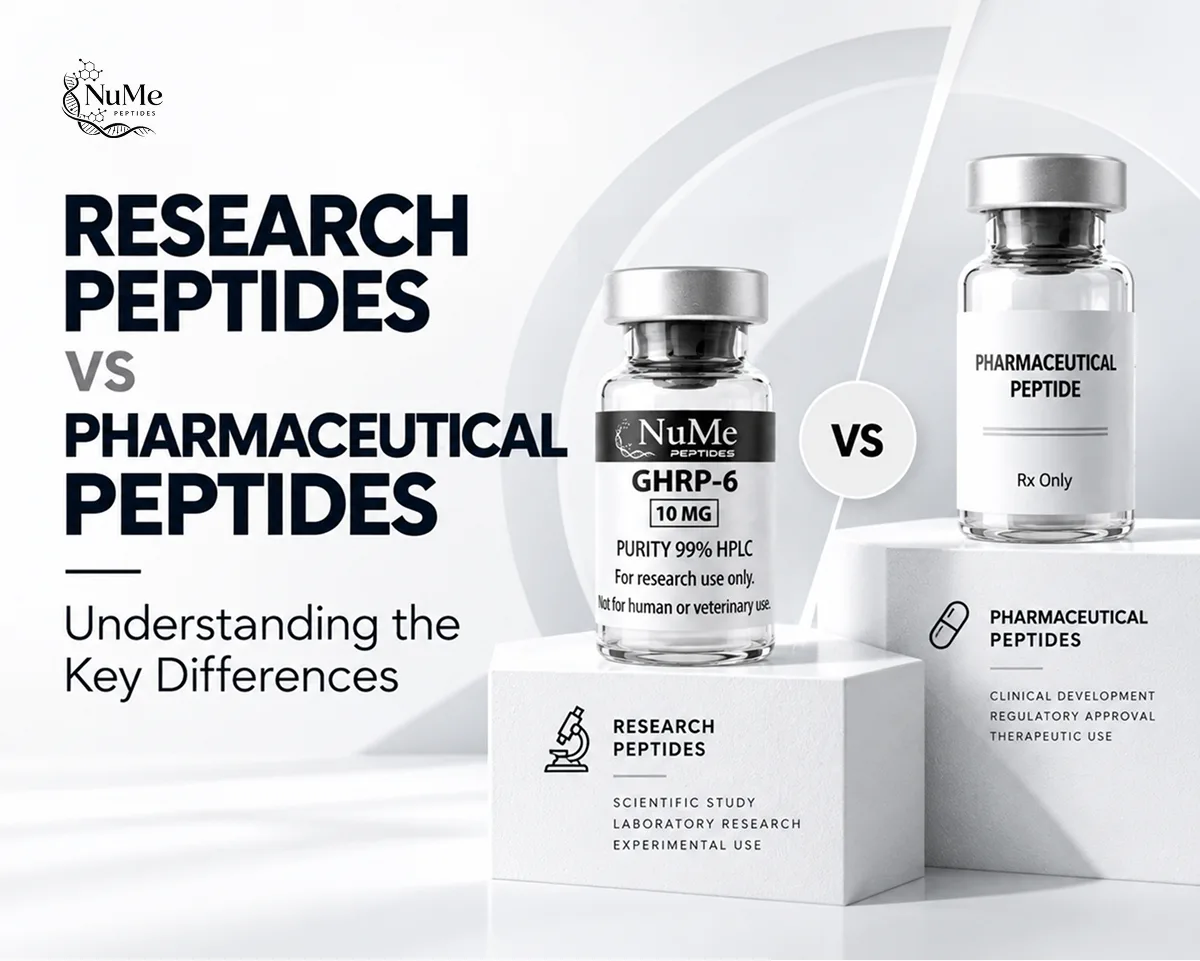
Research Peptides vs Pharmaceutical Peptides: Understanding the Key Differences


Peptides can appear in very different scientific and regulatory contexts. Some are produced as laboratory materials for controlled research, while others are developed as pharmaceutical products through formal drug-development programs. Although the molecules may share similar amino-acid sequences, their intended uses, manufacturing controls, documentation, testing requirements, and regulatory status can differ substantially.
Understanding the distinction between research and pharmaceutical peptides is therefore important when interpreting experimental data or evaluating peptide materials. The distinction should not be based on a peptide name alone. Instead, researchers need to examine how the material was manufactured, what it was intended for, which analytical controls apply, and what evidence supports its use.
For U.S. researchers, this distinction is particularly relevant because the FDA evaluates products according to their intended use as well as their labeling and marketing context.
Explore the NuMe Peptides US Shop for research-focused peptide materials and laboratory product information intended for scientific investigation.
How Are Research Peptides and Pharmaceutical Peptides Used Differently?
The most fundamental difference in research peptides vs pharmaceutical peptides is their intended use.
Research peptides are generally supplied for laboratory investigation. Depending on the experimental design, they may serve as reference materials, assay components, molecular probes, analytical standards, or compounds used to investigate biological mechanisms. Researchers may study receptor interactions, signaling pathways, molecular stability, sequence-function relationships, or other defined scientific questions.
In contrast, pharmaceutical peptides are developed as drug products. Their development can involve preclinical studies, formulation research, pharmacokinetic evaluation, clinical trials, manufacturing validation, and regulatory review before they can be marketed for an approved medical indication in the United States.
FDA’s clinical pharmacology guidance for peptide drug products specifically addresses development programs submitted through new drug applications under section 505(b) of the Federal Food, Drug, and Cosmetic Act. Among other areas, the guidance discusses pharmacokinetics, drug interactions, QTc considerations, and immunogenicity in relation to peptide drug safety and efficacy. (U.S. Food and Drug Administration, 2023)
Therefore, the comparison of research peptides vs pharmaceutical peptides is not simply “experimental versus manufactured.” Pharmaceutical peptides are also researched extensively, but that research occurs within a structured drug-development pathway designed to support specific therapeutic claims and regulatory submissions.
Research-use materials, by contrast, may be appropriate for laboratory experiments without having undergone the development program required to establish clinical safety or effectiveness.
This difference is essential when interpreting published findings. Evidence that a peptide affects a molecular pathway in vitro does not automatically establish that the same peptide is safe or effective as a medicine.
Visit the NuMe Peptides US Shop to explore available research peptides and laboratory-focused products for scientific study.
How Do Their Manufacturing and Quality Standards Compare?
Manufacturing represents one of the clearest differences in research peptides vs pharmaceutical peptides.
Both types of peptides may be synthesized using sophisticated chemical methods. However, the quality systems governing their production may differ substantially according to intended use.
Research peptides can be manufactured according to specifications chosen for a particular scientific application. Relevant attributes may include sequence identity, molecular mass, chromatographic purity, peptide content, counterion, or other characteristics required by the experiment.
Pharmaceutical peptide manufacturing operates within a more formal regulatory quality system. In the United States, FDA’s Current Good Manufacturing Practice regulations establish minimum requirements for methods, facilities, and controls used in drug manufacturing, processing, and packaging. FDA also reviews whether manufacturers have suitable facilities, equipment, and capabilities as part of the drug-approval process. (U.S. Food and Drug Administration, 2026)
The reason for these controls becomes clearer when considering peptide chemistry. Synthetic peptides can contain impurities originating from raw materials, synthesis reactions, purification processes, storage, or degradation. Lian and colleagues describe structural modifications including process-related impurities, isomers, and degradation-related products that may require detailed characterization during pharmaceutical peptide development. (Lian et al., 2021)
Consequently, comparing research peptides vs pharmaceutical peptides requires more than comparing two purity percentages.
A research peptide reported as having high chromatographic purity may be suitable for a particular laboratory study. However, pharmaceutical quality involves a larger control strategy that can include identity, potency, impurities, stability, manufacturing consistency, container systems, microbiological attributes, and other critical quality characteristics relevant to the final drug product.
The appropriate standard depends on the intended purpose of the material.
What Testing and Documentation Are Associated With Each Type?
Testing is another area where research peptides vs pharmaceutical peptides should be distinguished carefully.
Research peptide documentation may include analytical data such as:
- HPLC chromatograms;
- mass-spectrometry results;
- peptide sequence information;
- stated purity;
- molecular weight;
- lot or batch identification;
- Certificates of Analysis;
- storage recommendations.
These data can help researchers determine whether a material appears suitable for a defined experiment. However, individual documentation packages can vary significantly between suppliers and products.
For peptide drug products, analytical characterization can become considerably more extensive.
Peptide synthesis can produce closely related impurities that conventional analytical techniques may not always resolve. Researchers from the FDA demonstrated this challenge when studying peptide drug quality control. Their work found that amino-acid deletion and insertion impurities could escape adequate resolution by certain HPLC-UV methods, while liquid chromatography coupled with high-resolution mass spectrometry offered additional selectivity for impurity characterization. (Zeng et al., 2015)
Likewise, Lian and colleagues describe LC-MS strategies for evaluating peptide impurities, including structural isomers and stereoisomers, within risk-based pharmaceutical control programs. (Lian et al., 2021)
Therefore, when evaluating research peptides vs pharmaceutical peptides, researchers should distinguish between a test result and an overall quality system.
For example, an HPLC chromatogram may provide valuable information about chromatographic composition. A mass spectrum may support molecular identity. However, neither document alone demonstrates all aspects of pharmaceutical-grade manufacturing, stability, sterility, potency, or regulatory compliance.
Pharmaceutical development also requires documentation across multiple stages. Depending on the product and development pathway, this may include chemistry, manufacturing and controls information, analytical-method validation, stability studies, pharmacology and toxicology data, clinical protocols, manufacturing records, and regulatory submissions.
In July 2026, FDA revised product-specific guidances for several generic peptide products. These recommendations address areas including impurity thresholds, higher-order structure, biological activity, innate immune response testing, and pathways for synthetically or recombinantly produced peptides. (U.S. Food and Drug Administration, 2026)
This illustrates how peptide-drug evaluation can extend far beyond a single purity measurement.
Visit the NuMe Peptides US Shop to explore available research peptides and laboratory-focused products for scientific study.
How Do Regulatory Frameworks Differ Between Research and Pharmaceutical Peptides?
The U.S. regulatory framework is a central part of understanding research peptides vs pharmaceutical peptides.
An approved pharmaceutical peptide is marketed through an applicable FDA drug-approval pathway. The manufacturer must provide evidence and documentation sufficient for the relevant regulatory application, while production must meet applicable quality requirements.
Research materials occupy a different context when they are genuinely intended solely for laboratory research.
However, writing “research use only” on a label does not automatically determine how FDA will classify a product.
In March 2026, FDA issued a warning letter involving peptide products labeled “Research Use Only” and “not intended for human consumption, medical use, or veterinary use.” FDA stated that other website evidence established an intended human drug use, meaning the disclaimers did not control the regulatory determination. (U.S. Food and Drug Administration, 2026)
FDA expressed the same principle again in a June 2026 warning letter, stating that despite “RESEARCH USE ONLY” labeling, product labeling and website content established an intended human drug use. (U.S. Food and Drug Administration, 2026)
Additional warning letters issued in August 2026 likewise emphasized that research-use disclaimers did not override marketing content that FDA viewed as evidence of intended drug use. (U.S. Food and Drug Administration, 2026)
Therefore, the regulatory difference in research peptides vs pharmaceutical peptides depends substantially on intended use, claims, distribution context, and applicable legal requirements—not simply the molecular sequence or wording printed on a vial.
Why Is This Distinction Important When Reviewing Peptide Research?
Understanding research peptides vs pharmaceutical peptides helps researchers interpret evidence more accurately.
A common mistake is assuming that because a peptide exists as an approved pharmaceutical ingredient in one context, any material with the same stated sequence is equivalent to the approved drug product. That conclusion does not necessarily follow.
Manufacturing methods can influence impurity profiles. Formulation can affect stability. Analytical methods can vary in their ability to detect related substances. Furthermore, pharmaceutical products may have defined specifications for potency, degradation products, microbiological characteristics, and other attributes that are not automatically represented by a research-material specification.
Synthetic peptide drugs are particularly challenging because their manufacturing and storage processes may create structurally similar impurities. Research has shown that mass-spectrometry-based methods can provide additional information about such impurities beyond conventional chromatography alone. (Lian et al., 2021)
Researchers should also distinguish experimental evidence by stage.
An in vitro experiment may reveal a molecular interaction. An animal study may examine physiological responses under a defined model. Clinical research investigates questions in human participants under controlled protocols. Regulatory approval then requires evaluation of the totality of evidence relevant to a specific product and indication.
As a result, a study using a research peptide should not automatically be interpreted as evidence about every pharmaceutical formulation containing a similar peptide. Conversely, evidence from an approved pharmaceutical product may not automatically establish that an independently sourced research material has identical quality characteristics.
A useful comparison is:
| Factor | Research Peptides | Pharmaceutical Peptides |
|---|---|---|
| Primary purpose | Laboratory investigation | Therapeutic development or approved medical use |
| Intended population | Experimental systems | Patients within approved or investigational contexts |
| Manufacturing framework | Based on research specifications | Applicable pharmaceutical CGMP and regulatory controls |
| Analytical documentation | Supplier- and study-dependent | Structured quality and regulatory documentation |
| Clinical evidence | Not inherently required | Required according to applicable development pathway |
| FDA approval | Not implied | Required before an approved new drug is marketed |
| Claims | Should remain research-focused | Limited to authorized or appropriately investigational uses |
Ultimately, research peptides vs pharmaceutical peptides should be understood as a difference in context, evidence, quality systems, and regulatory status—not merely as a difference in peptide chemistry.
New to peptide research? Read our guide on What Are Research Peptides? to understand how research peptides are defined, studied, and evaluated before exploring proper storage practices.
FAQs About Research Peptides vs Pharmaceutical Peptides
Are research peptides the same molecules as pharmaceutical peptides?
Sometimes a research material may have a stated sequence related or identical to a peptide studied or used pharmaceutically. However, molecular sequence alone does not establish equivalence. Manufacturing, formulation, impurity profile, analytical controls, stability, documentation, and regulatory status may differ.
Are research peptides FDA-approved?
A research designation does not mean FDA approval. Approved drug products undergo an applicable FDA review process before they can be marketed for approved therapeutic uses in the United States.
Does high purity make a research peptide pharmaceutical grade?
Not by itself. High chromatographic purity describes one analytical characteristic. Pharmaceutical quality encompasses a broader manufacturing and control framework, which may include potency, impurity specifications, stability, validated analytical methods, manufacturing consistency, and other requirements.
Why is LC-MS important when comparing peptide quality?
Mass spectrometry can provide detailed molecular information that complements chromatography. FDA-affiliated research has shown that certain peptide impurities may be difficult to distinguish using HPLC-UV alone, while high-resolution LC-MS can improve impurity characterization. (Zeng et al., 2015)
Does “research use only” automatically determine regulatory status?
No. FDA enforcement actions in the United States demonstrate that intended use may be determined from labeling, website statements, marketing claims, and the surrounding context—not solely from a research-use disclaimer. (U.S. Food and Drug Administration, 2026)
Why should researchers understand research peptides vs pharmaceutical peptides?
Because the distinction affects how experimental materials, analytical results, and scientific claims should be interpreted. It helps prevent laboratory findings from being confused with evidence supporting a clinically approved pharmaceutical product.
Understanding the Difference in Scientific Context
The comparison of research peptides vs pharmaceutical peptides ultimately comes down to intended use, quality systems, documentation, evidence, and regulatory context.
Research peptides can serve valuable roles in controlled scientific studies. Researchers may use them to investigate molecular pathways, develop analytical methods, compare peptide sequences, or explore early-stage biological questions.
Pharmaceutical peptides operate within a different framework. Drug development requires structured manufacturing controls, extensive analytical characterization, safety and efficacy evaluation, and regulatory oversight appropriate to the intended therapeutic use.
For researchers, understanding research peptides vs pharmaceutical peptides helps keep experimental interpretation precise. A familiar peptide name does not establish pharmaceutical equivalence, and a purity result does not replace the broader quality framework required for an approved medicine.
Maintaining this distinction allows peptide research to remain focused on what the evidence actually demonstrates while avoiding conclusions that extend beyond the experimental or regulatory context.
Explore the NuMe Peptides US Shop to review research-focused peptide materials and product information intended for laboratory and scientific investigation.
Disclaimer: This content is provided for scientific and educational purposes only. Research peptides discussed here are presented in a laboratory research context and are not described as products for human consumption, diagnosis, treatment, cure, or prevention of disease.


This comparison made the differences between research and pharmaceutical peptides much easier to understand. I particularly liked the explanation of how intended use and regulatory requirements can affect how each type is handled. It would be interesting to learn more about the documentation researchers should review when sourcing peptides for laboratory work.
Really clear explanation of a topic that can be confusing when you’re first learning about peptides. The section on the different standards and purposes of research versus pharmaceutical products was especially helpful. Are there specific quality-control tests that are more relevant for research-grade peptides?
I enjoyed the practical approach in this article, especially the explanation of why research peptides and pharmaceutical peptides shouldn’t simply be treated as the same thing. The regulatory distinction was an interesting part of the discussion. I’d like to see a follow-up explaining how researchers assess purity and identity before using a peptide in an experiment.