


Peptides for Tissue Regeneration Research: Mechanisms and Experimental Evidence


Tissue regeneration is a complex biological process involving inflammatory signaling, vascular remodeling, extracellular matrix production, cell migration, and tissue-specific repair responses. Researchers study these mechanisms to understand why some tissues restore structure effectively after injury while others develop fibrosis, persistent inflammation, or incomplete functional recovery.
Interest in peptides for tissue regeneration research has grown because some peptide molecules interact with biological pathways involved in angiogenesis, cellular protection, inflammation, fibroblast activity, and extracellular matrix remodeling. However, the strength of evidence differs substantially among compounds, and much of the current literature remains based on cell and animal models.
BPC-157, thymosin-related peptides such as TB-500, and ARA-290 are examples frequently discussed in regenerative research. Importantly, experimental findings should be interpreted according to the specific model, compound, dose, and outcome being studied rather than treated as established evidence of human therapeutic benefit.
Explore the NuMe Peptides US Shop to review research-focused peptide materials for laboratory and scientific investigation.
How Is Tissue Regeneration Studied in Scientific Research?
Researchers investigate regeneration using experimental systems ranging from isolated cells to complex animal injury models.
In vitro studies provide a controlled environment for examining individual cellular responses. Fibroblasts, endothelial cells, keratinocytes, muscle cells, and other cell populations can be exposed to experimental compounds while researchers measure proliferation, migration, gene expression, inflammatory signaling, collagen production, or survival.
These models are useful for identifying mechanisms, but they cannot reproduce the full biological environment of injured tissue.
Animal studies provide another level of complexity. Researchers may create standardized skin wounds, tendon injuries, muscle lesions, burns, nerve injuries, or other experimental damage and then evaluate how tissues change over time. Measurements may include histological organization, vascular density, collagen deposition, inflammatory markers, wound closure, biomechanical properties, and functional outcomes.
For example, research involving the tissue-protective peptide ARA-290 has used mouse burn and wound models to examine inflammatory signaling, microvascular integrity, and tissue preservation after injury. In one cutaneous burn model, ARA-290 was associated with maintenance of microvascular patency and reduced inflammatory responses in surrounding tissue. (Hand et al., 2013)
Researchers may also use biomaterials and controlled-delivery systems to investigate how long a peptide remains available within a wound environment. ARA-290, for example, has been incorporated into elastin-like protein systems in experimental diabetic wound models to examine whether localized delivery influences angiogenesis and repair. (Koria et al., 2017)
Together, these models allow scientists to investigate individual mechanisms while gradually increasing experimental complexity.
Explore research compounds studied in tissue repair and regeneration through our Healing & Recovery collection.
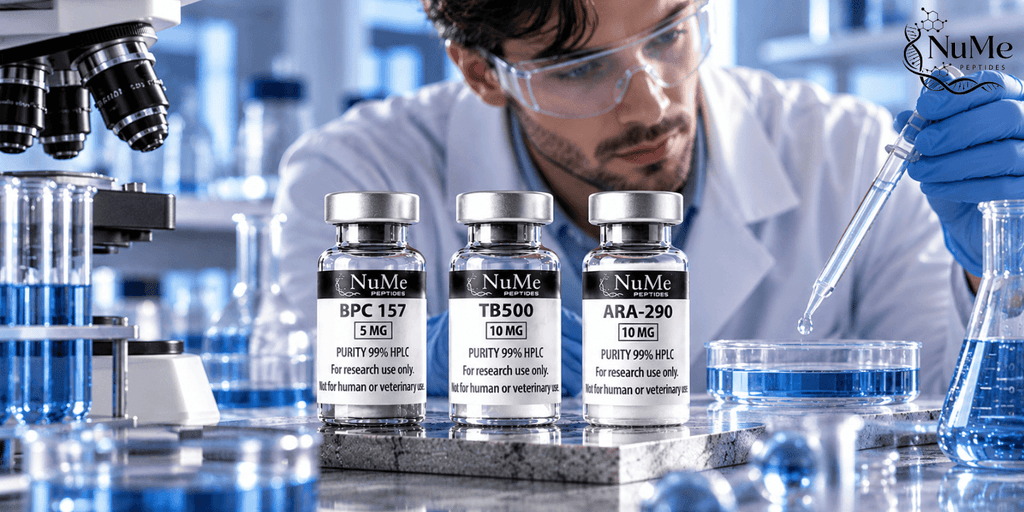
Which Cellular Processes Contribute to Tissue Regeneration?
Regeneration depends on multiple overlapping processes rather than one biological pathway.
Inflammation and Resolution
Inflammation is an essential early response to tissue injury.
Immune cells clear damaged material and release signaling molecules that coordinate subsequent repair. However, prolonged inflammatory signaling can interfere with regeneration and contribute to fibrosis or chronic tissue damage.
Experimental regenerative compounds are therefore often evaluated for their effects on inflammatory mediators rather than simply for their ability to stimulate cell growth.
ARA-290 has received research attention partly because it interacts with tissue-protective pathways related to erythropoietin signaling without producing the same erythropoietic activity as conventional EPO. Experimental studies have investigated its effects on inflammatory signaling and tissue preservation after injury. (Hand et al., 2013)
Angiogenesis
Damaged tissue requires an adequate vascular network to receive oxygen and nutrients.
Angiogenesis—the development of new blood vessels—is therefore a major endpoint in regenerative research.
BPC-157 studies have explored signaling associated with VEGF, endothelial activity, nitric oxide, and angiogenesis. Recent mechanistic work has also examined pathways involving BACH1 stabilization in models of burns, dermal wounds, and skeletal muscle injury. (Yuan et al., 2026)
Fibroblast Activity and Extracellular Matrix
Fibroblasts contribute to the production and organization of collagen and other extracellular matrix components.
Appropriate matrix formation provides structural support during repair. However, excessive matrix deposition may contribute to scar formation rather than true regeneration.
Research therefore considers not only how much collagen is produced but also how newly formed tissue is organized and remodeled.
Cell Migration
Cells often need to migrate into injured areas before repair can proceed.
Thymosin beta-4 research has demonstrated effects on keratinocyte migration and wound-associated cellular activity in experimental models. In a rat full-thickness wound study, thymosin beta-4 was associated with increased re-epithelialization, angiogenesis, collagen deposition, and keratinocyte migration. (Malinda et al., 1999)
These interconnected processes explain why regenerative outcomes cannot be evaluated using a single marker.
How Are Peptides Investigated in Regenerative Research Models?
Peptides can be evaluated at several stages of the repair process.
A laboratory may first investigate whether a compound alters a specific signaling pathway. Researchers can then examine whether that molecular effect produces measurable changes in cells, tissues, or animal injury models.
Typical endpoints include:
- endothelial-cell migration;
- fibroblast activity;
- inflammatory cytokines;
- collagen organization;
- angiogenesis;
- apoptosis;
- oxidative stress;
- wound closure;
- tissue histology;
- mechanical strength.
The same peptide may produce different findings depending on the model.
Dose also matters. A concentration that influences isolated cells may not produce the same exposure within living tissue. Similarly, systemic administration, localized delivery, and biomaterial-based delivery can generate different pharmacological environments.
Timing is another important variable.
Early intervention may influence inflammation or vascular preservation, while later exposure may primarily affect proliferation or remodeling. Researchers therefore need to interpret experimental results within the exact injury stage studied.
Current reviews of regenerative peptides repeatedly emphasize this translational gap. BPC-157, thymosin beta-4–related compounds, TB-500, and ARA-290 have generated substantial scientific interest, but evidence ranges from extensive preclinical data to very limited clinical investigation depending on the compound. (Fonseca et al., 2026)
For this reason, experimental evidence is strongest when researchers clearly distinguish mechanistic findings from demonstrated clinical outcomes.
Explore research compounds studied in tissue repair and regeneration through our Healing & Recovery collection.
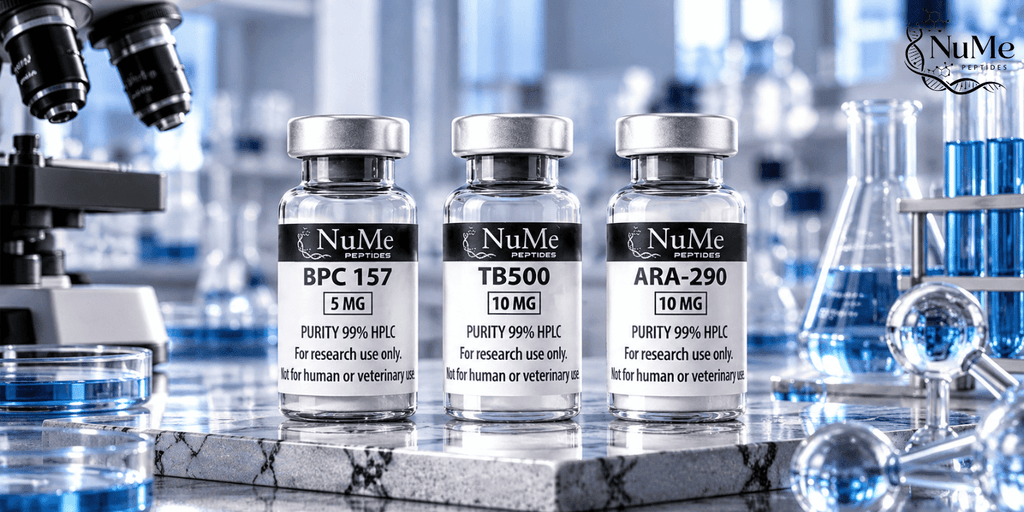
Which Research Peptides Are Associated With Regenerative Studies?
Several compounds appear repeatedly in regenerative and tissue-repair literature, although they differ significantly in structure, mechanism, and available evidence.
BPC-157
BPC-157 is a synthetic pentadecapeptide that has been studied extensively in preclinical injury models.
Experimental research has examined tendon, muscle, ligament, bone, skin, vascular, and gastrointestinal models. Proposed mechanisms include modulation of VEGF-related signaling, the Akt/eNOS nitric oxide pathway, ERK1/2 signaling, fibroblast activity, angiogenesis, and inflammatory responses. (McGuire et al., 2025)
Newer mechanistic studies continue to explore how BPC-157 may affect vascular responses. Experimental research published in 2026 examined FBXO22-dependent stabilization of BACH1 and reported angiogenic and tissue-repair effects across burn, dermal incision, and muscle-contusion models. (BPC157 Angiogenesis Study, 2026)
However, translation to humans remains uncertain.
A systematic review published in October 2026 identified only three eligible human studies involving a total of 30 participants and rated the overall certainty of evidence as very low. The authors concluded that current human evidence is insufficient for clinical recommendations. (Poolton et al., 2026)
TB-500 and Thymosin Beta-4 Research
TB-500 is commonly discussed alongside thymosin beta-4, but researchers should avoid assuming that evidence generated using native thymosin beta-4 applies automatically to every synthetic derivative or fragment marketed under related names.
Thymosin beta-4 is an actin-sequestering protein involved in several cellular processes. Research has examined its role in cell migration, angiogenesis, inflammation, and tissue remodeling. (Goldstein et al., 2005)
In classic wound research, thymosin beta-4 increased keratinocyte migration and was associated with greater angiogenesis, collagen deposition, and re-epithelialization in experimental rat wounds. (Malinda et al., 1999)
More recent sports-medicine reviews describe TB-4 and TB-500 as compounds of interest in regenerative research but emphasize that human orthopaedic evidence remains limited. (Injectable Peptide Therapy Review, 2026)
ARA-290
ARA-290, also known as cibinetide in some literature, is an engineered peptide derived from the helix-B surface region of erythropoietin.
Unlike erythropoietin itself, ARA-290 was designed to activate tissue-protective signaling without stimulating the classical erythropoietic receptor responsible for red blood cell production.
Research has explored its effects on inflammatory regulation, tissue protection, microvascular injury, and wound models.
In a mouse skin-wound study, ARA-290 accelerated wound closure compared with saline controls. Researchers investigated its effects as a tissue-protective compound rather than as a conventional hematopoietic agent. (Brines et al., 2009)
Another study using cutaneous burns reported reduced secondary microvascular thrombosis and inflammatory signaling following ARA-290 administration. (Hand et al., 2013)
These findings make ARA-290 relevant to peptides for tissue regeneration research, particularly where investigators are studying tissue protection and inflammatory responses rather than simply increasing cell proliferation.
What Factors Can Influence Tissue Regeneration Research?
Regenerative findings can vary substantially depending on experimental design.
Tissue Type
Skin, muscle, tendon, nerve, bone, and cartilage have different regenerative capacities.
A compound that produces measurable changes in a highly vascularized wound may behave differently in poorly vascularized tendon tissue.
Injury Model
A clean surgical incision differs biologically from a burn, crush injury, chronic diabetic wound, or degenerative tissue condition.
Researchers should therefore avoid comparing outcomes across fundamentally different injury models without considering these differences.
Dose and Exposure
The concentration and duration of peptide exposure can influence cellular signaling.
Pharmacokinetic limitations can also complicate interpretation. A 2026 review of BPC-157 noted a short measured plasma half-life in available preliminary work despite longer-lasting biological responses in preclinical models, highlighting unresolved questions regarding pharmacokinetics and mechanism. (BPC-157 Biopharmaceutical Review, 2026)
Delivery Method
Systemic injection, local administration, topical exposure, and biomaterial-based delivery do not create equivalent experimental conditions.
For example, ARA-290 has been studied both systemically and through engineered delivery systems designed to increase local exposure in wound models. (Koria et al., 2017)
Outcome Selection
Researchers should distinguish surrogate biological markers from functional regeneration.
An increase in VEGF expression or collagen production may indicate pathway activity, but stronger evidence comes from combining molecular findings with histological organization, tissue strength, vascularization, or functional recovery.
FAQs About Peptides for Tissue Regeneration Research
Why are peptides studied in tissue regeneration?
Peptides can interact with signaling pathways involved in angiogenesis, inflammation, cell migration, extracellular matrix remodeling, and tissue protection, making them useful experimental tools for studying regenerative biology.
What is BPC-157 studied for in regeneration research?
Preclinical work has examined BPC-157 in tendon, muscle, ligament, bone, skin, and other injury models, with proposed mechanisms involving angiogenesis, nitric oxide signaling, fibroblast activity, and inflammatory regulation. Human evidence remains very limited. (Poolton et al., 2026)
Is TB-500 the same as thymosin beta-4?
They are related terms in current research and commercial discussions, but findings involving native thymosin beta-4 should not automatically be attributed to every TB-500 preparation or derivative without confirming the compound used in the original study.
What is ARA-290 investigated for?
ARA-290 has been studied in models involving tissue protection, inflammatory regulation, microvascular preservation, wound closure, and angiogenesis. (Hand et al., 2013)
Do animal regeneration studies prove that peptides work in humans?
No. Animal and cellular models help researchers investigate mechanisms and generate hypotheses, but human efficacy and safety require appropriately designed clinical research.
Which factor is most important when interpreting regenerative peptide research?
No single factor is sufficient. Researchers should consider the compound, tissue type, model, dose, delivery method, timing, endpoints, and level of evidence together.
Understanding the Experimental Evidence
Research into peptides for tissue regeneration research increasingly examines how molecular signaling connects with complete tissue-level outcomes.
BPC-157 has been investigated extensively in animal injury models, with research examining angiogenesis, vascular signaling, fibroblast responses, and musculoskeletal repair. However, current human evidence remains sparse and of very low certainty.
Thymosin beta-4 research provides evidence involving cell migration, angiogenesis, extracellular matrix responses, and wound repair, while interpretation of TB-500 studies requires careful attention to the exact compound investigated.
ARA-290 represents a different research approach. Rather than focusing primarily on matrix formation, it has been investigated for tissue-protective signaling, inflammatory modulation, microvascular preservation, and wound repair.
These differences demonstrate why regenerative peptides should not be treated as one interchangeable category.
The most informative research considers mechanism, experimental design, and functional outcomes together. As evidence develops, carefully controlled models and well-designed human studies will be necessary to determine which preclinical findings can meaningfully translate beyond the laboratory.
Explore the NuMe Peptides US Shop to review research-focused peptide materials for laboratory and scientific investigation.
Disclaimer: This content is provided for scientific and educational purposes only. Research peptides discussed here are presented in a laboratory research context and are not described as products for human consumption, diagnosis, treatment, cure, or prevention of disease.