

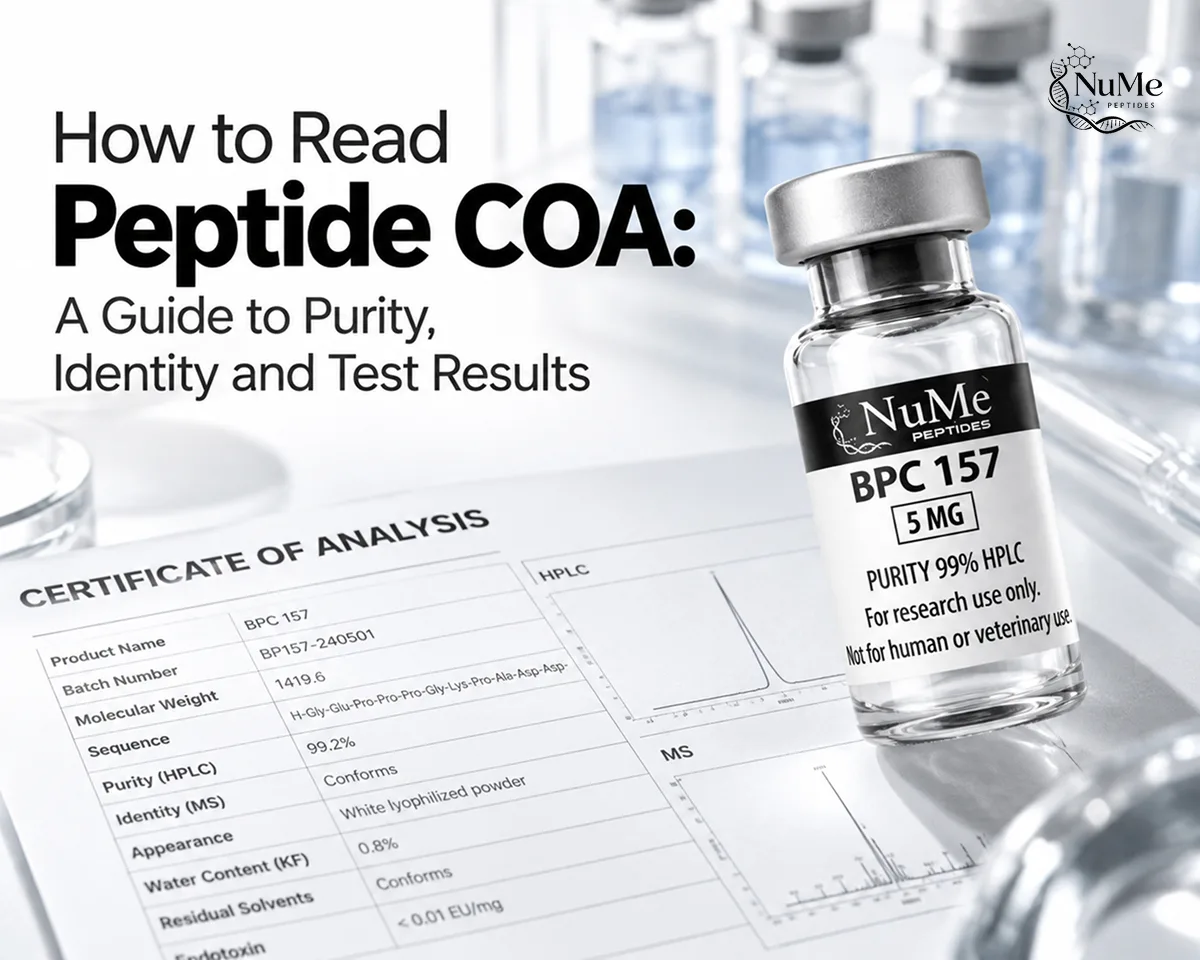
How to Read Peptide COA: A Guide to Purity, Identity and Test Results


A Certificate of Analysis can provide valuable information about a research peptide, but only when the document is interpreted correctly. Researchers need to distinguish product specifications from actual test results, understand what each analytical method measures, and confirm that the certificate corresponds to the specific material being evaluated.
Understanding how to read peptide COA therefore involves much more than finding a purity percentage. A practical review begins with the product and batch information, moves through HPLC and mass spectrometry results, and finishes by checking whether the analytical records match the physical peptide sample.
Established quality guidance offers useful principles for this process. FDA’s ICH Q7 guidance describes Certificates of Analysis as batch-specific documents that should identify the material, list relevant tests and acceptance limits, report numerical results, and include appropriate release and quality information. (U.S. Food and Drug Administration, 2001)
Explore the NuMe Peptides US Shop to review research-focused peptide materials and supporting laboratory documentation.
Which Sections Should You Check First on a Peptide COA?
Researchers can make COA review more consistent by reading the document in a logical order rather than beginning with whichever number appears largest.
A practical sequence is:
- product name;
- peptide sequence or molecular description;
- batch or lot number;
- theoretical molecular mass;
- analytical tests performed;
- specifications or acceptance criteria;
- measured results;
- analytical or release date;
- storage information;
- laboratory or quality authorization, where provided.
The first goal is to establish traceability.
A certificate may report impressive analytical numbers, but they have limited value if researchers cannot connect those results to the actual batch being used.
FDA’s ICH Q7 guidance states that a COA for an API should identify the material and batch number, list each test performed, include acceptance limits, and report numerical results when applicable. The certificate should also be dated and authorized by the appropriate quality unit. (U.S. Food and Drug Administration, 2001)
Researchers should also distinguish between a specification and a result.
For example:
| COA Field | Example |
|---|---|
| Test | HPLC Purity |
| Specification | ≥98.0% |
| Result | 99.2% |
The specification is the acceptance criterion. The result is what was actually measured for that sample.
If a document lists only “Purity ≥98%,” researchers may be looking at a product specification rather than a complete batch-specific analytical result.
How Should Product, Batch and Sample Information Be Interpreted?
The identification section should make it possible to determine exactly what material was analyzed.
Useful fields may include:
- peptide name;
- amino-acid sequence;
- lot or batch number;
- theoretical molecular weight;
- molecular formula;
- physical form;
- salt or counterion, where relevant;
- storage conditions.
Researchers should compare this information with the vial or packaging in the laboratory.
The lot number is especially important because it creates the connection between the physical material and its analytical documentation.
For example, if the peptide vial states:
Lot: NP-261014-A
the COA should identify the same lot or clearly establish how the report relates to that batch.
FDA quality guidance similarly uses batch identification as a foundation of traceability, requiring relevant certificates and laboratory records to identify the specific batch represented by the analytical results. (U.S. Food and Drug Administration, 2001)
Sample form also matters.
A lyophilized peptide is not necessarily composed entirely of peptide by weight. Water, counterions, residual solvents, and other components may contribute to the final material.
Research establishing synthetic peptide reference standards illustrates this distinction. Multiple methods were required to evaluate different attributes, including identity, chromatographic purity, water, residual solvents, counterions, and peptide content. (McCarthy et al., 2023)
This means researchers should ask not only which peptide the certificate names, but exactly which material and batch were tested.
Visit the NuMe Peptides US Shop to explore available research peptides and laboratory-focused products for scientific study.
How Can HPLC Purity Results Be Evaluated?
HPLC purity is one of the most commonly reviewed values on a peptide COA.
High-performance liquid chromatography separates components in a sample according to their behavior within a chromatographic system. As different components leave the column, they generate detector signals that appear as peaks.
A high-purity peptide sample commonly shows one dominant peak and smaller peaks representing detectable related components.
A COA might report:
HPLC Purity: 99.1%
In many cases, this means approximately 99.1% of the relevant integrated chromatographic signal was associated with the principal peak under the specific analytical conditions used.
It does not automatically mean that 99.1% of everything in the vial by weight is the target peptide.
For highly characterized peptide materials, laboratories may separately measure water, counterions, residual solvents, inorganic components, and other variables because HPLC area purity does not capture every part of sample composition. (McCarthy et al., 2023)
Researchers should therefore look beyond the headline number when supporting information is available.
Useful HPLC details may include:
- chromatogram;
- retention time;
- minor peaks;
- column type;
- mobile phase;
- gradient;
- run time;
- flow rate;
- detection wavelength.
Method conditions can materially influence the result.
In an independent analysis of 98 synthetic peptides, every sample arrived with documentation stating at least 95% purity. However, only 43 samples met that specification under the investigators’ independent quality-control method. The study also noted differences between supplier and investigator chromatographic methods. (Verbeke et al., 2018)
The practical lesson is not that one method must always be correct and another wrong. Rather, chromatographic purity is method-dependent and should be interpreted with the analytical conditions in mind.
How Can Mass Spectrometry Results Help Assess Peptide Identity?
HPLC and mass spectrometry answer different questions.
HPLC primarily describes chromatographic composition. Mass spectrometry can provide evidence about molecular identity.
A synthetic peptide has an expected molecular mass calculated from its amino-acid sequence.
A COA might therefore contain:
| Measurement | Example |
|---|---|
| Theoretical Mass | 2,143.8 Da |
| Observed Mass | 2,143.7 Da |
Close agreement between the measured and theoretical values supports the conclusion that the detected molecule is consistent with the intended peptide.
Researchers should still avoid interpreting mass confirmation as proof of purity.
A sample could contain the correct peptide together with other related compounds. Conversely, an HPLC chromatogram might display one dominant component without demonstrating that the component has the expected molecular identity.
Published recommendations for synthetic peptides used in quantitative mass-spectrometry assays emphasize the value of combining chromatographic and MS data. These approaches provide complementary information about purity, molecular mass, contaminants, and peptide characterization. (Hoofnagle et al., 2016)
Some analytical reports may also include tandem mass spectrometry, or MS/MS.
MS/MS fragments selected peptide ions and evaluates the resulting fragment pattern. This can provide additional sequence-related evidence beyond intact molecular mass.
For practical COA reading, researchers can think of the methods this way:
HPLC: How does the sample separate, and how much of the detected signal belongs to the main peak?
Mass spectrometry: Is the molecular information consistent with the peptide the sample claims to contain?
Neither question replaces the other.
How Can Researchers Match COA Details With the Peptide Sample?
The final part of understanding how to read a peptide COA is making sure that the document actually corresponds to the material in hand.
A structured cross-check can help.
Step 1: Match the Product
The peptide name on the vial and certificate should agree.
If the COA provides an amino-acid sequence, verify that it corresponds with the intended research material.
Step 2: Match the Lot Number
Compare the batch identifier on the physical vial with the certificate.
A mismatch means the analytical report may describe a different production batch.
Step 3: Review Molecular Information
Check whether the theoretical molecular mass, observed MS result, sequence, and stated chemical form are logically consistent.
Step 4: Review the Test Dates
Testing or release dates help place the analytical result within the production timeline.
An older generic certificate should not automatically be assumed to describe a newer batch.
Step 5: Check the Analytical Attachments
If separate chromatograms or mass spectra are provided, determine whether they display a sample name, lot number, file identifier, or other information linking them to the certificate.
FDA’s Q7 framework emphasizes maintaining complete laboratory-control records, including graphs, charts, and spectra from instrumental analyses, together with identification of the material and batch tested. (U.S. Food and Drug Administration, 2001)
Step 6: Look for Internal Consistency
Compare all available information.
For example:
- Does the molecular weight correspond with the peptide?
- Does the observed MS mass agree reasonably with the theoretical value?
- Is the reported HPLC result an actual measurement or only a specification?
- Do chromatogram and COA lot identifiers match?
- Are storage instructions consistent across documents?
Step 7: Identify What Was Not Tested
A COA only provides evidence about attributes actually evaluated.
A high HPLC purity result does not automatically establish:
- sterility;
- endotoxin level;
- peptide content by weight;
- residual solvent level;
- moisture;
- long-term stability;
- every possible impurity.
The importance of independent verification is illustrated by research showing that supplier-reported COA purity and independent laboratory measurements can differ significantly depending on the material and analytical method. (Verbeke et al., 2018)
A complete review therefore considers both what the certificate reports and what information remains outside its scope.
Read more about Research Peptide Quality to see how testing, purity, identity, and documentation work together.
FAQs About How to Read a Peptide COA
What should researchers check first on a peptide COA?
Start with the product and lot number. Confirm that the certificate corresponds to the material being reviewed before interpreting purity or identity results.
What is the difference between a specification and a result?
A specification defines an acceptance criterion, such as HPLC purity ≥98%. A result shows what was actually measured for the batch, such as 99.2%.
What does 99% HPLC purity mean?
It usually means the main chromatographic peak represented approximately 99% of the relevant integrated detector signal under that analytical method. It does not automatically mean the vial contains 99% peptide by total weight.
How can mass spectrometry help confirm identity?
Researchers can compare the observed molecular mass with the theoretical mass expected from the peptide sequence. Agreement provides evidence supporting molecular identity. (Hoofnagle et al., 2016)
Should the COA lot number match the vial?
Yes. Matching batch identifiers provide the clearest connection between the analytical report and the physical material used in the laboratory.
Does a COA prove every aspect of peptide quality?
No. A certificate reports only the tests performed and results obtained. Characteristics that were not tested should not be assumed from unrelated results.
Reading a Peptide COA as an Analytical Record
Understanding how to read peptide COA means treating the certificate as a structured analytical record rather than focusing on one attractive percentage.
Begin by confirming product and batch identity.
Next, distinguish specifications from measured results. Evaluate HPLC purity as chromatographic information and mass spectrometry as complementary evidence about molecular identity.
Then compare the certificate with the physical sample, including the lot number, sequence, molecular information, test dates, and any accompanying chromatograms or spectra.
Finally, consider what the COA does not measure.
Purity, identity, peptide content, moisture, residual solvents, stability, and other quality characteristics are separate analytical questions. One successful test cannot automatically substitute for another.
A well-constructed certificate can therefore improve traceability and help researchers evaluate whether available analytical evidence is relevant to their study. Its value comes not from the title “Certificate of Analysis,” but from the quality, consistency, and applicability of the information it contains.
Explore the NuMe Peptides US Shop to review research-focused peptide materials and supporting analytical documentation for laboratory studies.
Disclaimer: This content is provided for scientific and educational purposes only. Research peptides discussed here are presented in a laboratory research context and are not described as products for human consumption, diagnosis, treatment, cure, or prevention of disease.