

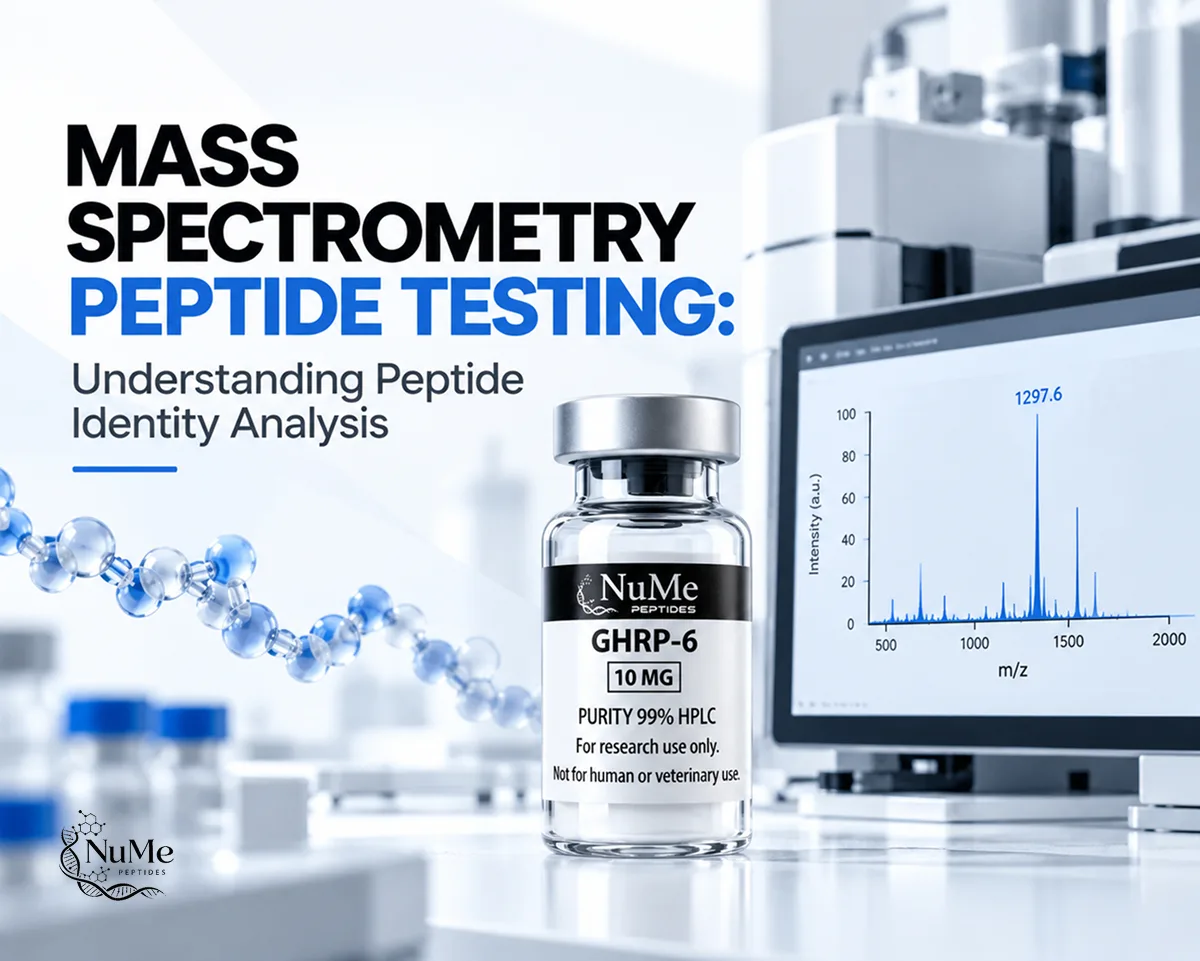
Mass Spectrometry Peptide Testing: Understanding Peptide Identity Analysis


Mass spectrometry has become an important analytical tool in peptide research because it can provide molecular information that chromatography alone cannot fully reveal. Rather than simply showing when a peptide exits a chromatographic column, mass spectrometry measures ions according to their mass-to-charge ratios, allowing researchers to compare experimental data with the expected molecular characteristics of a peptide.
For synthetic materials, mass spectrometry peptide testing can support identity assessment, reveal related molecular species, and complement purity information generated by techniques such as HPLC. Depending on the instrument and experimental method, researchers may examine intact molecular mass, charge states, isotopic distributions, fragment ions, or low-level impurities.
However, an MS result should still be interpreted within an analytical framework. A matching molecular mass provides important evidence, but it does not independently establish chromatographic purity, total peptide content, stability, or every other quality characteristic.
Explore the NuMe Peptides US Shop to review research-focused peptide materials and supporting analytical information for laboratory investigation.
What Is Mass Spectrometry in Peptide Research?
Mass spectrometry, commonly abbreviated MS, is an analytical technique used to measure ions according to their mass-to-charge ratio, usually expressed as m/z.
For peptide research, the technique is especially valuable because the amino-acid sequence of a synthetic peptide is usually known in advance. Researchers can calculate the theoretical molecular mass from that sequence and compare it with experimentally measured values.
A 2024 methodological review describes mass spectrometry as a highly useful approach for evaluating the authenticity and integrity of synthetic peptides. Techniques such as LC-MS and MALDI-TOF-MS can be applied when the analytical goal is to verify a known synthetic sequence and investigate related molecular species. (Højrup, 2024)
The basic process involves three broad stages:
- converting peptide molecules into gas-phase ions;
- separating those ions according to their mass-to-charge ratios;
- detecting and processing the resulting signals.
Several ionization techniques can be used.
Electrospray ionization (ESI) is common in liquid chromatography–mass spectrometry because peptides can move directly from an LC system into the mass spectrometer. ESI frequently produces multiply charged peptide ions, meaning a single peptide can appear at several m/z values.
MALDI, or matrix-assisted laser desorption/ionization, uses a different approach and is often combined with time-of-flight mass analyzers.
The FDA has long recognized mass spectrometry as useful for primary structural analysis of peptides and small proteins, including molecular-mass determination, peptide mapping, identification of variants, and analysis of certain structural modifications. (U.S. Food and Drug Administration, 1991)
Visit the NuMe Peptides US Shop to explore available research peptides and laboratory-focused products for scientific study.

How Does Mass Spectrometry Analyze a Peptide Sample?
Before a mass spectrometer can measure a peptide, the molecule must first become ionized.
In ESI-based analysis, a peptide solution passes through a charged spray. Small droplets form, solvent evaporates, and charged peptide ions eventually enter the mass analyzer.
Because peptides can carry multiple charges, one molecule may generate several signals.
For example, a peptide with molecular mass M might appear as ions carrying +2, +3, or +4 charges. Analytical software can use these charge-state patterns to calculate a deconvoluted molecular mass.
The instrument then separates ions based on their m/z values.
Different mass analyzers accomplish this in different ways. Common examples include:
- time-of-flight analyzers;
- quadrupoles;
- Orbitrap systems;
- ion traps;
- hybrid mass spectrometers.
Higher-resolution instruments can distinguish ions whose masses differ by relatively small amounts, making them especially useful when closely related peptide species need to be investigated.
Mass spectrometry is also frequently coupled to liquid chromatography.
LC separates components before they enter the mass spectrometer, while MS provides molecular information about the separated peaks. This combination is particularly useful for complex peptide samples containing multiple related species.
FDA researchers developed LC-high-resolution MS approaches for peptide quality analysis using calcitonin, bivalirudin, and exenatide as model systems. Their work demonstrated that LC-HRMS could provide high selectivity and sensitivity while also supporting amino-acid composition analysis, sequence confirmation, and impurity measurements, including certain co-eluting species. (Zeng et al., 2015)
This complementary relationship explains why LC-MS is frequently used when researchers need more information than HPLC retention and peak area alone can provide.
What Can Molecular Mass Data Reveal About Peptide Identity?
One of the most direct uses of MS is comparing expected and observed molecular mass.
A peptide’s theoretical mass can be calculated from its amino-acid sequence. If experimental analysis produces a corresponding molecular mass, that result supports the conclusion that the detected material is consistent with the intended peptide.
This is especially useful for synthetic peptides because the expected structure is already defined before testing.
However, researchers should distinguish between supporting identity and proving every aspect of molecular structure.
Two different molecular species can occasionally have the same or very similar nominal mass. Structural isomers and certain stereochemical variants, for example, may not be distinguishable through intact mass alone.
For this reason, more detailed experiments may use tandem mass spectrometry, or MS/MS.
In MS/MS, a selected peptide ion is fragmented inside the instrument. Researchers then examine the fragment-ion pattern to gain additional information about the peptide sequence.
High-resolution LC-MS methods used in peptide research can provide benefits beyond intact molecular mass. FDA research found that these approaches can help confirm peptide sequence and investigate related impurities within the same analytical workflow. (Zeng et al., 2015)
Mass information can also reveal certain modifications.
For instance, oxidation, deletion of an amino acid, or addition of another chemical group may produce a predictable mass difference. Researchers can compare those changes with expected modification patterns to investigate potential related species.
Therefore, molecular mass is highly informative, but the strongest identity assessment may combine intact mass, fragmentation data, chromatography, and other analytical evidence.
How Are Mass Spectrometry Results Evaluated in Research?
A mass spectrum can contain substantially more information than a single molecular-weight value.
Researchers may evaluate several features depending on the analytical goal.
Mass-to-Charge Peaks
The horizontal axis of a mass spectrum usually represents m/z.
A peptide may appear as multiple charged forms, particularly when ESI is used. Analysts identify those charge states and calculate the corresponding molecular mass.
Isotopic Distribution
Natural isotopes create characteristic clusters of peaks.
High-resolution instruments can resolve these isotopic patterns, providing additional evidence about molecular composition and helping analysts distinguish related ions.
Mass Accuracy
Researchers can compare the measured mass with the theoretical value.
The difference may be reported in daltons or parts per million. The acceptable tolerance depends on the instrument, method, and scientific purpose.
Fragment Ions
MS/MS experiments can generate series of peptide fragments.
These fragments may provide sequence-level information, allowing researchers to examine whether portions of the molecule correspond to the expected amino-acid arrangement.
Related Impurity Signals
LC-MS is particularly valuable when a sample contains minor peptide-related components.
FDA research using data-dependent LC-MS/MS identified more than 120 peptide impurities across analyzed calcitonin products. Monoisotopic masses and charge states were evaluated using extracted ion chromatograms and examination of the associated spectra. (U.S. Food and Drug Administration, 2026)
Such approaches may even reveal components that are difficult to recognize as separate peaks in a conventional chromatogram.
Current FDA guidance for certain synthetic peptide drug applications consequently recommends sensitive, high-resolution analytical methods such as UHPLC-HRMS for detecting and characterizing peptide-related impurities. (U.S. Food and Drug Administration, 2021)
For research laboratories, these examples illustrate why MS results are most useful when the analytical objective is defined first: identity confirmation, impurity investigation, sequence analysis, or another specific question.
What Are the Limitations of Mass Spectrometry Peptide Testing?
Mass spectrometry is powerful, but it does not provide every quality measurement on its own.
One limitation is that a correct molecular mass does not establish chromatographic purity.
A sample could contain the intended peptide together with other compounds. Detecting the expected molecular ion confirms that the peptide may be present, but researchers still need appropriate separation and quantitative methods to understand sample composition.
Conversely, some impurities can be difficult to distinguish by intact mass alone.
Stereoisomers are an important example. Two peptide species may have identical molecular formulas and masses but differ in spatial configuration. Specialized chromatography or additional structural methods may therefore be necessary.
Structural complexity can present another challenge.
FDA researchers developed top-down MS approaches for peptide drug products when traditional HPLC methods could not adequately resolve all related peptides or low-level impurities. This demonstrates that even sophisticated MS analysis may require carefully chosen fragmentation or separation strategies for complex materials. (Gucinski & Boyne, 2014)
Ionization efficiency can also vary between compounds.
Two molecules present at identical concentrations may not necessarily produce identical MS signal intensities. Matrix effects, charge state, solvent conditions, peptide sequence, and instrument settings can all affect detector response.
Consequently, signal intensity should not automatically be interpreted as absolute concentration unless the method has been designed and validated for quantitative analysis.
MS also does not independently establish characteristics such as:
- total peptide content by weight;
- moisture content;
- sterility;
- endotoxin status;
- residual solvent concentrations;
- complete stability profile;
- biological activity.
These attributes require other analytical procedures.
For this reason, mass spectrometry peptide testing is strongest when used as part of an orthogonal analytical strategy. FDA materials addressing peptide impurity characterization similarly emphasize combining high-resolution MS with chromatographic methods rather than depending on one technique alone. (U.S. Food and Drug Administration, 2023)
Read more about Research Peptide Quality to see how testing, purity, identity, and documentation work together.

FAQs About Mass Spectrometry Peptide Testing
What does mass spectrometry measure in a peptide sample?
Mass spectrometry measures ions according to their mass-to-charge ratios. From these measurements, researchers can calculate molecular mass and investigate molecular identity or related peptide species.
Can mass spectrometry confirm peptide identity?
It can provide strong supporting evidence. A measured molecular mass that agrees with the expected sequence supports identity, while MS/MS can add sequence-related information.
What is the difference between MS and MS/MS?
MS examines mass-to-charge information for ions, while MS/MS selects an ion and fragments it to produce additional structural or sequence information.
Why is LC-MS commonly used for peptide analysis?
Liquid chromatography first separates components, while mass spectrometry provides molecular information about those components. This combination can help characterize peptide-related impurities and distinguish species that conventional HPLC detection may not fully resolve.
Does a correct molecular mass mean a peptide is pure?
No. Molecular identity and purity are separate analytical characteristics. A sample can contain a peptide with the expected mass while also containing impurities.
Can mass spectrometry detect peptide impurities?
Yes, particularly when combined with liquid chromatography and high-resolution or tandem MS. The ability to detect an impurity depends on its concentration, ionization behavior, separation, instrument sensitivity, and analytical method.
Understanding Molecular Identity Through Mass Spectrometry
Mass spectrometry peptide testing provides researchers with a detailed way to examine the molecular characteristics of peptide samples.
Intact-mass measurements can be compared with theoretical values calculated from the expected amino-acid sequence. High-resolution instruments can provide accurate mass and isotopic information, while tandem MS can add sequence-related evidence through analysis of peptide fragments.
When paired with liquid chromatography, the technique becomes especially useful for investigating complex samples and related peptide impurities.
However, molecular identity is only one aspect of sample characterization.
Mass spectrometry does not replace chromatographic purity testing, content assays, stability studies, moisture analysis, or other methods required to answer different quality questions. Likewise, a matching molecular mass should not automatically be interpreted as proof that every structural variant or impurity has been excluded.
The most informative approach is therefore to combine MS with complementary analytical methods according to the needs of the experiment.
Used in this context, mass spectrometry provides an important bridge between a peptide’s stated sequence and the molecular evidence supporting its identity.
Explore the NuMe Peptides US Shop to review research-focused peptide materials and supporting analytical information for scientific studies.
Disclaimer: This content is provided for scientific and educational purposes only. Research peptides discussed here are presented in a laboratory research context and are not described as products for human consumption, diagnosis, treatment, cure, or prevention of disease.