

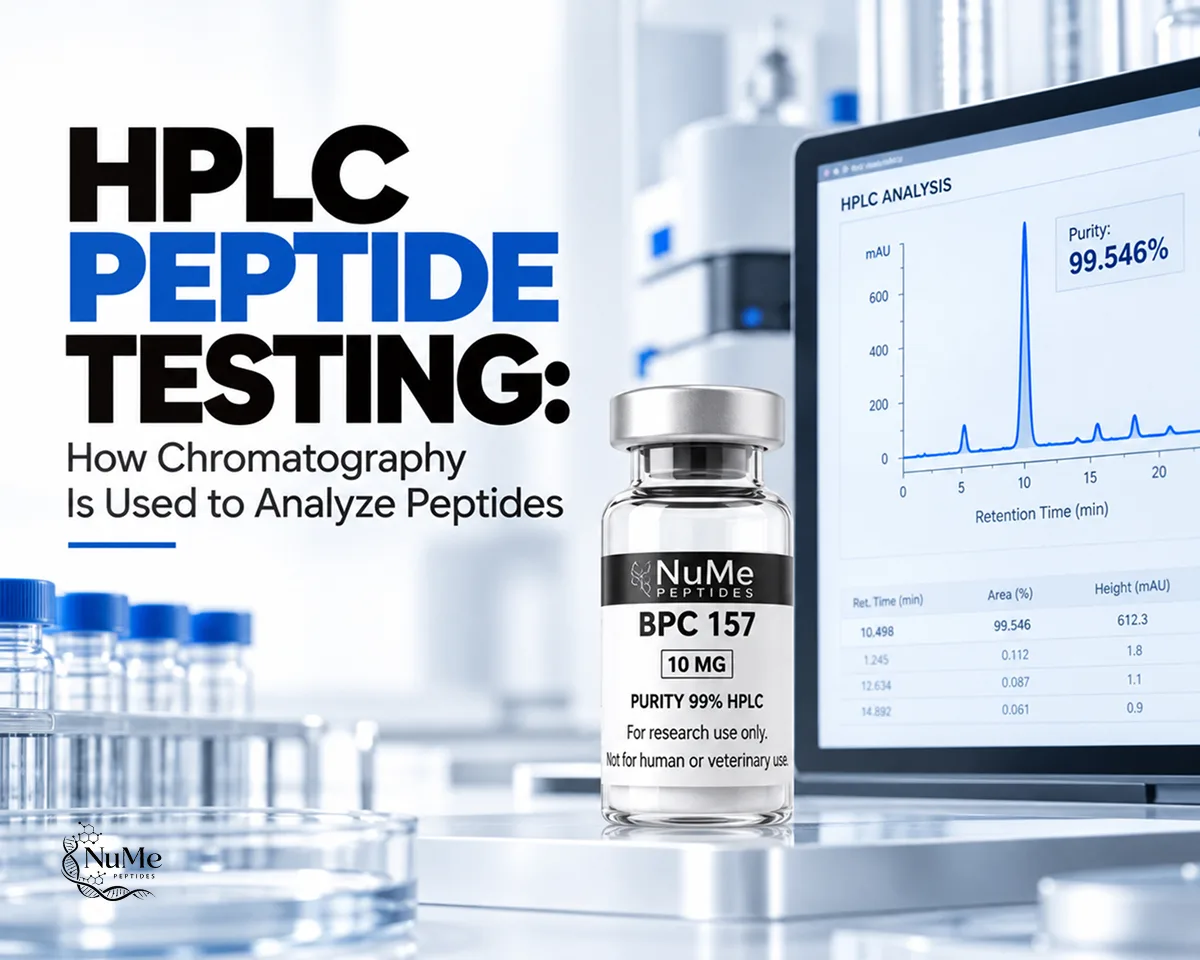
HPLC Peptide Testing: How Chromatography Is Used to Analyze Peptides


HPLC peptide testing is one of the most widely used analytical approaches in peptide science. High-performance liquid chromatography can separate a complex sample into individual components, helping researchers examine the relative composition of a peptide preparation and identify detectable impurities.
For research peptides, reversed-phase HPLC is particularly common because peptide molecules can be separated according to differences in their interactions with the stationary phase and mobile phase. The resulting chromatogram provides information about retention behavior, peak distribution, and relative peak areas.
However, chromatography should not be interpreted as a complete quality assessment by itself. A large primary peak does not independently confirm molecular identity, and closely related compounds may sometimes co-elute. Understanding how the method works is therefore essential when interpreting reported purity values.
Explore the NuMe Peptides US Shop to review research-focused peptide materials and supporting analytical information for laboratory investigation.
What Is HPLC and How Does the Technique Work?
High-performance liquid chromatography, commonly abbreviated HPLC, is a separation technique that moves a liquid sample through a column packed with a stationary material.
The instrument typically includes several major components:
- mobile-phase reservoirs;
- pumps;
- an injector or autosampler;
- a chromatographic column;
- a detector;
- data-processing software.
Once injected, the sample travels through the column with the mobile phase. Different compounds interact with the stationary phase to different degrees, causing them to move through the system at different rates.
The time between injection and detection is known as retention time.
For peptide analysis, reversed-phase HPLC, or RP-HPLC, is among the most important chromatographic modes. In this system, peptides are separated largely according to differences in hydrophobic interactions. More hydrophobic molecules generally interact more strongly with the reversed-phase stationary material and may require a higher proportion of organic solvent before they elute.
RP-HPLC has become a major method for peptide separation at analytical and preparative scales and is also highly compatible with downstream mass spectrometry. (Josic & Kovac, 2010)
Peptide analysis often uses a gradient rather than a constant mobile-phase composition.
For example, the proportion of organic solvent can gradually increase during the run. As solvent strength changes, different peptide species elute from the column and enter the detector at different times.
The method can therefore convert a complex peptide mixture into a chromatogram in which individual components appear as peaks.
Importantly, the quality of the separation depends on the chromatographic method. Column characteristics, solvent composition, temperature, gradient steepness, flow rate, and mobile-phase additives can all influence retention and resolution. (Sharma et al., 2022)
Visit the NuMe Peptides US Shop to explore available research peptides and laboratory-focused products for scientific study.
How Is HPLC Applied to Research Peptide Analysis?
HPLC peptide testing can serve several purposes during research peptide production and evaluation.
One application is purification.
After chemical synthesis, crude peptide material may contain the target molecule together with deletion sequences, truncated peptides, side-reaction products, residual synthesis components, and other impurities.
Preparative chromatography allows the desired peptide fraction to be separated from many of these unwanted components.
HPLC has been used extensively for peptide isolation and purification because several chromatographic modes can be adapted to peptide properties. Reversed-phase, ion-exchange, size-exclusion, and mixed-mode methods can each provide different separation mechanisms. (Mant et al., 2007)
Analytical HPLC serves a different purpose.
Instead of collecting purified material, laboratories use a smaller analytical run to examine sample composition. The chromatogram may reveal whether one component dominates the sample and whether additional detectable peptide-related species remain.
This distinction between preparative and analytical chromatography is useful:
| HPLC Application | Main Purpose |
|---|---|
| Preparative HPLC | Isolate and collect the target peptide |
| Analytical HPLC | Examine composition and chromatographic purity |
| LC-MS | Combine separation with molecular information |
| Size-exclusion HPLC | Examine separation related to molecular size |
| Ion-exchange HPLC | Separate compounds according to charge |
Researchers can also use chromatography to monitor peptide degradation.
If a sample is analyzed at multiple time points, new peaks or changes in peak areas may indicate the formation of degradation-related species. Chromatographic techniques are widely used for characterization because peptide degradation products and impurities can differ in retention behavior from the original molecule. (Sharma et al., 2022)
Thus, the role of HPLC extends beyond reporting a headline purity percentage. It can contribute to purification, process monitoring, stability analysis, and impurity investigation.
What Information Can an HPLC Chromatogram Provide?
A chromatogram is the visual output of an HPLC analysis.
The horizontal axis typically represents time, while the vertical axis represents detector response. As different components leave the column, they generate individual peaks.
Several features can provide useful analytical information.
Retention Time
Retention time indicates when a detected component exits the chromatographic column.
Under the same validated conditions, the target peptide may show relatively consistent retention behavior. However, retention time alone should not be treated as definitive molecular identification because unrelated compounds can sometimes have similar chromatographic behavior.
Peak Area
Peak area measures the integrated detector response associated with a chromatographic peak.
In many purity analyses, researchers compare the area of the principal peptide peak with the total relevant integrated peak area.
For example, if the dominant peak represents approximately 99% of the integrated chromatographic signal, the sample may be reported as approximately 99% pure by that HPLC method.
This percentage should be understood as area purity under defined analytical conditions, not automatically as 99% peptide by total vial mass.
Minor Peaks
Smaller peaks may represent synthesis-related impurities, degradation products, structural variants, or other detectable components.
Their appearance can help laboratories evaluate the complexity of the impurity profile.
However, not every impurity will necessarily produce a clearly separated peak. Product-related peptide impurities can be especially challenging because they may differ from the target molecule by only a small structural modification. Liquid chromatography remains important for separating such species, but closely related impurities can require carefully optimized methods. (De Luca et al., 2021)
A chromatogram therefore gives researchers a map of detectable components under a specific set of chromatographic conditions rather than a complete molecular inventory of the sample.
How Are HPLC Peaks and Purity Results Interpreted?
Interpreting an HPLC result requires more than identifying the largest peak.
The first consideration is resolution.
Two molecules can only be measured separately when the chromatographic method separates them sufficiently. If an impurity elutes very close to the main peptide, the resulting peaks may overlap.
This process is known as co-elution.
When co-elution occurs, an impurity can contribute signal to what appears to be the target peak. As a result, the reported purity may look higher than it would under a method capable of completely separating the compounds.
Recent research using a defined peptide impurity library demonstrated that chromatographic variables such as flow rate, gradient conditions, temperature, and mobile-phase modifiers can influence peptide selectivity and resolution. (Streuli et al., 2026)
This is why a purity percentage should always be interpreted together with method information.
Researchers may consider:
- column chemistry;
- column dimensions;
- mobile-phase composition;
- gradient profile;
- flow rate;
- column temperature;
- detection wavelength;
- injection amount;
- integration settings.
Peak shape is another consideration.
A narrow, symmetrical peak generally indicates more favorable chromatographic behavior than a broad, tailing, or distorted peak. However, peak appearance alone cannot confirm sample identity.
Chromatograms can also be compared across batches or time points.
If the target peak decreases while additional peaks increase, researchers may investigate whether degradation has occurred. Likewise, differences in impurity patterns between lots may suggest variations in synthesis, purification, or storage history.
Consequently, a reported value such as “99% by HPLC” is most informative when the analytical conditions and actual chromatogram are available for review.
What Are the Limitations of HPLC Peptide Testing?
HPLC is powerful, but it does not answer every analytical question.
One important limitation is molecular identification.
A chromatographic peak shows that a component eluted from the column at a particular time, but the chromatogram alone does not reveal the complete molecular structure of that component.
For this reason, chromatography is frequently paired with mass spectrometry.
LC-MS combines the resolving power of liquid chromatography with mass-based detection. This allows laboratories to separate peptide species and then examine their mass-to-charge characteristics, providing information that conventional HPLC-UV alone cannot provide. (John et al., 2003)
Another limitation is co-elution.
Closely related peptide impurities may have very similar chromatographic properties. If the method does not provide adequate resolution, multiple species can contribute to a single apparent peak.
FDA research on peptide impurity profiling illustrates why complementary MS-based approaches can be valuable. LC-MS/MS methods have been used to identify large numbers of low-level peptide impurities that require more detailed molecular characterization than a conventional chromatogram alone provides.
Detection method also matters.
UV detection depends on how strongly a molecule absorbs at the selected wavelength. Different species may produce different detector responses, which means chromatographic area is not always equivalent to absolute molecular quantity.
In addition, HPLC purity does not automatically establish:
- molecular identity;
- exact peptide content by weight;
- sterility;
- endotoxin status;
- moisture content;
- counterion concentration;
- residual solvents;
- every possible impurity.
Therefore, HPLC peptide testing is best interpreted as one component of a broader analytical framework.
Mass spectrometry can provide complementary identity information, while additional methods may be needed to examine moisture, residual solvents, peptide content, aggregation, or other attributes relevant to the research application.
Read more about Research Peptide Quality to see how testing, purity, identity, and documentation work together.
FAQs About HPLC Peptide Testing
What does HPLC stand for?
HPLC stands for high-performance liquid chromatography. It is an analytical and preparative technique used to separate components in a mixture according to their interactions with a chromatographic system.
Why is reversed-phase HPLC commonly used for peptides?
RP-HPLC provides effective peptide separation based largely on differences in hydrophobic behavior and can be used across analytical and preparative applications. It is also compatible with mass spectrometry. (Josic & Kovac, 2010)
What does a 99% HPLC purity result mean?
It generally means that approximately 99% of the relevant integrated chromatographic signal was associated with the principal peak under the specific method used. It does not necessarily mean that 99% of the total vial mass is peptide.
Does one HPLC peak prove peptide identity?
No. A single dominant peak indicates chromatographic composition but does not independently confirm molecular identity. Mass spectrometry can provide complementary molecular-mass information.
Can two peptide samples with the same HPLC purity have different impurities?
Yes. Two samples can report the same overall percentage while containing different minor impurities or degradation products. Purity percentage and impurity identity are separate analytical questions.
Why can different laboratories obtain different HPLC results?
Differences in columns, mobile phases, gradients, temperatures, flow rates, instrumentation, detection conditions, and integration methods can influence peptide separation and reported purity. (Streuli et al., 2026)
Understanding HPLC Results in Peptide Research
HPLC peptide testing is a valuable tool because it transforms a complex peptide sample into an analytical separation that researchers can examine.
Retention time provides information about chromatographic behavior. Peak area helps estimate relative composition, while minor peaks can reveal detectable impurities or degradation-related species.
However, the quality of that information depends strongly on the method.
A chromatogram showing one dominant peak is most meaningful when the analytical conditions provide sufficient resolution to separate the target peptide from closely related compounds. Gradient design, column chemistry, temperature, flow rate, and mobile-phase composition can all influence that separation.
Researchers should therefore interpret HPLC purity as method-specific evidence rather than as a universal statement about total sample quality.
When deeper characterization is required, combining chromatography with mass spectrometry can add molecular information and help distinguish peptide-related species that may otherwise be difficult to identify.
Used within this broader analytical context, HPLC remains one of the most useful techniques for examining peptide composition, purification performance, impurity patterns, and stability changes in scientific research.
Explore the NuMe Peptides US Shop to review research-focused peptide materials and supporting analytical information for laboratory studies.
Disclaimer: This content is provided for scientific and educational purposes only. Research peptides discussed here are presented in a laboratory research context and are not described as products for human consumption, diagnosis, treatment, cure, or prevention of disease.


This article does a great job of explaining HPLC testing in a way that’s accessible to readers without a strong chemistry background. I found the explanation of how chromatography helps assess peptide purity particularly useful. Could you explain in a future post how to interpret a chromatogram and identify the main peaks?
I appreciate how this article highlights the role of HPLC in evaluating research peptide samples. One thing I find interesting is that a high purity percentage doesn’t necessarily confirm a peptide’s identity or establish every aspect of its quality. How is HPLC typically combined with other analytical techniques to provide a more complete assessment?
This was a helpful overview of an analytical technique that’s important in peptide research. I particularly liked the focus on understanding test results rather than treating a single purity number as the whole story. Are there common factors, such as sample preparation or testing conditions, that researchers should consider when comparing HPLC results from different laboratories?