

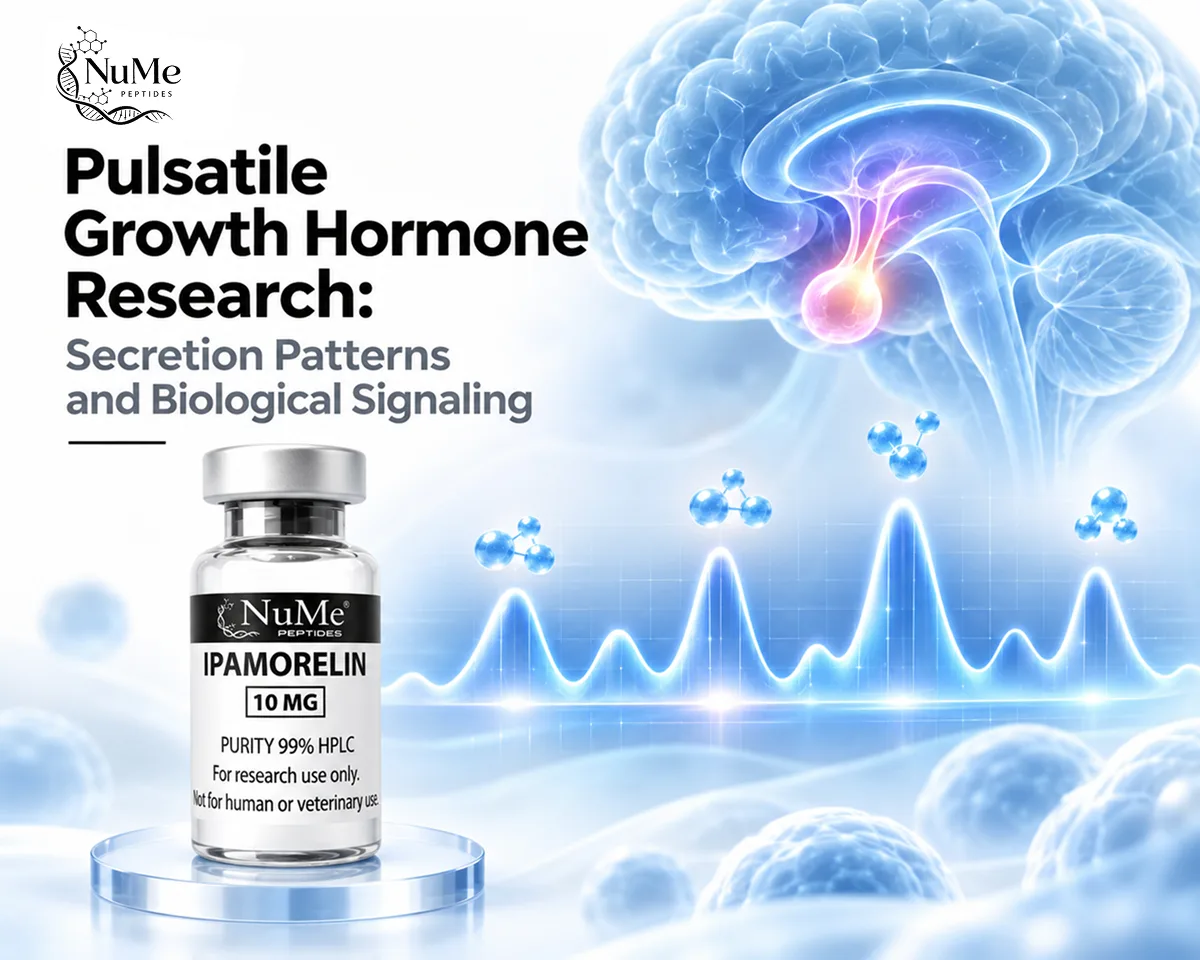
Pulsatile Growth Hormone Research: Secretion Patterns and Biological Signaling


Growth hormone (GH) is not normally released into circulation at a constant rate. Instead, pituitary somatotroph cells produce a series of secretory bursts separated by periods in which circulating GH concentrations can fall substantially. This pulsatile organization is a fundamental feature of the somatotropic axis and can influence how target tissues respond to hormonal signals.
Modern pulsatile growth hormone research examines much more than total GH concentration. Researchers measure pulse frequency, amplitude, duration, trough levels, total secretion, and relationships with insulin-like growth factor 1 (IGF-1). They also investigate how sleep, sex, age, nutrition, hypothalamic GHRH, somatostatin, and ghrelin-related pathways modify these patterns.
Peptides such as Ipamorelin, GHRP-6, and CJC-1295 provide different experimental tools for altering GH secretion. Their mechanisms and effects on pulse architecture differ, making them useful for studying separate levels of GH-axis regulation.
Explore the NuMe Peptides US Shop for research-focused compounds associated with growth hormone secretion, endocrine signaling, and laboratory investigation.
What Is Pulsatile Growth Hormone Secretion?
Pulsatile secretion means that GH enters circulation in distinct bursts rather than at a steady concentration.
Between these secretory events, GH levels may decrease toward relatively low baseline or trough concentrations. During a pulse, however, circulating levels can rise rapidly before declining again.
A recent review of GH synthesis and regulation describes this pulsatility as a tightly regulated feature of the hypothalamic-pituitary system. GHRH, somatostatin, and ghrelin-related signals interact with feedback from GH and IGF-1, while sleep, age, sex, nutrition, and physiological state further influence secretion. (Iglesias & Guerrero-Pérez, 2026)
Two hypothalamic signals are particularly important.
GHRH promotes GH release from pituitary somatotrophs.
Somatostatin suppresses secretion and contributes to the intervals between secretory bursts.
Ghrelin and growth hormone secretagogue receptor signaling add another layer of control.
Consequently, a GH pulse does not represent activity from one receptor alone. It reflects the changing balance among multiple stimulatory and inhibitory signals.
Researchers may describe a secretion pattern according to several characteristics:
- pulse frequency;
- pulse amplitude;
- pulse duration;
- basal or trough GH;
- total GH secretion;
- inter-pulse intervals;
- integrated GH concentration.
These variables can change independently. A compound might raise trough GH without increasing pulse frequency, for example, producing a different endocrine pattern from a compound that primarily increases pulse amplitude.
Why Do Researchers Study Growth Hormone Secretion Patterns?
Researchers study secretion patterns because the biological information carried by an endocrine signal may depend partly on its timing.
Two subjects could theoretically produce a similar total quantity of GH over 24 hours while distributing that secretion differently across the day.
One might have several pronounced peaks separated by low troughs, whereas another could maintain more continuously elevated concentrations.
These patterns are not necessarily biologically equivalent.
Experimental evidence has shown that GH signaling can depend on whether tissues experience intermittent or continuous hormone exposure. Pulsatile stimulation can generate different downstream responses from persistent signaling, particularly in pathways involving gene transcription and hepatic GH activity.
Secretion patterns also vary physiologically.
Classic 24-hour sampling studies found substantial age- and sex-related differences in GH secretion. Younger individuals had greater integrated GH secretion and larger secretory pulses than older participants, while sex-related differences were also observed in total secretion. (Ho et al., 1987)
Modern reviews continue to identify age, sex, sleep, nutritional status, stress, body composition, and metabolic state as major modifiers of GH output.
Pulsatility also matters when interpreting IGF-1.
GH stimulates IGF-1 production, particularly through hepatic growth hormone receptor signaling. However, total IGF-1 response does not necessarily correspond directly with one individual characteristic of GH pulses.
This was demonstrated in research involving CJC-1295: IGF-1 increased substantially despite no significant change in pulse frequency or pulse magnitude. Instead, increased trough and mean GH contributed to greater overall hormonal exposure. (Ionescu & Frohman, 2006)
This distinction helps researchers separate how much GH is secreted from how that secretion is temporally organized.
Explore the Growth Hormone research collection for peptides associated with GH-axis, GHRH, and endocrine signaling studies.
How Are Growth Hormone Pulses Measured in Research?
A single GH measurement cannot reliably describe pulsatility.
Because concentrations can change rapidly, researchers commonly use frequent blood sampling over extended periods.
For example, blood may be collected every 10–20 minutes for:
- several hours;
- overnight periods;
- 12-hour protocols;
- full 24-hour studies.
Researchers can then construct a concentration-versus-time profile.
In the CJC-1295 pulsatility study, healthy men underwent blood sampling every 20 minutes over a 12-hour overnight period. This allowed investigators to compare GH pulse characteristics before and one week after exposure to the long-acting GHRH analogue. (Ionescu & Frohman, 2006)
Researchers may calculate several metrics from these profiles.
Pulse Frequency
This indicates how many identifiable secretory episodes occur during the observation period.
Pulse Amplitude
Amplitude describes how large a secretory burst becomes relative to preceding baseline concentrations.
Trough GH
Trough concentration represents the lower GH level occurring between pulses.
This parameter can be especially informative when studying prolonged stimulation.
Mean GH Concentration
Mean concentration reflects overall exposure across the measurement period.
Area Under the Curve
GH area under the curve, or AUC, summarizes hormone exposure over time and is frequently used in secretagogue studies.
Researchers may also use mathematical pulse-detection or deconvolution methods to estimate underlying secretion rates rather than relying only on measured blood concentrations.
For example, prolonged GHRP infusion experiments have used detailed secretion analysis to show that GH output can increase substantially while remaining organized into identifiable pulses. (Jaffe et al., 1993)
These methods help distinguish a true change in pulse organization from a general increase in circulating hormone.
Which Biological Factors Influence Growth Hormone Pulsatility?
GH secretion patterns reflect interactions among central neuroendocrine signals and broader physiological conditions.
GHRH
Growth hormone-releasing hormone stimulates pituitary somatotrophs and contributes to initiation of secretory episodes.
Changes in endogenous GHRH availability can therefore modify GH pulse generation.
Somatostatin
Somatostatin supplies inhibitory control.
Changes in somatostatin tone help determine whether pituitary somatotrophs are relatively responsive or suppressed during a given period.
Ghrelin and Secretagogue Signaling
Ghrelin activates GHS-R1a and can stimulate GH release through mechanisms that interact with endogenous GHRH.
GHRP-6 has been particularly useful for demonstrating this relationship. In healthy men, blocking endogenous GHRH removed most of the GH response to GHRP-6, indicating that secretagogue activity depends substantially on the surrounding GHRH system. (Popovic et al., 1998)
Sleep
GH secretion has a strong relationship with sleep architecture.
Major GH pulses frequently occur during early nighttime sleep, particularly in association with slow-wave sleep, although sleep-related patterns vary with age and other physiological factors.
Age and Sex
Aging is associated with reduced GH secretion, including changes in pulse amplitude and overall output.
Twenty-four-hour sampling studies have demonstrated lower integrated secretion and reduced pulse characteristics in older adults compared with younger groups. (Ho et al., 1987)
Nutrition and Metabolic State
Glucose availability, fasting, amino acids, body composition, and insulin-related signals can influence GH secretion.
A 2025 review of GH feedback emphasizes that the hormone is regulated through interacting hypothalamic, endocrine, metabolic, and feedback signals rather than a fixed secretory program. (de Sousa et al., 2025)
Researchers must therefore control experimental conditions carefully when comparing GH pulse profiles.
How Are Peptides Investigated in Growth Hormone Secretion Studies?
Peptide studies can modify different regulatory points within the GH axis.
Ipamorelin
Ipamorelin is a synthetic pentapeptide growth hormone secretagogue associated with the GHS-R pathway.
Its original pharmacological characterization demonstrated potent GH release in cultured pituitary cells and animal models. Importantly, Ipamorelin produced relatively selective GH stimulation compared with earlier GHRPs under the experimental conditions studied.
This profile makes Ipamorelin useful for investigating secretagogue-driven GH release without treating the compound as a direct growth hormone receptor agonist.
The distinction matters mechanistically:
Ipamorelin activates an upstream secretagogue pathway, endogenous GH is released, and that GH can subsequently activate peripheral growth hormone receptors.
Explore Ipamorelin 10 mg for laboratory research involving growth hormone secretagogue signaling and GH-axis regulation.
GHRP-6
GHRP-6 is one of the foundational peptide secretagogues used to investigate GH secretion.
It can produce substantial GH responses, but those effects depend strongly on the surrounding endocrine environment.
In healthy men, administration of a GHRH antagonist before GHRP-6 reduced the maximum GH response from approximately 33.8 to 6.2 µg/L, demonstrating that endogenous GHRH contributes substantially to GHRP-6 activity. (Popovic et al., 1998)
Longer exposure provides additional insight.
In prolonged GHRP infusion experiments, GH secretion increased markedly but retained pulsatile characteristics. Pulse number, duration, height, amplitude, and inter-pulse concentrations were greater during secretagogue exposure than during saline control periods.
This makes GHRP research useful for investigating how secretagogue signaling modifies an existing pulse-generating system rather than simply replacing it with constant secretion.
Explore GHRP-6 10 mg for laboratory research involving secretagogue signaling and endogenous GH regulation.
CJC-1295
CJC-1295 acts through a different receptor pathway.
Classic CJC-1295 is a long-acting GHRH analogue containing a Drug Affinity Complex that prolongs exposure through albumin binding.
Human studies demonstrated sustained increases in mean GH and IGF-1. A single administration increased mean GH approximately two- to ten-fold for six days or longer and increased IGF-1 for approximately nine to eleven days. (Teichman et al., 2006)
The most relevant finding for pulsatility came from a subsequent study.
One week after CJC-1295 administration, researchers found that GH secretion remained pulsatile. Pulse frequency and magnitude were not significantly changed, but trough GH increased approximately 7.5-fold, mean GH increased approximately 46%, and IGF-1 increased approximately 45%
This experiment illustrates an important principle: prolonged stimulation of the GHRH receptor can increase overall GH exposure without necessarily eliminating the endogenous pulse structure.
Researchers should also distinguish classic DAC-containing CJC-1295 from products described as CJC-1295 No DAC, because pharmacokinetic findings from the long-acting compound should not automatically be applied to shorter-acting modified GHRH preparations.
FAQs About Pulsatile Growth Hormone Research
What does pulsatile GH secretion mean?
It means GH is released in distinct secretory bursts separated by lower concentrations rather than maintaining one constant circulating level.
Why can’t researchers measure GH with one blood sample?
A single measurement may occur during either a pulse or a trough. Frequent sampling provides a more complete picture of secretion frequency, amplitude, and overall exposure.
What controls GH pulses?
GHRH, somatostatin, ghrelin-related secretagogue signaling, GH and IGF-1 feedback, sleep, age, sex, nutrition, and metabolic state all influence GH secretion patterns. (Iglesias & Guerrero-Pérez, 2026)
Does GHRP-6 preserve pulsatile GH secretion?
Experimental prolonged-infusion studies found that GH secretion remained pulsatile while several pulse characteristics and total secretion increased.
Does CJC-1295 eliminate natural GH pulses?
No. Human research with long-acting CJC-1295 found preserved pulsatility despite higher mean and trough GH concentrations.
How does Ipamorelin fit into pulsatility research?
Ipamorelin is a growth hormone secretagogue that stimulates endogenous GH through a GHS-R-related pathway. It is useful experimentally for studying secretagogue-dependent GH release rather than direct GHR activation.
Current pulsatile growth hormone research shows that GH secretion should be interpreted as a dynamic pattern rather than a single concentration.
Pulse frequency, amplitude, trough levels, mean GH, and total exposure may each respond differently to physiological or experimental stimulation.
Ipamorelin and GHRP-6 investigate the secretagogue side of this regulatory system. GHRP-6 research demonstrates the importance of endogenous GHRH and shows that secretagogue stimulation can amplify GH output while retaining pulsatile organization. CJC-1295 approaches the system through prolonged GHRH-receptor stimulation and provides direct human evidence that increased overall GH and IGF-1 can coexist with preserved pulses.
These differences make timing and secretion patterns essential when interpreting experimental GH data.
Rather than asking only whether a peptide increases growth hormone, researchers can examine how the temporal structure of secretion changes and which regulatory pathway produced that change.
Explore the NuMe Peptides US Shop for research-focused compounds associated with growth hormone secretion, endocrine signaling, and laboratory investigation.
Disclaimer: This content is provided for scientific and educational purposes only. Research peptides discussed here are presented in a laboratory research context and are not described as products for human consumption, diagnosis, treatment, cure, or prevention of disease.