

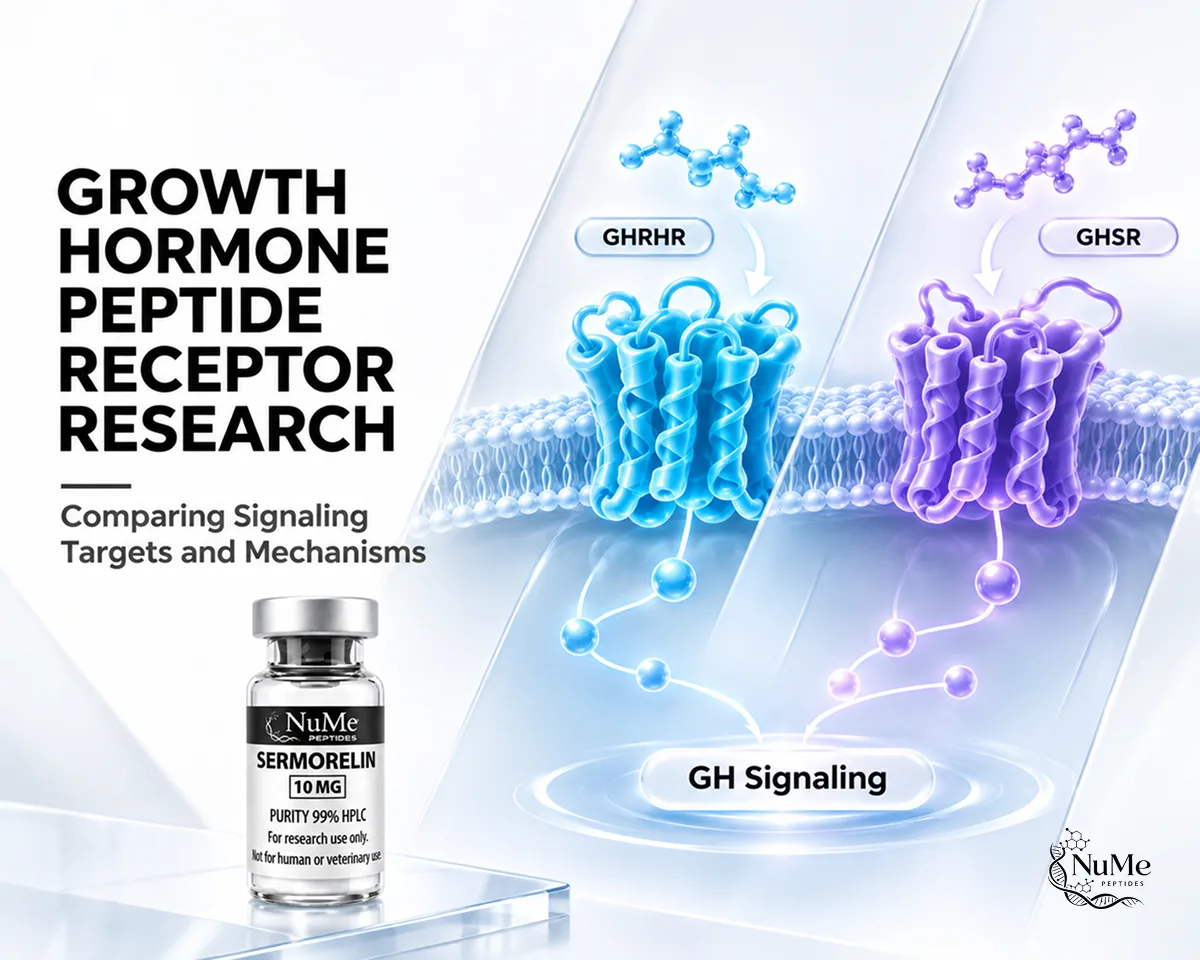
Growth Hormone Peptide Receptor Research: Comparing Signaling Targets and Mechanisms


Growth hormone regulation involves several receptor systems that operate at different levels of the hypothalamic-pituitary-peripheral axis. Understanding which receptor a peptide interacts with is essential because compounds that ultimately increase growth hormone (GH) secretion do not necessarily act through the same molecular target.
Modern growth hormone peptide receptor research distinguishes between peptides that activate the growth hormone-releasing hormone receptor (GHRHR), compounds associated with the growth hormone secretagogue receptor (GHS-R1a), and downstream receptors such as the growth hormone receptor (GHR) and insulin-like growth factor 1 receptor (IGF1R).
CJC-1295 and Sermorelin are investigated primarily as GHRH-related peptides. Ipamorelin and GHRP-6 belong to the growth hormone secretagogue class and interact with a different receptor system. Comparing these pathways helps researchers interpret changes in GH secretion without incorrectly assuming that all GH-releasing peptides share the same mechanism.
Explore the NuMe Peptides US Shop for research-focused compounds associated with growth hormone secretion, endocrine signaling, and laboratory investigation.
Which Receptors Are Relevant to Growth Hormone Peptide Research?
Several receptors are relevant when researchers investigate peptide-mediated regulation of growth hormone.
Growth Hormone-Releasing Hormone Receptor
GHRHR is a G protein-coupled receptor expressed prominently on pituitary somatotroph cells.
When endogenous GHRH or a GHRH-related analogue binds the receptor, Gs proteins activate adenylyl cyclase, increasing intracellular cyclic AMP. This activates protein kinase A and downstream processes involved in GH synthesis and secretion.
Modern receptor research confirms that GHRHR is a seven-transmembrane GPCR and that cAMP signaling remains one of its central signaling mechanisms. (Halmos et al., 2025)
CJC-1295 and Sermorelin are relevant to this receptor family.
Growth Hormone Secretagogue Receptor
GHS-R1a is another GPCR, but it is molecularly and functionally distinct from GHRHR.
It is commonly called the ghrelin receptor because acyl-ghrelin is its endogenous ligand.
GHS-R exists in multiple isoforms, but GHS-R1a is the form capable of binding ghrelin and transmitting intracellular signals. The receptor commonly couples to Gαq/11-related pathways and also displays substantial constitutive activity. (Laviano et al., 2012)
Ipamorelin and GHRP-6 belong to the synthetic growth hormone secretagogue class associated with this receptor system.
Growth Hormone Receptor
GHR is a separate downstream receptor.
It is activated by GH itself, not directly by GHRH analogues or GH secretagogues.
Once a peptide stimulates the pituitary to release endogenous GH, circulating GH can bind GHR in tissues such as liver, muscle, adipose tissue, and bone.
This distinction prevents a common mechanistic error: CJC-1295, Sermorelin, Ipamorelin, and GHRP-6 should not be described as direct GHR agonists.
IGF-1 Receptor
IGF1R sits even further downstream.
GH stimulation of hepatic and peripheral tissues can increase IGF-1 production. IGF-1 can then activate IGF1R.
Therefore, changes in IGF-1 signaling following a GH-releasing peptide are secondary endocrine effects rather than evidence that the peptide directly binds IGF1R.
Explore the Growth Hormone research collection for peptides associated with GH-axis, GHRH, and endocrine signaling studies.
How Do Different Peptide Classes Interact With Growth Hormone-Related Receptors?
The most useful way to compare research peptides is by their initial receptor target.
| Peptide Class | Examples | Primary Research Target | Relationship to GH |
|---|---|---|---|
| GHRH-related peptides | CJC-1295, Sermorelin | GHRHR | Stimulate pituitary GH synthesis and release |
| GH secretagogues | Ipamorelin, GHRP-6 | GHS-R1a-related pathway | Stimulate endogenous GH through secretagogue signaling |
| Endogenous GH | Growth hormone | GHR | Activates peripheral GH signaling |
| Downstream growth factor | IGF-1 | IGF1R | Mediates downstream growth-factor signaling |
GHRH-related compounds imitate or modify signaling normally initiated by endogenous GHRH.
Sermorelin corresponds to GHRH(1-29)-NH₂, the N-terminal sequence responsible for much of native GHRH’s biological activity. Research in healthy men showed that GHRH(1-29)-NH₂ stimulated GH release with potency comparable to longer GHRH sequences. (Lance et al., 1984)
CJC-1295 also belongs to the GHRH analogue category but was engineered for extended activity. The classic DAC-containing compound binds circulating albumin, producing substantially longer exposure than native GHRH fragments.
Ipamorelin and GHRP-6 approach the system differently.
Ipamorelin was characterized as a potent synthetic GH secretagogue in pituitary and animal models. It produced GH release with activity comparable to GHRP-6 in experimental pituitary cells while demonstrating a comparatively selective GH secretory profile in the original pharmacological work. (Raun et al., 1998)
GHRP-6 is an earlier hexapeptide secretagogue whose mechanism helped researchers establish that GH release could be stimulated through a pathway distinct from GHRHR.
The key point is that similar endocrine outcomes do not prove identical receptor mechanisms.
How Are Receptor Interactions Studied in Experimental Models?
Researchers use several complementary approaches to determine how peptides interact with GH-related receptors.
Receptor Binding Studies
Binding assays evaluate whether a compound interacts with a receptor and can estimate parameters such as binding affinity.
These experiments are important for distinguishing direct receptor interactions from indirect downstream hormonal changes.
Cell-Based Signaling Assays
Cultured cells expressing a receptor can be exposed to defined peptide concentrations.
Researchers may then measure:
- intracellular cAMP;
- calcium mobilization;
- receptor phosphorylation;
- protein kinase activation;
- gene transcription;
- GH release from pituitary cells.
For GHRHR, increases in cAMP are particularly informative because receptor activation commonly couples through Gs proteins and adenylyl cyclase. The resulting cAMP–PKA pathway contributes to both secretion and transcriptional regulation within somatotrophs. (Bizzi et al., 2019)
GHS-R1a experiments often evaluate calcium-related and Gq/11-dependent signaling.
Research has also shown that GHS-R1a can interact with other GPCRs, meaning receptor context may modify downstream responses in different cellular systems. (Mear et al., 2021)
Pituitary Cell Models
Primary pituitary cells provide a functional model for examining whether receptor activation leads to actual GH release.
Ipamorelin, for example, was evaluated in primary rat pituitary cells during its pharmacological characterization and demonstrated potent GH-releasing activity. (Raun et al., 1998)
Receptor Antagonist Studies
Blocking one receptor pathway can reveal whether another peptide depends on that pathway.
This strategy has been particularly informative for GHRP-6.
In healthy men, researchers administered a GHRH antagonist before GHRP-6. Blocking GHRH activity eliminated most of the GH response to GHRP-6, reducing the maximum increase from approximately 33.8 to 6.2 µg/L. (Pandya et al., 1998)
This does not mean GHRP-6 directly activates GHRHR. Instead, it demonstrates functional interaction between the secretagogue pathway and endogenous GHRH signaling.
Human Hormonal Response Studies
Researchers may also measure GH, IGF-1, pulse characteristics, or pharmacokinetic parameters after experimental peptide exposure.
CJC-1295 provides a useful example.
In randomized trials involving healthy adults, classic long-acting CJC-1295 increased mean plasma GH approximately two- to ten-fold for six days or longer and increased mean IGF-1 approximately 1.5- to three-fold for nine to eleven days. (Teichman et al., 2006)
These hormonal measurements provide functional evidence of prolonged upstream GHRH-receptor stimulation.
What Is the Difference Between GHRH-Related and Secretagogue Signaling?
GHRH-related and secretagogue peptides ultimately converge on pituitary GH secretion, but their initial signaling pathways are different.
GHRH-Related Signaling
Endogenous GHRH binds GHRHR on somatotroph cells.
The simplified sequence is:
GHRH-related peptide → GHRHR → Gs → adenylyl cyclase → cAMP → PKA → GH synthesis and secretion
CJC-1295 and Sermorelin fall into this research category.
GHRHR activation can also influence calcium signaling and additional intracellular pathways, but cAMP remains a defining feature of the receptor.
Secretagogue Signaling
Growth hormone secretagogues such as GHRP-6 and Ipamorelin interact with the GHS-R1a-related pathway.
A simplified model is:
GH secretagogue → GHS-R1a → Gq/11-related signaling → intracellular calcium signaling → GH release
However, physiological interactions make the full mechanism more complex.
GHRP-6 shows strong synergy with GHRH. One human study found that combined administration of GHRP-6 and GHRH produced a substantially greater GH response than either peptide alone.
Later antagonist research demonstrated that endogenous GHRH is required for most of the maximal human GH response to GHRP-6. (Pandya et al., 1998)
Therefore, receptor pathways should not be viewed as isolated switches.
GHRHR and GHS-R signaling are molecularly distinct, yet their activities can converge and interact within the hypothalamic-pituitary network.
This mechanistic distinction is more informative than simply classifying every compound as a “GH peptide.”
Which Research Peptides Are Investigated in Receptor-Based Studies?
CJC-1295
CJC-1295 is investigated as a modified GHRH analogue.
Classic CJC-1295 containing a Drug Affinity Complex was designed to bind endogenous albumin and prolong GHRH-like stimulation.
Human research found an estimated half-life of approximately 5.8–8.1 days and sustained elevations in GH and IGF-1.
A subsequent study demonstrated that GH pulsatility remained detectable during prolonged stimulation, despite increased mean and trough GH. (Ionescu & Frohman, 2006)
Researchers should not automatically apply these pharmacokinetic findings to products described as “CJC-1295 No DAC,” because removing the DAC changes the molecular design and expected exposure profile.
Sermorelin
Sermorelin represents GHRH(1-29)-NH₂.
It provides a useful receptor-level model because it contains the biologically active N-terminal region of GHRH without the prolonged albumin-binding design associated with CJC-1295 DAC.
Human research demonstrated that GHRH(1-29)-NH₂ stimulates GH release and has similar molar potency to longer GHRH sequences in the experimental conditions studied. (Lance et al., 1984)
Sermorelin is therefore relevant to studies of relatively direct, shorter-duration GHRHR stimulation.
Explore Sermorelin 10 mg for laboratory research involving GHRH receptor signaling and endogenous growth hormone regulation.
Ipamorelin
Ipamorelin is investigated as a synthetic pentapeptide GH secretagogue.
Unlike Sermorelin and CJC-1295, its research mechanism belongs to the GHS-R-related pathway rather than GHRHR.
The original pharmacological study described potent GH release in vitro and in vivo while finding comparatively limited stimulation of ACTH and cortisol relative to some earlier GH secretagogues.
This makes Ipamorelin useful for comparing secretagogue receptor signaling with GHRH-based stimulation.
Explore Ipamorelin 10 mg for laboratory research involving growth hormone secretagogue signaling and GH-axis regulation.
GHRP-6
GHRP-6 is a synthetic hexapeptide that played an important role in defining the GH secretagogue pathway.
Research demonstrates both a receptor pathway distinct from GHRHR and substantial functional interaction with endogenous GHRH.
When GHRH and GHRP-6 were administered together, GH responses were markedly greater than with either compound alone. (Peñalva et al., 1993)
Antagonist experiments later showed that blocking endogenous GHRH greatly reduced GHRP-6-induced GH secretion. (Pandya et al., 1998)
These findings make GHRP-6 particularly useful for studying cross-talk between receptor systems.
Explore GHRP-6 10 mg for laboratory research involving secretagogue signaling and endogenous GH regulation.
FAQs About Growth Hormone Peptide Receptor Research
Do all growth hormone-related peptides activate the same receptor?
No. CJC-1295 and Sermorelin are associated primarily with GHRHR, whereas Ipamorelin and GHRP-6 belong to the GHS-R-related secretagogue pathway.
Does CJC-1295 directly activate the growth hormone receptor?
No. CJC-1295 acts upstream through GHRH-related signaling. Endogenous GH released from the pituitary subsequently activates GHR in peripheral tissues.
What receptor is associated with Ipamorelin?
Ipamorelin is a growth hormone secretagogue associated with the ghrelin/GHS-R1a receptor system rather than GHRHR.
Why do GHRP-6 and GHRH produce synergistic responses?
They activate different regulatory pathways that converge on pituitary GH secretion. Human studies demonstrate that endogenous GHRH contributes strongly to the maximal response produced by GHRP-6.
Is GHR the same receptor as GHRHR?
No. GHRHR is primarily involved in regulating pituitary GH release, whereas GHR is activated by released GH in peripheral tissues.
Why are receptor-based studies important?
Receptor studies help researchers distinguish direct peptide targets from downstream hormonal consequences. This prevents increases in GH or IGF-1 from being incorrectly interpreted as evidence that a peptide directly activates GHR or IGF1R.
Current growth hormone peptide receptor research demonstrates that receptor identity is fundamental to interpreting peptide experiments.
CJC-1295 and Sermorelin investigate the GHRH receptor pathway, where Gs, cAMP, and PKA signaling contribute to pituitary GH synthesis and release. Ipamorelin and GHRP-6 investigate the separate GHS-R1a-related secretagogue system, which uses different intracellular signaling mechanisms while converging on the same pituitary endocrine output.
The pathways also interact. GHRP-6 studies show that secretagogue signaling can depend strongly on endogenous GHRH activity, demonstrating why receptor mechanisms should be studied as part of an integrated endocrine network rather than as isolated pathways.
GHR and IGF1R represent subsequent stages of the signaling cascade rather than direct targets of these four peptides.
Keeping these receptor levels separate provides a clearer framework for comparing experimental compounds, interpreting GH and IGF-1 measurements, and designing receptor-specific laboratory studies.
Explore the NuMe Peptides US Shop for research-focused compounds associated with growth hormone secretion, endocrine signaling, and laboratory investigation.
Disclaimer: This content is provided for scientific and educational purposes only. Research peptides discussed here are presented in a laboratory research context and are not described as products for human consumption, diagnosis, treatment, cure, or prevention of disease.