

Peptide Purity: How Purity Is Evaluated in Research Peptides


In peptide research, a purity percentage is often one of the first specifications researchers notice. A sample may be reported as 95%, 98%, or 99% pure, which can provide useful information about its analytical profile. However, the percentage alone does not describe every component of the sample or establish all aspects of its quality.
Peptide purity generally reflects the relative amount of the target peptide compared with detectable peptide-related impurities under a defined analytical method. The meaning of that value depends on the technique used, the ability of the method to separate related compounds, and the way the result was calculated.
For researchers, the most useful approach is therefore not simply to look for the highest number. Instead, purity data should be interpreted alongside molecular identity, impurity characterization, peptide content, analytical documentation, and the requirements of the experiment.
Explore the NuMe Peptides US Shop to review research-focused peptide materials and supporting information for laboratory investigation.
What Does Peptide Purity Tell Researchers About a Sample?
A purity result provides researchers with information about sample composition under defined analytical conditions.
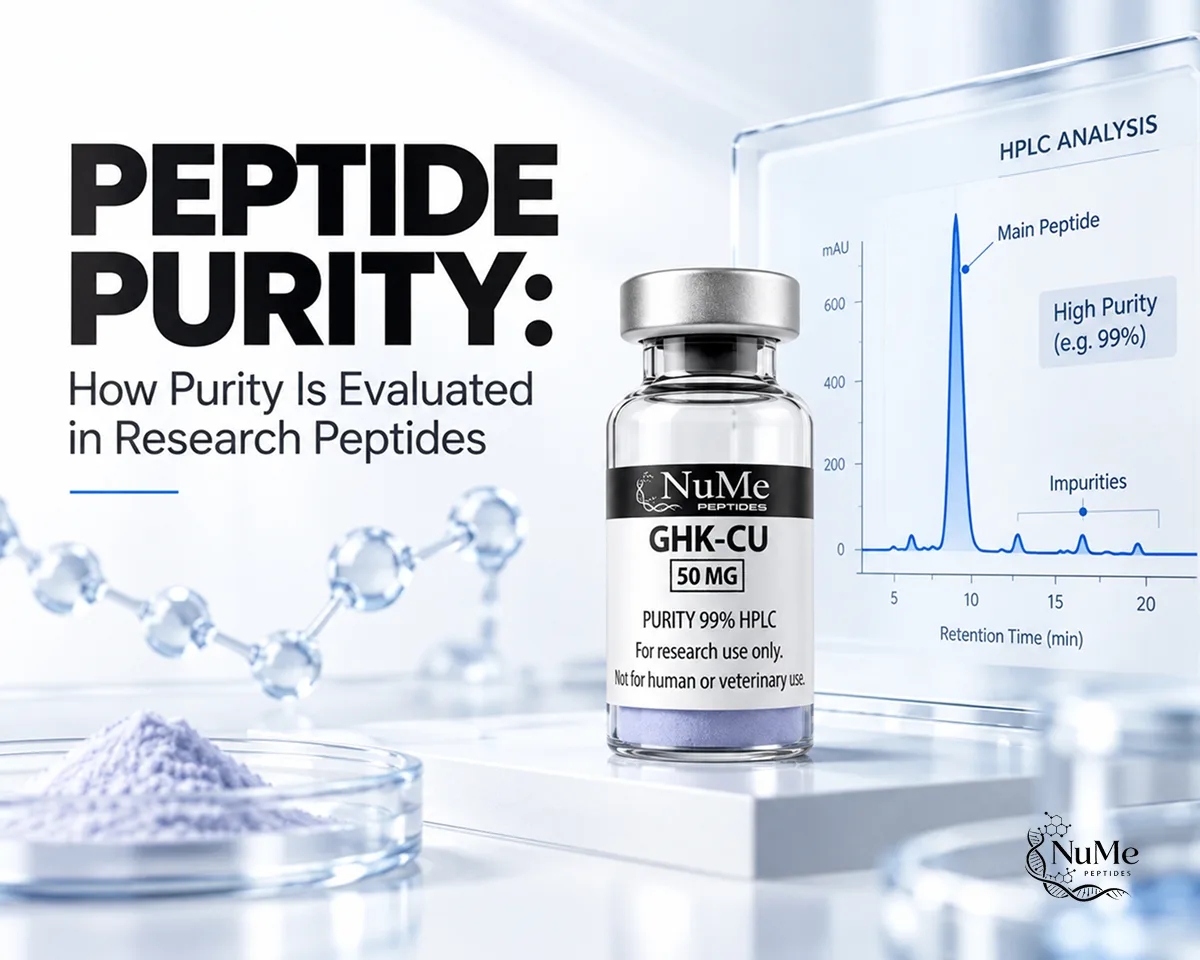
When a peptide is analyzed using reversed-phase high-performance liquid chromatography, or RP-HPLC, the target molecule and detectable impurities move through the chromatographic system differently. The detector records these components as peaks, and the major peak typically represents the intended peptide when identity has been appropriately confirmed.
The relative area of that peak compared with other detectable peaks can then be used to estimate chromatographic purity.
This makes peptide purity useful for assessing whether a sample contains predominantly the target material or a larger proportion of detectable peptide-related substances.
However, chromatographic purity should not automatically be interpreted as total peptide content by weight.
Reference-standard research demonstrates that peptide samples may also contain water, residual solvents, counterions, inorganic residues, and other non-peptide components. For high-accuracy reference materials, laboratories may therefore evaluate these components separately and use a mass-balance approach rather than relying solely on HPLC peak area. (McCarthy et al., 2023).
Analytical conditions also matter. Column chemistry, gradient design, mobile-phase composition, temperature, and detection method may all influence how well closely related compounds separate. Reviews of peptide chromatography note that these variables can affect separation, recovery, and stability during analysis. (Rathore et al., 2022).
For this reason, researchers should treat a purity percentage as a result produced by a specific analytical procedure rather than as an absolute description of everything contained in a vial.
Visit the NuMe Peptides US Shop to explore available research peptides and laboratory-focused products for scientific study.
How Do Laboratories Measure Peptide Purity?
Laboratories can use several analytical techniques to characterize peptide samples, with chromatography and mass spectrometry among the most important.
Reversed-Phase HPLC
RP-HPLC is widely used because it can separate peptide-related compounds according to differences in their interactions with the chromatographic stationary and mobile phases.
As the sample passes through the column, different components appear at different retention times. Researchers can integrate the resulting peaks and estimate the proportion represented by the principal component.
For well-designed analytical methods, this provides an effective way to monitor peptide purity and detect many synthesis- or degradation-related impurities.
However, the method has limitations. Structurally similar peptides may behave similarly during chromatography and can sometimes overlap or co-elute. This means an apparently clean chromatogram may still require further investigation when detailed impurity characterization is important.
Recent research continues to highlight this challenge. Even minor impurities can influence biological activity or downstream analytical results, while differences in chromatography systems, gradients, and mobile phases can affect peptide separation. (Streuli et al., 2026).
Mass Spectrometry
Mass spectrometry provides complementary information by measuring ions according to their mass-to-charge ratios.
Because the expected sequence of a synthetic peptide is normally known, MS can help researchers determine whether the detected molecule has the expected molecular mass. Tandem mass spectrometry can provide additional structural or sequence information when required.
A 2024 methodological review describes mass spectrometry as a valuable technique for evaluating the authenticity and integrity of synthetic peptides, including LC-MS and MALDI-TOF-MS approaches. (Højrup, 2024).
LC-MS combines chromatographic separation with mass-based detection. This can be particularly useful when researchers need to investigate impurities that may not be fully resolved by conventional chromatographic detection.
As a result, HPLC and MS should be viewed as complementary rather than interchangeable tools: one provides strong information about separation and relative composition, while the other can contribute molecular identity and structural information.
How Should Researchers Interpret a 99% Purity Result?
A 99% result may initially suggest that 99% of everything in the vial is the desired peptide. In practice, that interpretation can be too simplistic.
If the value comes from an HPLC chromatogram, it commonly represents chromatographic area purity. Under those specific experimental conditions, approximately 99% of the relevant integrated chromatographic signal may be associated with the principal peak.
That does not necessarily mean that the target peptide accounts for exactly 99% of the total dry mass.
For example, peptide materials can include counterions, moisture, residual solvents, or inorganic components that require separate methods for accurate measurement. Work on USP peptide reference standards uses multiple analytical procedures to distinguish purity, content, identity, residual solvents, counterions, water, and other characteristics. (McCarthy et al., 2023).
Researchers also need to consider whether minor impurities are sufficiently separated from the main peak.
High-resolution LC-MS research involving synthetic human C-peptide identified more than 65 structurally related impurities in the study material. The study emphasized that accurate purity assignment requires identifying and accounting for related peptide impurities rather than relying solely on a single chromatographic measurement. (Josephs et al., 2018).
Therefore, when researchers see a 99% peptide purity specification, useful follow-up questions include:
- Which analytical method produced the result?
- Was the value calculated from chromatographic peak area?
- Was molecular identity independently confirmed?
- Could related impurities co-elute with the main peak?
- Is actual peptide content reported separately?
- Does the analytical documentation correspond to the same production lot?
These questions help transform a percentage into meaningful analytical context.
New to peptide research? Read our guide on What Are Research Peptides? to understand how research peptides are defined, studied, and evaluated before exploring proper storage practices.
What Types of Impurities May Be Present in Peptide Samples?
Synthetic peptides are commonly produced through stepwise chemical synthesis. Because each amino acid must be coupled in the correct order, incomplete reactions or side reactions can generate peptide-related impurities.
One common category is a deletion sequence, where one or more intended amino acids are absent.
Other synthesis-related variants may include insertion sequences, truncated peptides, or products created through unintended chemical modification.
Storage and handling can introduce additional changes. Reviews of synthetic peptide characterization describe impurities associated with starting materials, manufacturing processes, and storage conditions. These can include oxidation products, hydrolysis products, structural isomers, and stereoisomers such as peptide epimers. (Lian et al., 2021).
Chiral impurities are particularly interesting analytically. Amino acids usually occur in specific stereochemical forms, but undesired D-isomers may enter through raw materials, synthesis, or changes during shelf life. Researchers have developed chiral HPLC-MS/MS methods specifically to quantify these forms in synthetic peptide materials. (Lian et al., 2023).
Some impurities are especially difficult to detect because they resemble the target molecule closely.
A recent glucagon case study, for example, examined low-abundance impurities that co-eluted during RP-HPLC analysis. High-resolution mass spectrometry provided an additional way to investigate and quantify those species when chromatographic separation alone was insufficient. (Kodidasu et al., 2025).
Researchers should therefore avoid interpreting peptide purity as proof that every possible impurity has been identified. It is more accurate to see it as a measurement of what a specified analytical method was able to resolve and quantify.
Why Should Purity Be Considered Alongside Other Quality Indicators?
Purity is valuable, but it answers only one part of a broader quality question.
Consider molecular identity.
A chromatogram can show that one dominant component is present, but the dominant component still needs to be confirmed as the intended peptide. Mass spectrometry can help establish whether the observed molecular mass corresponds to the expected sequence and can support additional characterization when needed. (Højrup, 2024).
Actual peptide content is another distinct measurement.
Studies comparing peptide quantification methods have evaluated HPLC assay, quantitative NMR, and amino-acid analysis for assigning peptide content. Such work demonstrates that purity assessment and quantitative content assignment are related but separate analytical questions. (Görög et al., 2019).
A useful quality review may therefore include several indicators:
| Quality Indicator | What It Can Help Assess |
|---|---|
| HPLC analysis | Relative chromatographic composition |
| Mass spectrometry | Molecular mass and identity |
| LC-MS impurity profiling | Related peptide species and modifications |
| Peptide content assay | Amount of peptide material |
| Residual moisture testing | Water present in the sample |
| Counterion analysis | Associated counterions such as acetate or TFA |
| Lot-specific COA | Traceability of analytical results |
| Stability information | Changes that may occur during storage |
Well-characterized peptide reference standards demonstrate why this multi-method approach matters. Analytical programs may combine HPLC, GC, NMR, mass spectrometry, moisture measurement, residual-solvent testing, identity testing, and stability studies to establish different attributes of a reference material. (McCarthy et al., 2023).
The importance of each test depends on the scientific application.
A peptide used during exploratory screening may not require exactly the same characterization strategy as a quantitative reference standard. Laboratories should therefore evaluate whether available analytical information is sufficient for the precision and reproducibility expected from the planned experiment.
In that context, peptide purity becomes more useful when it is interpreted as one component of an analytical profile rather than a standalone quality label.
FAQs About Peptide Purity
What does peptide purity mean?
It generally describes the relative amount of the target peptide compared with detectable peptide-related impurities under a specified analytical method. The exact interpretation depends on the technique and calculation used.
Does 99% purity mean 99% of the vial is peptide?
Not necessarily. A 99% HPLC result commonly represents chromatographic area purity rather than total peptide mass. Water, counterions, residual solvents, and other components may need separate measurement.
Is HPLC enough to confirm peptide identity?
HPLC can provide valuable information about sample composition, but it does not independently confirm every aspect of molecular identity. Mass spectrometry is commonly used as a complementary method for synthetic peptide characterization. (Højrup, 2024).
Can two peptide samples both be 99% pure but contain different impurities?
Yes. The overall purity percentage does not describe the exact identity of every minor component. Two samples can report the same percentage while having different impurity profiles.
Why is LC-MS useful when evaluating peptides?
LC-MS combines chromatographic separation with mass information, making it valuable for detecting and characterizing structurally related impurities, including some species that may be difficult to resolve through conventional chromatography alone. (Lian et al., 2021).
Should researchers always select the sample with the highest purity percentage?
Not based on that number alone. Researchers should also consider identity confirmation, analytical method, impurity profile, peptide content, lot-specific documentation, storage history, and the requirements of the intended study.
Understanding Peptide Purity in Research
Peptide purity is an important analytical measurement, but its scientific value depends on how researchers interpret it.
A chromatographic result can show the relative proportion of a major peptide component under defined conditions. Mass spectrometry can provide complementary evidence about molecular identity and help investigate related impurities. Additional analytical methods can evaluate peptide content, moisture, counterions, residual solvents, stability, and other characteristics.
This is particularly important when interpreting high-purity results such as 99%. The percentage provides useful information, but it should not automatically be treated as equivalent to total peptide content or as evidence that every possible impurity has been identified.
Researchers can make stronger assessments by examining the analytical method behind the number and considering whether the supporting documentation matches the needs of their experiment.
Ultimately, peptide quality is best understood through multiple complementary measurements rather than a single specification.
Explore the NuMe Peptides US Shop to review research-focused peptide materials and laboratory product information for scientific studies.
Disclaimer: This content is provided for scientific and educational purposes only. Research peptides discussed here are presented in a laboratory research context and are not described as products for human consumption, diagnosis, treatment, cure, or prevention of disease.


This article gives a very clear explanation of why peptide purity matters in research. I especially liked the point that a purity percentage alone may not provide the complete picture of a sample’s quality. Are there specific analytical methods researchers should prioritize when evaluating peptide purity?
I found the discussion about impurities particularly useful because even small differences in sample quality can be important in research. The distinction between peptide identity and purity was also explained really well. Would it be possible to cover how researchers typically verify both factors in a future post?
Really helpful read for anyone who is new to evaluating research peptides. I appreciated the explanation of why testing methods are important when interpreting a reported purity level. I’d be interested in learning more about the role of HPLC and mass spectrometry in confirming peptide quality.