

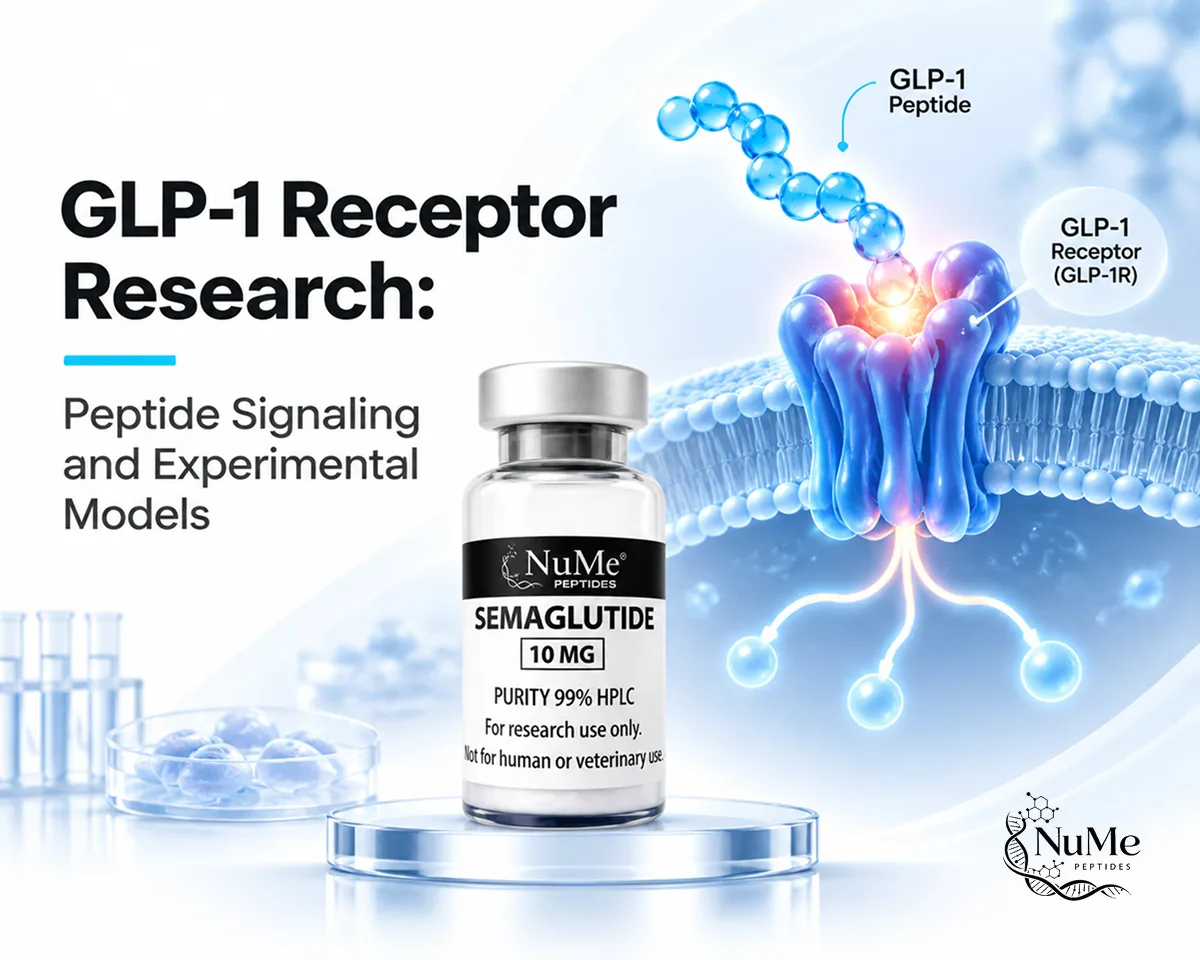
GLP-1 Receptor Research Peptides Signaling and Experimental Models


The glucagon-like peptide-1 receptor, or GLP-1R, is one of the most extensively studied metabolic receptors in modern peptide research. It connects extracellular peptide signals with intracellular pathways involved in insulin secretion, nutrient sensing, neural signaling, and broader metabolic regulation.
GLP-1 Receptor Research Peptides are increasingly investigated at the molecular level rather than being treated as functionally identical compounds. Researchers compare receptor binding, G-protein activation, cyclic AMP production, β-arrestin recruitment, receptor internalization, recycling, and interactions with other metabolic receptors.
Semaglutide provides a model of selective GLP-1R agonism. Tirzepatide combines GLP-1R with GIP receptor activity, while Retatrutide extends this framework to GLP-1, GIP, and glucagon receptors.
These differences make receptor-specific studies important for understanding how structurally related peptides can produce distinct signaling profiles.
Explore the NuMe Peptides US Shop for research-focused compounds associated with growth hormone secretion, endocrine signaling, and laboratory investigation.
What Is the GLP-1 Receptor?
GLP-1R is a class B1 G protein-coupled receptor, or GPCR.
Its endogenous ligand is glucagon-like peptide-1, a peptide hormone produced primarily by intestinal enteroendocrine L cells after nutrient intake. GLP-1 is also produced in specific neuronal populations.
The receptor contains a relatively large extracellular domain connected to a seven-transmembrane helical core.
This architecture allows peptide ligands to interact with both extracellular and transmembrane regions of the receptor.
Structural studies have shown that GLP-1 is positioned between the receptor’s N-terminal extracellular domain and transmembrane core. Ligand binding causes conformational changes that allow the intracellular side of the receptor to interact with stimulatory G proteins. (Zhang et al., 2017)
GLP-1R expression is particularly relevant in pancreatic beta cells and several regions of the nervous system, although receptor expression has also been investigated in additional tissues.
In pancreatic beta cells, activation of GLP-1R can enhance glucose-dependent insulin secretion.
In neural systems, GLP-1R signaling is associated with nutrient sensing, food-intake regulation, and autonomic responses.
More recent receptor biology has moved beyond a simple “ligand binds receptor, receptor produces cAMP” model.
A 2026 review describes GLP-1R as an organizer of spatially and temporally regulated signaling assemblies, sometimes referred to as signalosomes. These complexes may involve receptor localization, organelle contact sites, and intracellular signaling compartments. (Austin & Tomas, 2026)
This makes GLP-1R a useful model for studying how peptide-receptor signaling changes over both space and time.
Explore the Metabolic & Longevity research collection for compounds associated with mitochondrial function, cellular energy, and metabolic signaling studies.

How Does GLP-1 Receptor Signaling Work?
The best-established GLP-1R pathway involves the stimulatory G protein Gs.
When an agonist binds GLP-1R, the activated receptor interacts with Gs, stimulating adenylyl cyclase.
The simplified pathway is:
GLP-1R activation → Gs → adenylyl cyclase → cAMP → downstream signaling
Cyclic AMP is a major second messenger.
In pancreatic beta cells, increased cAMP can activate protein kinase A and exchange proteins directly activated by cAMP, commonly called Epac proteins. These pathways interact with calcium signaling and the insulin-secretory machinery.
GLP-1R signaling is therefore strongly connected with glucose-dependent insulin release rather than being a direct insulin receptor pathway.
Recent neural research adds further complexity.
A 2026 study examining Semaglutide in GLP1R-expressing area postrema neurons found that the peptide produced graded increases in cAMP through Gs signaling while also engaging Gq-dependent pathways in specific neuronal populations. (Gao et al., 2026)
Researchers also study biased agonism.
Biased agonism occurs when different ligands stabilize receptor conformations that favor particular signaling pathways.
One GLP-1R ligand might strongly activate cAMP while producing relatively little β-arrestin recruitment, whereas another may generate a different balance.
This concept is important when comparing Semaglutide with multi-receptor peptides.
Receptor trafficking is another major research area.
After activation, GLP-1R may move away from the cell surface through internalization. Historically, GPCR internalization was strongly associated with β-arrestins, but GLP-1R appears to be more complex.
A 2025 study using receptor-internalization assays found that GLP-1R could internalize largely independently of β-arrestin through mechanisms involving G-protein receptor kinases, clathrin, and caveolae-related processes. (Moo et al., 2025)
This demonstrates why receptor activity cannot be defined by cAMP concentration alone.
How Is GLP-1 Receptor Activity Studied in Research?
Researchers use several complementary methods to characterize GLP-1R activity.
Receptor Binding Assays
Binding studies determine whether a peptide interacts with GLP-1R and can estimate receptor affinity.
These studies are useful for distinguishing direct GLP-1R agonism from downstream metabolic effects.
cAMP Assays
Because GLP-1R commonly signals through Gs, cAMP accumulation is one of the most widely used functional measurements.
Cells engineered to express human GLP-1R can be exposed to increasing peptide concentrations to generate dose-response curves.
Researchers may calculate:
- potency;
- maximal response;
- concentration-response relationships;
- signaling bias.
β-Arrestin Recruitment
β-Arrestin assays help investigators determine whether receptor activation recruits arrestin proteins.
This is particularly useful when comparing ligands with biased signaling profiles.
For example, Tirzepatide generates strong cAMP signaling at GLP-1R while producing comparatively weaker β-arrestin recruitment than native GLP-1. (Willard et al., 2020)
Receptor Internalization
Imaging and fluorescence-based assays can determine how rapidly GLP-1R leaves the plasma membrane after activation.
Researchers may also examine whether receptors:
- enter endosomes;
- recycle back to the membrane;
- remain intracellular;
- undergo degradation.
Differences in trafficking can change both the duration and location of receptor signaling.
Structural Biology
Cryogenic electron microscopy has become especially important.
A 2021 structural study visualized Semaglutide bound to GLP-1R and Gs, showing how the peptide interacts with the receptor while also revealing ligand- and receptor-specific conformational dynamics. (Zhao et al., 2021)
These experiments connect peptide sequence with receptor conformation and downstream signaling.
How Are GLP-1-Related Peptides Investigated Experimentally?
GLP-1-related compounds can be compared according to receptor selectivity and signaling behavior.
Semaglutide
Semaglutide is primarily a GLP-1 receptor agonist.
This makes it a useful reference compound for studying relatively selective GLP-1R signaling.
Structural analysis of the Semaglutide–GLP-1R–Gs complex has shown that the peptide occupies the canonical GLP-1 binding region while producing specific conformational dynamics within the receptor complex. (Zhao et al., 2021)
Recent in vivo mechanistic work also reinforces the importance of cAMP.
In GLP1R-expressing hindbrain neurons, Semaglutide activated graded Gs-dependent cAMP signaling, while genetic manipulation of this pathway altered downstream responses. (Gao et al., 2026)
Explore Semaglutide 10 mg for laboratory research involving GLP-1 receptor signaling and metabolic pathway regulation.
Tirzepatide
Tirzepatide activates both GIPR and GLP-1R.
Its interaction with GLP-1R is particularly interesting because it does not simply reproduce native GLP-1 signaling.
Cell-based studies found that Tirzepatide behaves as an imbalanced dual agonist with greater functional engagement of GIPR than GLP-1R.
At GLP-1R, Tirzepatide favors cAMP signaling over β-arrestin recruitment and produces less receptor internalization than native GLP-1. (Willard et al., 2020)
This makes Tirzepatide a useful research model for biased GLP-1R agonism.
Explore Tirzepatide 10 mg for laboratory research involving dual GIP and GLP-1 receptor signaling in metabolic pathway studies.
Retatrutide
Retatrutide expands multi-receptor research further.
It is a single peptide designed to activate:
GIPR + GLP-1R + GCGR
Phase 2 research established Retatrutide as a triple hormone-receptor agonist and evaluated its physiological effects across multiple doses. (Jastreboff et al., 2023)
Research in type 2 diabetes similarly evaluated this GIP/GLP-1/glucagon receptor combination in a randomized US study. (Rosenstock et al., 2023)
As of 2026, Retatrutide has advanced into phase 3 clinical research, reinforcing interest in how coordinated receptor activity differs from GLP-1R agonism alone.
Explore Retatrutide 10 mg for laboratory research involving GIP, GLP-1, and glucagon receptor signaling in metabolic pathway studies.
How Does GLP-1 Receptor Research Relate to Other Metabolic Signaling Pathways?
GLP-1R does not operate in isolation.
Its activity intersects with several endocrine systems.
GIP Receptor Signaling
GIPR and GLP-1R are both class B GPCRs involved in incretin biology.
However, their signaling and receptor-trafficking characteristics differ.
Tirzepatide illustrates why these differences matter. It behaves similarly to native GIP at GIPR but produces biased activity at GLP-1R. (Willard et al., 2020)
Glucagon Receptor Signaling
GCGR is structurally related to GLP-1R but has distinct physiological roles.
Glucagon receptor activation strongly influences hepatic glucose metabolism, lipid metabolism, and energy expenditure.
Retatrutide combines this pathway with GLP-1R and GIPR activity, creating a model for investigating how related class B receptors can be co-activated by one peptide.
Insulin Signaling
GLP-1R is not an insulin receptor.
Instead, pancreatic GLP-1R activation can enhance glucose-dependent insulin secretion.
Released insulin then activates insulin receptors in peripheral tissues.
This distinction separates:
GLP-1R signaling → insulin secretion
from:
insulin → insulin receptor → IRS/PI3K/Akt signaling
Receptor Trafficking and Signaling Duration
Modern receptor research also examines how GLP-1R signaling continues after initial receptor activation.
A 2026 review describes GLP-1R signaling as spatially organized across receptor-associated complexes and intracellular compartments, rather than occurring exclusively at the plasma membrane. (Austin & Tomas, 2026)
This emerging model helps explain why ligand structure, receptor trafficking, and signal duration are increasingly important variables in peptide research.

FAQs About GLP-1 Receptor Research
What type of receptor is GLP-1R?
GLP-1R is a class B1 G protein-coupled receptor that signals strongly through Gs and cAMP.
Does Semaglutide directly activate insulin receptors?
No. Semaglutide activates GLP-1R. Its effects on insulin-related biology occur primarily through GLP-1 receptor signaling and glucose-dependent insulin secretion.
How does Tirzepatide differ from Semaglutide at the receptor level?
Semaglutide primarily targets GLP-1R, whereas Tirzepatide activates both GIPR and GLP-1R. Tirzepatide also displays biased GLP-1R signaling favoring cAMP over β-arrestin recruitment.
Which receptors does Retatrutide target?
Retatrutide activates GIP, GLP-1, and glucagon receptors.
Why do researchers measure GLP-1R internalization?
Internalization influences where receptors are located after activation and may affect signal duration, receptor recycling, and responsiveness to repeated stimulation.
What is biased agonism in GLP-1 receptor research?
Biased agonism describes a ligand favoring some signaling outputs over others. For example, one peptide may favor G-protein/cAMP activity relative to β-arrestin recruitment.
Current research shows that GLP-1R is not simply an on-or-off metabolic receptor.
Ligand binding changes receptor conformation, G-protein coupling, cAMP production, trafficking, intracellular localization, and interaction with regulatory proteins.
Semaglutide provides a relatively selective GLP-1R research model. Tirzepatide demonstrates how GLP-1R signaling can change when one peptide also activates GIPR and displays biased receptor pharmacology. Retatrutide extends the system further by combining GLP-1, GIP, and glucagon receptor activity.
For researchers, the most informative approach is therefore to ask not only whether GLP-1R is activated, but how strongly it signals, which intracellular pathway is favored, where the receptor moves after activation, and how other metabolic receptors modify the final response.
Explore the NuMe Peptides US Shop for research-focused compounds associated with growth hormone secretion, endocrine signaling, and laboratory investigation.
Disclaimer: This content is provided for scientific and educational purposes only. Research peptides discussed here are presented in a laboratory research context and are not described as products for human consumption, diagnosis, treatment, cure, or prevention of disease.