

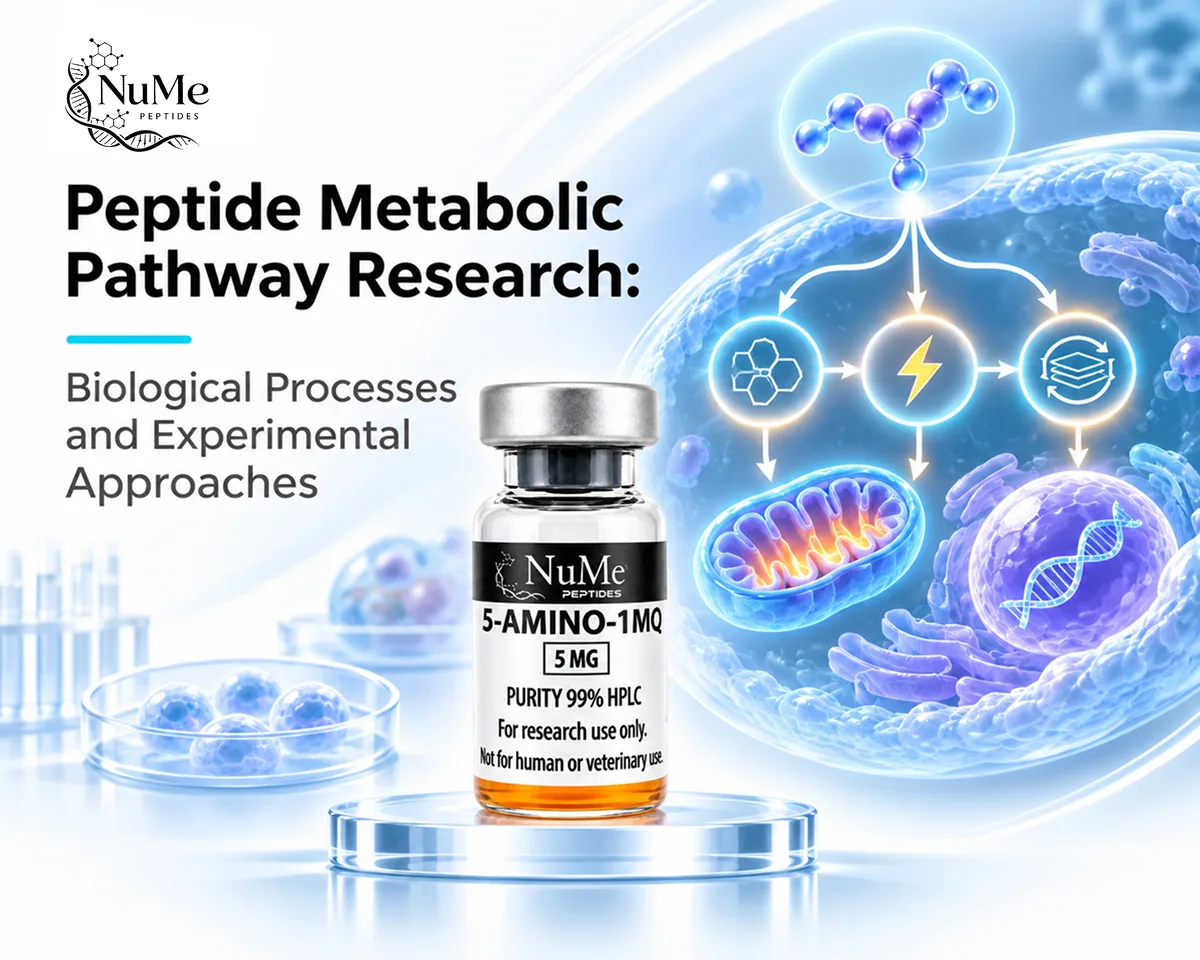
Peptide Metabolic Pathway Research: Biological Processes and Experimental Approaches


Cellular metabolism is organized through interconnected biochemical pathways that determine how nutrients are converted into energy, structural molecules, signaling intermediates, and metabolic cofactors. Rather than functioning as isolated reactions, glycolysis, the tricarboxylic acid cycle, fatty-acid oxidation, amino-acid metabolism, NAD redox chemistry, and mitochondrial respiration constantly exchange substrates and regulatory signals.
Modern peptide metabolic pathway research investigates how experimental compounds alter these networks at different control points. MOTS-C provides a peptide-based model involving mitochondrial-derived signaling and AMPK activation, while 5-Amino-1MQ targets nicotinamide N-methyltransferase, or NNMT. SLU-PP-332 activates estrogen-related receptors involved in oxidative metabolic gene programs, while NAD+ serves as a central redox coenzyme rather than a peptide.
Studying these mechanisms separately helps researchers determine whether a compound changes substrate flow, enzyme activity, energy sensing, transcriptional regulation, or mitochondrial metabolism.
Explore the NuMe Peptides US Shop for research-focused compounds associated with growth hormone secretion, endocrine signaling, and laboratory investigation.
What Are Metabolic Pathways in Scientific Research?
Metabolic pathways are ordered networks of biochemical reactions through which cells transform nutrients and other molecules.
Some pathways are primarily catabolic, meaning that they break larger molecules into smaller products while releasing usable energy. Others are anabolic, using energy and metabolic intermediates to synthesize proteins, lipids, nucleotides, and other cellular components.
Major pathways studied in metabolic biology include:
- glycolysis;
- the tricarboxylic acid cycle;
- oxidative phosphorylation;
- fatty-acid oxidation;
- lipogenesis;
- amino-acid metabolism;
- the pentose phosphate pathway;
- purine and pyrimidine synthesis;
- NAD+ synthesis and consumption.
These pathways are highly interconnected.
For example, glycolysis converts glucose into pyruvate. Pyruvate can then enter mitochondrial metabolism through acetyl-CoA, contributing to the TCA cycle and generation of NADH. NADH subsequently provides electrons to mitochondrial respiration.
Researchers therefore rarely interpret one metabolite in isolation.
A change in lactate, citrate, NADH, ATP, or fatty-acid oxidation may reflect alterations in several connected pathways.
Energy-sensing systems add another level of regulation.
AMP-activated protein kinase, or AMPK, integrates information about cellular energy availability, nutrients, redox state, and stress. Current research identifies AMPK as a major coordinator of glucose and lipid metabolism, mitochondrial function, autophagy, and metabolic adaptation. (Zhang et al., 2026)
This makes AMPK particularly relevant when studying compounds such as MOTS-C that alter upstream metabolic intermediates.
Explore the Metabolic & Longevity research collection for compounds associated with mitochondrial function, cellular energy, and metabolic signaling studies.

How Do Researchers Map Metabolic Pathways at the Cellular Level?
Researchers use multiple experimental methods because pathway activity cannot be determined reliably from gene expression alone.
Metabolomics
Metabolomics measures small molecules within cells, tissues, or biological fluids.
Researchers may quantify:
- glucose-related intermediates;
- amino acids;
- fatty acids;
- TCA-cycle metabolites;
- nucleotides;
- NAD-related metabolites.
Changes in metabolite concentrations can identify pathways that may be altered, although concentration alone does not necessarily reveal reaction rate.
Stable-Isotope Tracing
Stable-isotope tracing provides more direct information about metabolic flux.
Researchers can supply molecules labeled with non-radioactive isotopes such as carbon-13 and track where those atoms appear in downstream metabolites.
For example, labeled glucose can reveal whether carbon enters lactate, the TCA cycle, lipid synthesis, or other pathways.
This distinction between metabolite abundance and metabolic flux is important.
A metabolite can remain at a similar concentration even while its rate of production and consumption changes substantially.
Recent NAD research has combined isotope tracing with mathematical modeling to study movement and buffering of NAD+ across cellular compartments. (Høyland et al., 2024)
Enzyme Activity Assays
Researchers may directly evaluate metabolic enzymes and their inhibitors.
This approach is especially relevant to 5-Amino-1MQ because its primary experimental target is NNMT.
Rather than assuming a systemic metabolic effect, investigators can first establish whether NNMT activity changes and then measure downstream alterations in nicotinamide, methyl-donor metabolism, glucose handling, or lipid pathways.
Proteomics and Phosphoproteomics
Protein abundance and phosphorylation can identify regulatory changes that metabolite measurements alone may miss.
Mass spectrometry, for example, can be used to investigate AMPK-regulated protein phosphorylation and longer-term changes in metabolic protein expression. (Rider et al., 2024)
Together, these methods allow researchers to build a more complete map from molecular target to pathway-level metabolic response.
Which Signaling Networks Are Studied in Metabolic Research?
AMPK Signaling
AMPK is one of the most important pathway regulators in cellular metabolism.
When cellular energy availability decreases, AMPK can promote processes that generate ATP while reducing energy-intensive anabolic activity.
Its downstream effects include regulation of:
- glucose uptake;
- fatty-acid oxidation;
- mitochondrial biogenesis;
- autophagy;
- lipid synthesis;
- protein synthesis.
A 2025 review describes AMPK as a key interface connecting nutrient sensing, metabolic flux, mitochondrial function, cellular survival, and energy homeostasis. (Fullerton et al., 2025)
NAD+/NADH Redox Networks
NAD+ and NADH form a major redox couple involved in cellular energy transfer.
NAD+ accepts electrons during metabolic reactions, forming NADH. NADH can subsequently donate electrons to mitochondrial respiration.
NAD+ also serves as a substrate for signaling enzymes including sirtuins and PARPs.
Importantly, NAD is compartmentalized.
The nucleus, cytosol, and mitochondria maintain related but distinct NAD pools. Modern research shows that these pools communicate with one another while retaining compartment-specific metabolic functions. (Høyland et al., 2024)
NNMT Pathway
NNMT catalyzes methylation of nicotinamide using S-adenosylmethionine.
This links nicotinamide metabolism with methyl-donor availability and broader cellular metabolic regulation.
Inhibition of NNMT therefore provides an experimental way to investigate how altering nicotinamide utilization affects glucose, lipid, liver, and adipose-tissue metabolism.
ERR Signaling
Estrogen-related receptors, or ERRs, are nuclear receptors involved in transcriptional regulation of oxidative metabolism.
ERRα, ERRβ, and ERRγ regulate genes associated with:
- mitochondrial respiration;
- fatty-acid oxidation;
- oxidative muscle phenotype;
- energy expenditure.
This makes ERR agonists useful research tools for studying transcriptional control of metabolic pathways rather than acute peptide-receptor signaling.
How Are Peptides Investigated Across Metabolic Pathways?
Peptides can affect metabolism through extracellular receptors, intracellular signaling, or mitochondrial-derived communication.
MOTS-C is particularly relevant because it originates from mitochondrial DNA.
The peptide is encoded within mitochondrial 12S rRNA and consists of 16 amino acids.
Its original characterization showed that MOTS-C alters folate-cycle metabolism and de novo purine synthesis. These changes were associated with AMPK activation, demonstrating how one peptide can modify metabolism indirectly by changing intracellular metabolite availability. (Lee et al., 2015)
This mechanism is different from directly activating a classical membrane receptor.
MOTS-C has also been linked to skeletal-muscle metabolism and insulin sensitivity in animal models, making it useful for investigating how mitochondrial-derived signals interact with whole-cell metabolic regulation.
Researchers studying metabolic compounds generally use several layers of evidence:
- Target engagement – Does the compound interact with the proposed molecular target?
- Pathway response – Do metabolic intermediates or signaling proteins change?
- Flux response – Does substrate movement through the pathway change?
- Cellular phenotype – Are respiration, glucose utilization, lipid metabolism, or stress responses altered?
- Organismal response – Are similar effects observed in animal or human studies?
This hierarchy reduces the risk of treating a downstream outcome as proof of a direct molecular mechanism.
Which Research Peptides Are Relevant to Metabolic Pathway Studies?
MOTS-C
MOTS-C is a mitochondrial-derived peptide investigated through metabolic stress and energy-sensing pathways.
Foundational experiments demonstrated inhibition of folate-related metabolism and de novo purine biosynthesis, leading to AMPK activation. Mouse studies also reported changes in insulin sensitivity and metabolic homeostasis. (Lee et al., 2015)
MOTS-C therefore provides a useful model for studying the link between mitochondrial genetic information, metabolite availability, and AMPK-dependent signaling.
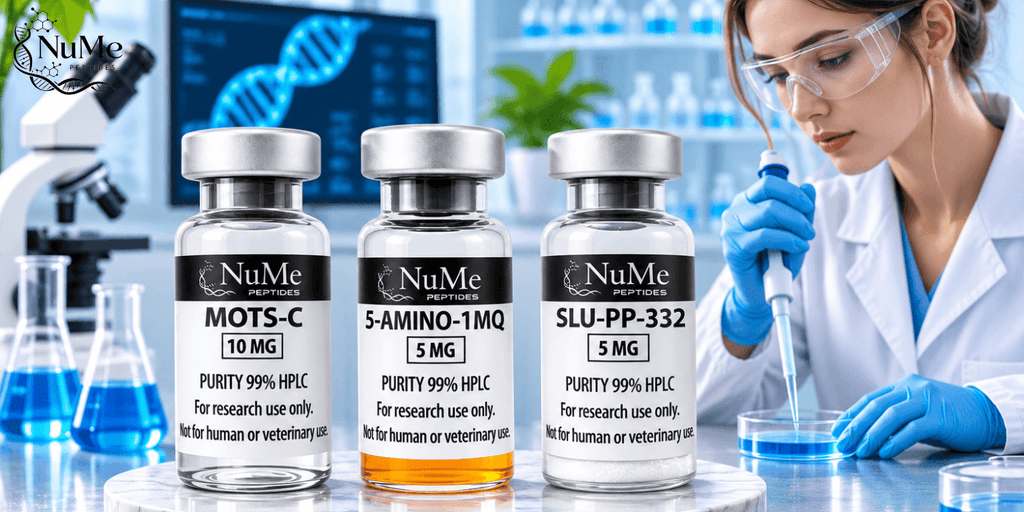
Explore MOTS-C 10 mg for laboratory research involving mitochondrial signaling, AMPK-related pathways, and cellular metabolism.
5-Amino-1MQ
5-Amino-1MQ is not a peptide. It is a small-molecule inhibitor of NNMT.
This distinction matters because its primary mechanism involves inhibition of a metabolic enzyme rather than peptide receptor signaling.
A 2024 study evaluated 5A1MQ in diet-induced obese mice and found dose-dependent changes in fat-mass gain, glucose tolerance, insulin sensitivity, circulating insulin, liver triglycerides, and hepatic pathology. (Babula et al., 2024)
These findings support NNMT inhibition as an experimental metabolic pathway strategy, but the evidence remains preclinical.
Explore 5-Amino-1MQ 5 mg for laboratory research involving NNMT inhibition and metabolic pathway regulation.
SLU-PP-332
SLU-PP-332 is also not a peptide.
It is a synthetic agonist of ERRα, ERRβ, and ERRγ, with particularly strong activity at ERRα.
In cultured skeletal-muscle cells, SLU-PP-332 increased mitochondrial respiration. In mice, it induced an ERRα-dependent aerobic exercise-like transcriptional program and increased oxidative muscle characteristics and endurance. (Billon et al., 2023)
More recent chemical research continues to use SLU-PP-332 as a benchmark ERR agonist while examining how structural changes affect ERRα/γ activity and metabolic gene expression. (Elgendy et al., 2026)
The current evidence remains predominantly cellular and animal-based.
Explore SLU-PP-332 5 mg for laboratory research involving ERR signaling, oxidative metabolism, and mitochondrial energy regulation.
NAD+
NAD+ is a nucleotide-derived coenzyme rather than a peptide.
It is central to glycolysis, the TCA cycle, fatty-acid oxidation, mitochondrial respiration, and numerous signaling reactions.
Current research increasingly emphasizes that NAD metabolism is spatially organized.
A 2026 review describes NAD+ as a metabolic signaling network connecting redox homeostasis with sirtuins, PARPs, CD38, cellular stress responses, and metabolic resilience. (McReynolds, 2026)
Recent mechanistic work has also identified mitochondrial NAD+ hydrolysis by SELENOO as a regulatory process associated with fatty-acid utilization and protection against excessive mitochondrial metabolic activity. (Jia et al., 2026)
These findings reinforce the importance of studying NAD+ as a dynamic metabolic pool rather than simply measuring total cellular concentration.
Explore NAD+ 500 mg for laboratory research involving cellular redox metabolism, NAD-dependent signaling, and metabolic pathway studies.
FAQs About Peptide Metabolic Pathway Research
What is a metabolic pathway?
A metabolic pathway is a linked series of biochemical reactions that transforms substrates into energy, metabolites, or cellular building blocks.
What is metabolic flux?
Metabolic flux describes the rate at which molecules move through a pathway. It can change even when the concentration of a metabolite remains relatively stable.
How is MOTS-C connected with metabolic pathways?
MOTS-C has been linked to folate-cycle metabolism, purine synthesis, AMPK activation, and metabolic homeostasis in experimental models.
Is 5-Amino-1MQ a peptide?
No. It is a small-molecule NNMT inhibitor studied in preclinical metabolic models.
What pathway does SLU-PP-332 target?
SLU-PP-332 activates estrogen-related receptors, particularly ERRα, which regulate transcriptional programs involved in mitochondrial and oxidative metabolism.
Why is NAD+ important in metabolic research?
NAD+ participates in redox reactions, mitochondrial metabolism, sirtuin activity, DNA-repair signaling, and multiple compartment-specific metabolic pathways.
Current peptide metabolic pathway research shows that metabolic regulation can be studied at several distinct levels.
MOTS-C influences intracellular metabolism and AMPK-related signaling. 5-Amino-1MQ targets NNMT and provides a model for metabolic enzyme inhibition. SLU-PP-332 modifies ERR-driven transcriptional programs associated with oxidative metabolism, while NAD+ functions as a central coenzyme connecting redox chemistry with signaling and mitochondrial homeostasis.
These compounds should not be grouped under one mechanism simply because they influence metabolic outcomes.
A more precise experimental framework asks whether the intervention changes enzyme activity, metabolite concentrations, pathway flux, energy sensing, transcriptional regulation, or mitochondrial substrate utilization.
That pathway-centered approach provides stronger mechanistic interpretation and helps separate direct molecular effects from downstream metabolic consequences.
Explore the NuMe Peptides US Shop for research-focused compounds associated with growth hormone secretion, endocrine signaling, and laboratory investigation.
Disclaimer: This content is provided for scientific and educational purposes only. Research peptides discussed here are presented in a laboratory research context and are not described as products for human consumption, diagnosis, treatment, cure, or prevention of disease.