

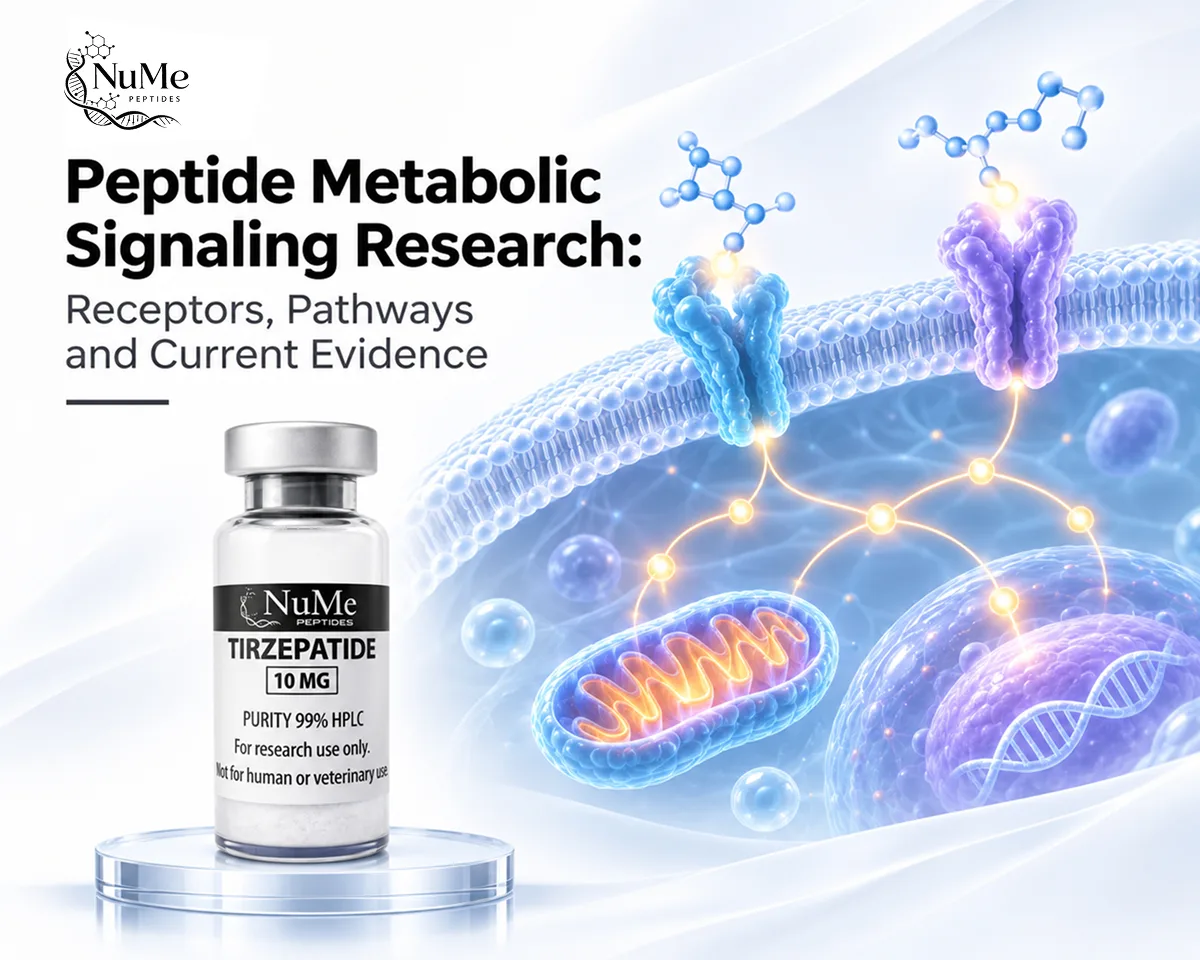
Peptide Metabolic Signaling Research: Receptors, Pathways and Current Evidence


Metabolic regulation depends on networks of peptide hormones that communicate information about nutrient availability, glucose status, energy balance, and food intake between the gastrointestinal tract, pancreas, liver, adipose tissue, and nervous system.
Modern peptide metabolic signaling research focuses increasingly on the receptors through which these signals operate. Rather than treating every metabolic peptide as having the same biological effect, researchers compare receptor selectivity, intracellular signaling, tissue distribution, receptor internalization, and interactions between multiple hormone pathways.
Semaglutide provides a model of GLP-1 receptor signaling. Tirzepatide combines GIP and GLP-1 receptor activity. Retatrutide extends this concept to GIP, GLP-1, and glucagon receptors, while Cagrilintide investigates the distinct amylin receptor system.
Together, these compounds provide useful research models for understanding how single-, dual-, and multi-receptor peptide signaling can influence metabolic physiology.
Explore the NuMe Peptides US Shop for research-focused compounds associated with growth hormone secretion, endocrine signaling, and laboratory investigation.
What Is Metabolic Signaling in Peptide Research?
Metabolic signaling describes the molecular communication systems that help coordinate energy intake, nutrient processing, glucose regulation, hormonal secretion, and energy expenditure.
Peptide hormones participate in this communication by binding specific receptors on target cells.
Many important metabolic receptors are G protein-coupled receptors, or GPCRs. These membrane proteins translate extracellular peptide binding into intracellular biochemical signals.
Among the best-studied metabolic peptide systems are:
- glucagon-like peptide-1, or GLP-1;
- glucose-dependent insulinotropic polypeptide, or GIP;
- glucagon;
- amylin.
GLP-1 and GIP are commonly described as incretin hormones because they contribute to glucose-dependent insulin secretion after nutrient intake.
GLP-1 receptors are expressed in pancreatic cells and several neural and peripheral tissues. Activation commonly promotes Gs-mediated increases in cyclic AMP, or cAMP, although receptor behavior can vary according to cell type and ligand.
Recent mechanistic work in GLP1R-expressing hindbrain neurons showed that Semaglutide increased cAMP through Gs signaling while also engaging calcium-associated signaling mechanisms. Disruption of the Gs–cAMP pathway substantially altered the biological response in the experimental model. (Gao et al., 2026)
This illustrates a central principle of metabolic peptide studies: researchers are increasingly interested not only in whether a receptor is activated, but also in which intracellular signaling pathways follow receptor activation.
Explore the Metabolic & Longevity research collection for compounds associated with mitochondrial function, cellular energy, and metabolic signaling studies.

How Do Peptides Influence Metabolic Signaling Pathways?
Peptides influence metabolism primarily by binding receptors that control intracellular second messengers, kinase pathways, ion flux, neuronal activity, and hormone secretion.
GLP-1 Signaling
Semaglutide is a GLP-1 receptor agonist.
GLP-1R is predominantly associated with Gs signaling, which activates adenylyl cyclase and increases intracellular cAMP.
In pancreatic beta cells, cAMP-related signaling can facilitate glucose-dependent insulin secretion.
GLP-1 receptor signaling also involves proteins such as β-arrestins. Earlier cellular research showed that β-arrestin-1 contributed to GLP-1-induced cAMP signaling, ERK activation, CREB activity, and insulin secretion in cultured pancreatic beta cells. (Sonoda et al., 2008)
More recent evidence suggests that GLP-1R may display prolonged Gs/cAMP signaling in physiologically relevant tissues rather than following a simple rapid-desensitization model.
GIP and GLP-1 Co-Signaling
Tirzepatide provides a model for dual-receptor signaling.
It activates both GIPR and GLP-1R, but experimental evidence indicates that it does not stimulate the two receptors identically.
Cell-based pharmacological studies found strong GIPR activity while Tirzepatide displayed biased signaling at GLP-1R, favoring cAMP generation relative to β-arrestin recruitment and producing less receptor internalization than native GLP-1. (Willard et al., 2020)
Structural studies have also demonstrated distinct interactions between Tirzepatide and GIPR versus GLP-1R, helping explain how one peptide can activate two related receptors differently. (Sun et al., 2022)
Triple-Receptor Signaling
Retatrutide extends metabolic signaling into three receptor systems:
GIPR + GLP-1R + GCGR
The glucagon receptor component adds an additional biological dimension because GCGR signaling influences hepatic glucose production, lipid metabolism, and energy expenditure.
Clinical development of Retatrutide has therefore provided an experimental framework for examining how coordinated activation of three metabolic receptors differs from selective GLP-1 or dual incretin signaling. (Jastreboff et al., 2023)
Which Receptors Are Studied in Metabolic Peptide Research?
Four receptor systems are particularly relevant to the compounds discussed here.
| Receptor System | Research Compound | Major Signaling Context |
|---|---|---|
| GLP-1 receptor | Semaglutide | cAMP, insulin secretion, neural signaling |
| GIP + GLP-1 receptors | Tirzepatide | Dual incretin signaling |
| GIP + GLP-1 + glucagon receptors | Retatrutide | Triple metabolic receptor signaling |
| Amylin receptors | Cagrilintide | Satiety-related and metabolic signaling |
GLP-1 Receptor
GLP-1R belongs to the class B1 GPCR family.
Ligand activation primarily stimulates Gs proteins and cAMP formation, although calcium signaling, β-arrestin recruitment, receptor trafficking, and tissue-specific effects also contribute to the final response.
GIP Receptor
GIPR is another class B1 GPCR.
Like GLP-1R, it can stimulate cAMP, but the two receptors do not necessarily display identical desensitization or trafficking behavior.
This distinction is important in Tirzepatide research because its pharmacology appears weighted differently across GIPR and GLP-1R. (Willard et al., 2020)
Glucagon Receptor
GCGR also belongs to the glucagon-family GPCR group.
Ligand activation commonly promotes Gs-dependent cAMP production in hepatocytes and other responsive cells.
GLP-1R and GCGR can also recruit β-arrestins, adding additional complexity to receptor regulation and downstream pathway selection. (Lymperopoulos et al., 2025)
Amylin Receptors
Amylin receptors differ structurally from the incretin receptors.
Functional amylin receptors are formed when a calcitonin receptor associates with a receptor activity-modifying protein, or RAMP.
Different RAMP combinations generate distinct amylin receptor subtypes. (Hay et al., 2004)
This means Cagrilintide operates through a fundamentally different receptor architecture from Semaglutide, Tirzepatide, and Retatrutide.
How Are Metabolic Signaling Pathways Investigated Experimentally?
Researchers combine molecular, cellular, animal, and human studies to determine how metabolic peptides signal.
Receptor Binding and Activation Assays
Cells engineered to express GLP-1R, GIPR, GCGR, or amylin receptor complexes can be exposed to different peptide concentrations.
Researchers can then measure:
- receptor affinity;
- activation potency;
- dose-response relationships;
- cAMP generation;
- calcium signaling.
β-Arrestin and Receptor-Trafficking Assays
Receptor activation does not end with G protein signaling.
Researchers examine whether activated receptors recruit β-arrestins, internalize from the cell membrane, recycle back to the surface, or undergo downregulation.
These methods were important in revealing Tirzepatide’s unusual signaling behavior.
Tirzepatide was found to produce relatively strong cAMP signaling at GLP-1R while recruiting less β-arrestin and producing weaker receptor internalization than native GLP-1. (Willard et al., 2020)
Structural Biology
Cryogenic electron microscopy has made it possible to visualize peptide-receptor complexes at near-atomic resolution.
Structural research on Tirzepatide has revealed how its amino-acid sequence and fatty-acid modification influence interactions with both GIPR and GLP-1R. (Sun et al., 2022)
Pancreatic and Neural Models
Pancreatic islet models allow researchers to connect receptor signaling with insulin and glucagon secretion.
Neural models can investigate signaling in regions involved in nutrient sensing and feeding behavior.
Recent Semaglutide research identified GLP1R-expressing neurons in the area postrema as an important experimental system for understanding cAMP-dependent signaling within the central nervous system. (Gao et al., 2026)
Human Studies
Clinical studies provide another level of evidence by measuring glucose-related markers, body composition, appetite-related outcomes, hormone concentrations, and adverse events.
However, human outcomes should not automatically be interpreted as direct receptor mechanisms. Cellular and receptor-level experiments remain important for explaining why particular physiological effects occur.
Explore the Metabolic & Longevity research collection for compounds associated with mitochondrial function, cellular energy, and metabolic signaling studies.

Which Research Peptides Are Associated With Metabolic Signaling Studies?
Semaglutide
Semaglutide represents selective GLP-1R signaling.
Its mechanism provides a useful baseline for comparing newer multi-receptor peptides.
In addition to extensive clinical investigation, recent mechanistic research has demonstrated an important role for cAMP signaling in GLP1R-expressing hindbrain neurons.
Semaglutide therefore provides researchers with a relatively focused receptor model compared with dual- and triple-agonist compounds.
Explore Semaglutide 10 mg for laboratory research involving GLP-1 receptor signaling and metabolic pathway regulation.
Tirzepatide
Tirzepatide combines GIPR and GLP-1R activity.
Its significance goes beyond simply activating two receptors.
Research indicates that Tirzepatide behaves similarly to native GIP at GIPR but displays distinct biased pharmacology at GLP-1R.
This makes it useful for studying receptor balance, biased agonism, internalization, and multi-receptor signaling.
Explore Tirzepatide 10 mg for laboratory research involving dual GIP and GLP-1 receptor signaling in metabolic pathway studies.
Retatrutide
Retatrutide activates GIP, GLP-1, and glucagon receptors.
Its triple-agonist design allows investigators to study how incretin signaling interacts with glucagon-receptor pathways.
Phase 2 research demonstrated substantial physiological effects across different Retatrutide doses, supporting further investigation of triple-receptor metabolic signaling.
More recent phase 3 research published in 2026 further confirms continued clinical investigation of this triple-receptor strategy, although clinical outcomes should remain distinct from mechanistic receptor evidence.
Explore Retatrutide 10 mg for laboratory research involving GIP, GLP-1, and glucagon receptor signaling in metabolic pathway studies.
Cagrilintide
Cagrilintide is a long-acting amylin analogue.
Unlike the other three compounds, it does not primarily target incretin receptors.
Amylin receptors consist of calcitonin receptors associated with RAMP proteins, giving this system a distinct receptor architecture.
A phase 2 study in adults with overweight or obesity showed dose-dependent changes in body weight while also documenting gastrointestinal and administration-site adverse events. (Lau et al., 2021)
Explore Cagrilintide 10 mg for laboratory research involving amylin signaling and metabolic pathway regulation.
FAQs About Peptide Metabolic Signaling Research
What is metabolic peptide signaling?
It describes how peptide hormones bind cellular receptors and activate intracellular pathways involved in glucose regulation, hormone secretion, nutrient sensing, appetite-related signaling, and energy metabolism.
Which receptor does Semaglutide target?
Semaglutide primarily activates GLP-1R, a class B GPCR strongly associated with Gs and cAMP signaling.
How is Tirzepatide different from Semaglutide?
Tirzepatide activates both GIPR and GLP-1R, whereas Semaglutide is primarily a GLP-1R agonist. Tirzepatide also displays distinct biased signaling behavior at GLP-1R.
Which receptors does Retatrutide activate?
Retatrutide is designed to activate GIP, GLP-1, and glucagon receptors.
Does Cagrilintide activate GLP-1 receptors?
No. Cagrilintide is an amylin analogue and is investigated through the amylin receptor system rather than direct GLP-1R agonism.
Why does receptor selectivity matter in metabolic research?
Receptor selectivity determines which intracellular pathways are activated. Two peptides may produce overlapping physiological outcomes while acting through different receptors, signaling proteins, or tissues.
Current peptide metabolic signaling research increasingly emphasizes receptor pharmacology rather than grouping compounds according to broad metabolic outcomes.
Semaglutide provides a selective GLP-1 receptor model. Tirzepatide introduces dual GIPR and GLP-1R signaling with distinct receptor bias. Retatrutide adds glucagon receptor activity, while Cagrilintide investigates the structurally different amylin receptor system.
Comparing these compounds at the receptor level helps researchers determine which receptor is activated, which intracellular signals follow, how receptor trafficking changes, and how multiple pathways interact.
This receptor-centered framework offers a more precise way to interpret metabolic peptide experiments and prevents compounds with very different molecular mechanisms from being treated as biologically equivalent.
Explore the NuMe Peptides US Shop for research-focused compounds associated with growth hormone secretion, endocrine signaling, and laboratory investigation.
Disclaimer: This content is provided for scientific and educational purposes only. Research peptides discussed here are presented in a laboratory research context and are not described as products for human consumption, diagnosis, treatment, cure, or prevention of disease.