


Peptide Extracellular Matrix Research: Collagen, Signaling and Tissue Structure


The extracellular matrix is much more than the material surrounding cells. It provides mechanical support, helps organize tissues, stores signaling molecules, and influences how cells migrate, differentiate, and respond to injury. Collagen, fibronectin, elastin, proteoglycans, and glycosaminoglycans work together to create a dynamic environment that continually changes during development, maintenance, and repair.
Interest in peptide extracellular matrix research centers on whether specific peptide signals can influence matrix production, degradation, organization, or the behavior of matrix-producing cells. GHK-Cu has particularly direct experimental evidence involving collagen accumulation and matrix metalloproteinases. Other compounds, including AHK-Cu, BPC-157, thymosin beta-4–related peptides, and ARA-290, have been investigated in models touching different parts of tissue remodeling, although the strength and directness of the evidence vary considerably.
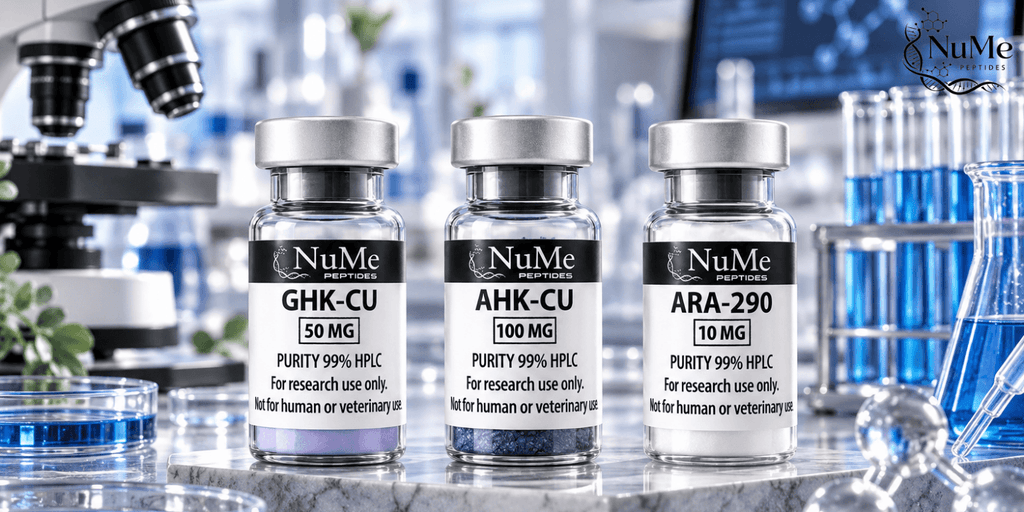
Explore the NuMe Peptides US Shop to review research-focused peptide materials for laboratory and scientific investigation.
What Is the Extracellular Matrix in Tissue Research?
The extracellular matrix, or ECM, is the network of proteins and carbohydrates surrounding cells within tissues.
Two broad forms are commonly discussed: basement membranes and interstitial matrices. Basement membranes form specialized sheets beneath epithelial and endothelial cells, while interstitial ECM forms the structural framework of tissues such as dermis, cartilage, bone, and connective tissue.
Fibroblasts are major producers of interstitial matrix proteins, including several collagen types, fibronectin, elastin-associated proteins, and other structural components. The resulting matrix influences tissue rigidity, elasticity, organization, and the behavior of surrounding cells. (Mouw et al., 2014)
Importantly, the ECM is not static.
Cells continuously produce, modify, and degrade matrix components. During injury, this turnover becomes particularly active as damaged structural proteins are removed and replaced with a provisional matrix that later undergoes maturation.
Researchers therefore examine several different characteristics:
- matrix composition;
- collagen type and abundance;
- fiber orientation;
- matrix stiffness;
- fibroblast behavior;
- matrix metalloproteinase activity;
- tissue inhibitor activity;
- interactions between cells and matrix proteins.
This is why a change in total collagen alone does not provide a complete picture of matrix biology. Functional tissue depends on the composition, organization, and turnover of the matrix as well as the amount produced.
Explore research compounds studied in tissue repair and regeneration through our Healing & Recovery collection.
How Does the Extracellular Matrix Contribute to Tissue Structure?
The ECM provides both structural support and biological information.
Collagen fibers contribute tensile strength. Elastin helps tissues recover after stretching. Proteoglycans and glycosaminoglycans bind water and influence compression, hydration, and molecular transport. Fibronectin and other adhesive proteins provide surfaces through which cells attach to and interact with the matrix.
These structural elements can also modify cellular signaling.
Cell-surface receptors such as integrins allow cells to sense matrix composition and mechanical properties. Changes in matrix stiffness or fiber organization can affect migration, gene expression, proliferation, and differentiation.
During repair, fibroblasts produce new extracellular material while enzymes remove or reorganize older matrix.
Matrix metalloproteinases, commonly abbreviated MMPs, are important in this turnover. Their activity is regulated partly by tissue inhibitors of metalloproteinases, or TIMPs. Appropriate remodeling therefore requires a balance between matrix deposition and matrix degradation.
GHK-Cu provides an experimental example of this dual process.
A fibroblast study found that GHK-Cu increased MMP-2 expression while also increasing secretion of TIMP-1 and TIMP-2. The researchers concluded that the copper peptide affected not only production of connective-tissue components but also extracellular matrix remodeling. (Siméon et al., 2000)
This distinction is important. Matrix-supporting research should not be interpreted as simply stimulating more tissue. Mature extracellular structure depends on controlled synthesis, degradation, and reorganization.
How Is Collagen Studied in Extracellular Matrix Research?
Collagen is one of the most widely studied components of the ECM because it contributes directly to tissue architecture and mechanical strength.
Researchers may measure collagen at several levels:
- collagen gene expression;
- collagen protein production;
- type I versus type III collagen;
- fibril organization;
- cross-linking;
- degradation products;
- matrix deposition;
- histological fiber orientation.
Different measurements answer different questions.
For example, an increase in collagen-related mRNA suggests altered gene expression but does not necessarily demonstrate that mature collagen fibers have formed. Histological measurements can provide additional information about fiber organization, while mechanical testing may help determine whether structural changes improve tissue strength.
GHK-Cu has a long experimental history in this area.
In an in vivo rat wound-chamber study, GHK-Cu increased total protein, collagen, glycosaminoglycans, DNA, and dry-weight accumulation. Type I and III collagen mRNA also increased in the experimental wounds. (Maquart et al., 1993)
More recent reviews continue to identify matrix synthesis and remodeling as major components of the GHK-Cu preclinical literature, while also emphasizing that clinical evidence remains much more limited than the laboratory evidence. (GHK-Cu Regenerative Review, 2026)
Collagen measurements should therefore be interpreted as one component of a broader matrix assessment rather than as a standalone indicator of successful regeneration.
How Are Peptides Investigated in Extracellular Matrix Models?
Researchers use several experimental approaches to determine whether peptides influence matrix biology.
Fibroblast Cultures
Fibroblasts are frequently used because they produce major ECM components.
Researchers may expose cultured fibroblasts to a peptide and then measure:
- collagen expression;
- MMP activity;
- TIMP secretion;
- migration;
- proliferation;
- focal-adhesion signaling;
- survival under cellular stress.
For BPC-157, tendon fibroblast research has demonstrated increased migration and spreading together with increased phosphorylation of FAK and paxillin, two proteins involved in focal-adhesion signaling between cells and their surrounding matrix. (Chang et al., 2011)
Wound Models
Animal wound models allow researchers to observe matrix formation within a more complete biological environment.
These studies can measure collagen deposition, vascularization, wound architecture, inflammation, and matrix maturation.
Thymosin beta-4 research, for example, has shown increased collagen deposition in experimental wounds and changes in keratinocyte migration and angiogenesis. (Malinda et al., 1999)
Separate experiments also found increased MMP-1, MMP-2, and MMP-9 expression after thymosin beta-4 exposure, supporting a role in active ECM remodeling during wound repair. (Philp et al., 2006)
Tendon Models
Tendons provide useful models because matrix organization is directly connected to mechanical function.
A 2026 rat Achilles tendon study examining BPC-157 and TB-500 reported differences in collagen organization, histopathology, and extracellular matrix maturation. TB-500 showed particularly notable changes in collagen alignment and biomechanical outcomes in that model. (Biçer et al., 2026)
These experiments show why peptide extracellular matrix research often combines molecular measurements with structural and biomechanical analysis.
Explore research compounds studied in tissue repair and regeneration through our Healing & Recovery collection.
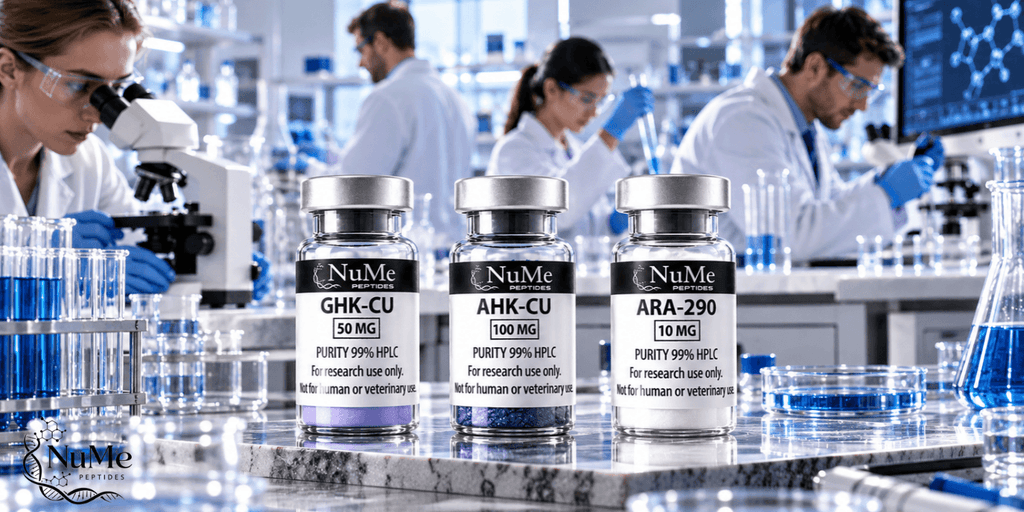
Which Research Peptides Are Studied in Matrix-Related Research?
Several peptide compounds appear in matrix-related literature, but their evidence bases differ considerably.
GHK-Cu
GHK-Cu has the most direct ECM-focused evidence among the compounds discussed here.
Research has examined collagen synthesis, glycosaminoglycan accumulation, fibroblast activity, MMP expression, TIMP secretion, angiogenesis, and matrix remodeling.
In cultured fibroblasts, GHK-Cu increased MMP-2 while also increasing TIMP-1 and TIMP-2, suggesting regulation of both matrix breakdown and its control mechanisms. (Siméon et al., 2000)
Animal wound research also demonstrated increased extracellular matrix accumulation, including collagen and glycosaminoglycans. (Maquart et al., 1993)
Recent reviews describe the preclinical matrix-remodeling evidence as biologically substantial while emphasizing limited high-quality clinical translation. (GHK-Cu Translational Review, 2026)
AHK-Cu
AHK-Cu is another copper-binding tripeptide, but its direct ECM research is much more limited.
An ex vivo human hair-follicle and cultured dermal papilla cell study found that AHK-Cu stimulated follicle elongation and proliferation of dermal papilla cells, which are specialized fibroblast-like cells. (Pyo et al., 2007)
However, those findings should not be expanded into claims that AHK-Cu has the same collagen- or matrix-remodeling evidence as GHK-Cu.
The two copper peptides should be evaluated independently.
BPC-157
BPC-157 is less directly associated with biochemical matrix turnover than GHK-Cu but has been investigated in tendon fibroblasts and tendon-repair models.
Experimental findings involving FAK-paxillin signaling, fibroblast migration, and cell spreading are relevant because focal adhesions connect cells mechanically and biochemically to the ECM. (Chang et al., 2011)
Human evidence remains extremely limited. A 2026 systematic review identified only three eligible human studies and rated the overall certainty of evidence as very low.
TB-500 and Thymosin Beta-4 Research
TB-500 is generally discussed in relation to thymosin beta-4, but evidence generated with native thymosin beta-4 should not automatically be attributed to every TB-500 preparation.
Thymosin beta-4 research has particularly interesting matrix findings.
The peptide can interact with fibrin and collagen through factor XIIIa-mediated cross-linking, potentially concentrating it around sites of tissue damage. (Huff et al., 2002)
Experimental wound studies have also reported increased MMP expression and more organized collagen architecture.
A separate rat wound study found more mature collagen fiber organization and fewer myofibroblasts in thymosin beta-4-treated wounds, suggesting that matrix quality and organization may be as important as total collagen quantity. (Sosne et al., 2010)
ARA-290
ARA-290 occupies a different position in matrix-related research.
Its evidence is stronger for tissue protection, inflammatory regulation, microvascular preservation, and wound biology than for direct collagen or ECM synthesis.
In a mouse burn model, ARA-290 reduced secondary microvascular thrombosis and inflammatory signaling while helping preserve viable tissue.
Another diabetic wound model combined ARA-290 with an elastin-like protein delivery system and reported enhanced wound healing and angiogenesis. (Koria et al., 2017)
For ECM-focused interpretation, ARA-290 is therefore better considered a matrix-adjacent tissue-protective research compound rather than a directly established matrix-remodeling peptide.
FAQs About Peptide Extracellular Matrix Research
What does the extracellular matrix do?
The ECM provides structural support while influencing cell adhesion, migration, signaling, differentiation, and tissue mechanics.
Is collagen the entire extracellular matrix?
No. The ECM also contains elastin, fibronectin, proteoglycans, glycosaminoglycans, basement-membrane proteins, and many regulatory molecules.
Why is GHK-Cu studied in matrix research?
GHK-Cu has experimental evidence involving collagen accumulation, glycosaminoglycans, fibroblast activity, MMPs, TIMPs, and matrix remodeling. (Siméon et al., 2000)
Does AHK-Cu have the same matrix evidence as GHK-Cu?
No. Direct AHK-Cu research is considerably more limited. Its published experimental literature includes dermal papilla cell and hair-follicle models rather than the broader ECM literature available for GHK-Cu.
How are BPC-157 and TB-500 connected with ECM research?
BPC-157 has been studied in tendon fibroblasts and focal-adhesion signaling, while thymosin beta-4 and TB-500 research includes collagen organization, matrix metalloproteinases, and experimental tendon repair. (Biçer et al., 2026)
Does increased collagen always indicate better tissue structure?
No. Functional matrix depends on collagen type, fiber orientation, cross-linking, degradation, matrix composition, and mechanical organization—not simply total collagen quantity.
Understanding the Current Matrix Evidence
Peptide extracellular matrix research illustrates how tissue structure emerges from a balance between synthesis and remodeling.
GHK-Cu has comparatively direct experimental evidence involving collagen, glycosaminoglycans, MMPs, TIMPs, and fibroblast-mediated matrix turnover. AHK-Cu remains less extensively studied and should not be assumed to share the same evidence simply because it is also a copper-binding tripeptide.
BPC-157 research adds another perspective through fibroblast migration and cell–matrix signaling. Thymosin beta-4 and TB-500-related research extends the discussion to matrix metalloproteinases, collagen organization, and tendon repair. ARA-290 appears more relevant to the surrounding inflammatory and microvascular environment than to direct ECM synthesis.
These distinctions matter because extracellular matrix biology is not a single process.
A meaningful experiment may need to evaluate collagen production, matrix degradation, fiber organization, cell adhesion, tissue mechanics, and inflammatory conditions together. The strongest evidence therefore comes from studies that combine molecular findings with structural and functional measurements.
Explore the NuMe Peptides US Shop to review research-focused peptide materials for laboratory and scientific investigation.
Disclaimer: This content is provided for scientific and educational purposes only. Research peptides discussed here are presented in a laboratory research context and are not described as products for human consumption, diagnosis, treatment, cure, or prevention of disease.